Written by: Hurmat Majid
Posted on: December 16, 2025 |  | 中文
| 中文
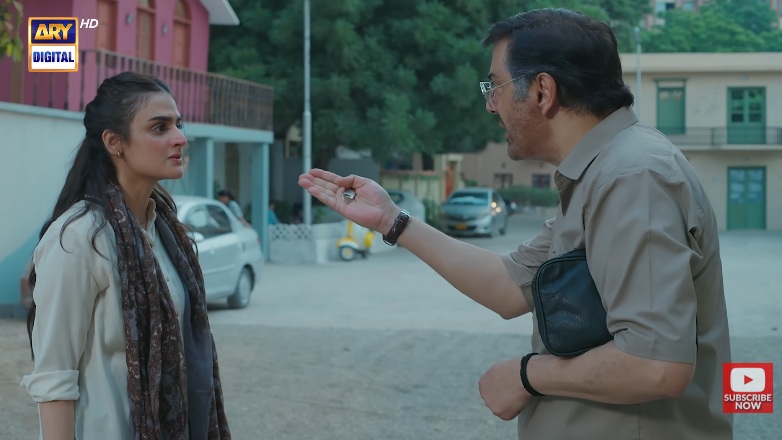
Hira Mani and Nauman Ijaz in Shar Pasand
Every television season gives us at least one drama that doesn’t arrive with a bang but with a kind of quiet confidence: the kind that dares you to lean in instead of shoving itself in your face. Shar Pasand, directed by Aehsun Talish and written by Sara Syed, is exactly that kind of creature. It doesn’t explode; it seeps. It doesn’t rush; it lingers. And before you know it, you’re locked into a psychological world that feels unsettlingly familiar: a neighborhood where virtue is staged, respectability is currency, and the most dangerous man is always the one who knows exactly how to hide his intentions under a polished smile.
This is not “fast food drama.” Shar Pasand is a pressure cooker, and while it takes its time to whistle, the ingredients are rich enough to keep you watching.
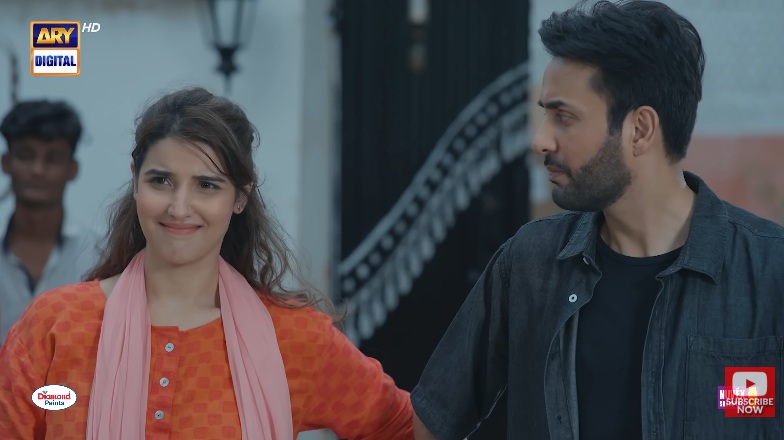
Hareem Farooq and Affan Waheed
At the heart of it is Farasat Ali Khan, played with astonishing nuance by Nauman Ijaz. And it is no exaggeration to say that his performance alone justifies the drama’s existence. Farasat is the quintessential double-faced patriarch: warm, sociable, deferential - until he isn’t. Nauman Ijaz doesn’t simply act; he inhabits. His face flickers between benevolence and menace so subtly that you sometimes catch the shift half a second too late. It’s a masterclass, and it anchors the entire show.
The story begins when newlyweds Fida (Affan Waheed) and Sanam (Hareem Farooq) move into Farasat Ali’s neighborhood, a seemingly harmless event that gradually reveals the fault lines beneath everyday niceties. What follows is not a loud, chaotic plot but a slow encirclement: a tightening of emotional stakes, social expectations, and Farasat’s insidious influence. The mohallah itself becomes a character, the kind of place where everyone smiles a little too politely, carries secrets a little too gently, and watches each other a little too closely.
This is where Talish’s direction shines: the pacing is intentional, atmospheric, almost theatrical at times. And while that pacing is also where some viewers may feel tested, the tension it builds is real, cumulative, and grounded in emotional truth.
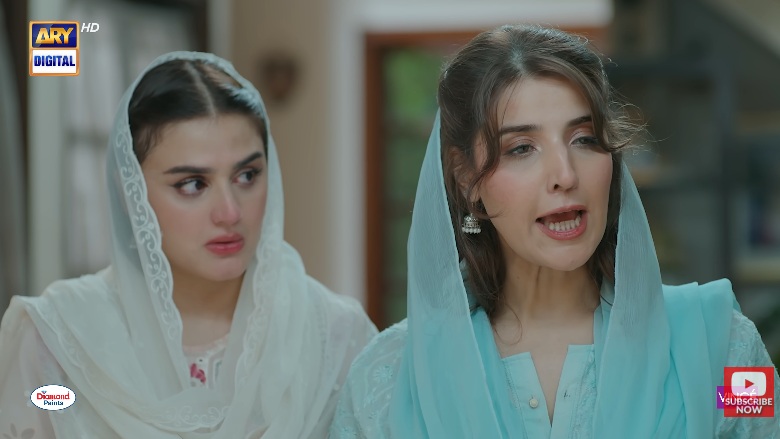
Hareem Farooq and Hira Mani
Hareem Farooq’s Sanam is the quiet moral center of the show: composed, alert, but never blatantly dramatic. Hareem plays her with a softness that feels earned rather than ornamental. Her expressions - wary, uncertain, sometimes quietly indignant, are exactly what the genre demands. She does not need to scream for the audience to understand her discomfort; she lets stillness do the work.
Affan Waheed as Fida brings sincerity in spades. His signature gentle demeanor serves the story well, though at times his control becomes a bit too restrained, bordering on passivity. Yet that very passivity is thematically significant: Fida represents the well-intentioned, conflict-averse man who unknowingly leaves openings in his marriage for wolves to step through. His chemistry with Hareem feels authentic, believable, and refreshingly un-melodramatic.
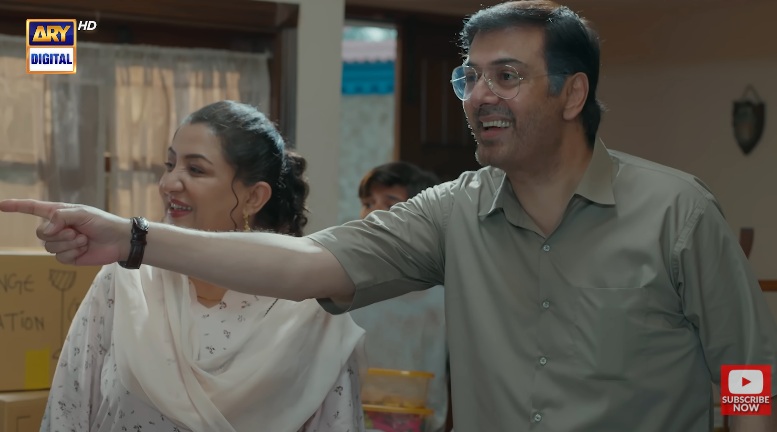
Nadia Afgan and Nauman Ijaz (
And then there is Hira Mani, who plays Shazmeen, a character orbiting the neighborhood’s social dramas with a history viewers are still piecing together. Hira gives a performance that is frequently emotional and occasionally inconsistent, but always watchable. When she is good, she is gripping. When she overplays a beat, it’s noticeable, but it never derails a scene. And perhaps this fluctuation mirrors her character’s internal turmoil, a woman trying to hold her dignity in a place that never lets her forget her vulnerabilities.
Together, this ensemble forms one of the more grounded mohallah ecosystems recently seen on Pakistani television. Supporting actors deliver realistic, lived-in performances that reinforce the show’s emphasis on community dynamics rather than high-action theatrics. Nobody feels like a caricature; nobody is phoning it in.
Plot-wise, Shar Pasand is compelling because it understands one core truth: the greatest danger in a community is always the man who controls the narrative. Farasat Ali isn’t a villain in the traditional drama sense; he’s far more terrifying. He’s manipulative in the quietest ways: through favors, through warmth, through the reputation he weaponizes with expert subtlety. He pretends to be a man of integrity while destabilizing the women around him, flirting under the guise of friendliness, imposing his views under the guise of guidance, and turning the neighborhood into an unspoken battlefield. This duality is the spine of Shar Pasand, and Nauman Ijaz gives it flesh, blood and teeth.
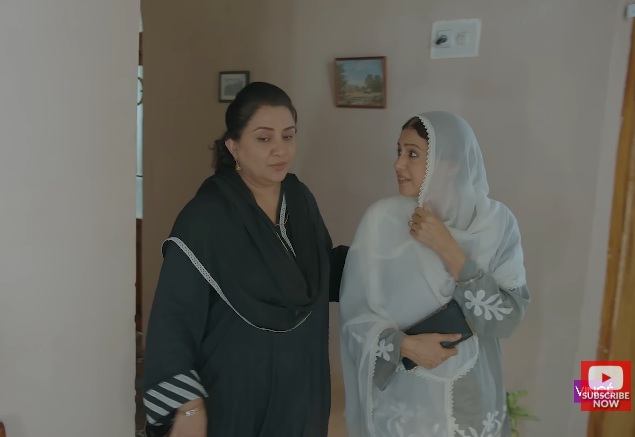
Nadia Afgan and Shaista Jabeen
Thematically, the show explores love, marriage, societal expectations, emotional resilience, and the way communities close ranks around the powerful while quietly suffocating the vulnerable. It critiques the culture of respectable men who are anything but respectable; men whose honor is a costume and whose ego is the real god they worship. In that sense, Shar Pasand is a social thriller masquerading as a domestic drama.
Where the show stumbles, or rather, where some viewers may feel the strain, is the pacing. It is undoubtedly a slow burn. Not the elegant, continuous slow burn of a tightly woven thriller, but the kind that occasionally dawdles, lingering a bit too long on neighborhood routines or repeatedly circling emotional beats that have already landed. The story unfolds like a novel that pauses to describe the curtains, the street, the weather - all immersive, but sometimes excessive. If you’re expecting a rapid-fire plot or quick resolutions, this is not that drama.
But the trade-off is worthwhile: the slowness creates a claustrophobic rhythm. You feel the suffocating politeness, the simmering suspicion, the unspoken hostility. The neighborhood becomes a pressure chamber, and by the time the plot truly flexes its muscles, you realize that every quiet moment was planting a seed.
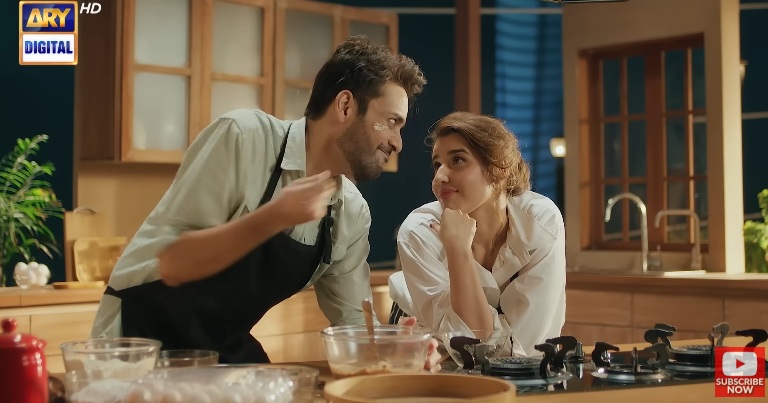
Affan Waheed and Hareem Farooq
Visually, the show maintains a muted, atmospheric palette, nothing overly stylized, but everything intentional. The music is subtle but effective. The writing, while occasionally repetitive, is sharp when it matters: especially in scenes involving Farasat Ali, where the dialogue dances between courtesy and threat with razor-thin precision.
Ultimately, Shar Pasand is the kind of drama that rewards viewers who appreciate character-driven conflict and psychological nuance over immediate payoff. It is not perfect, but it is undeniably absorbing. Above all, it is anchored by a career-best performance from Nauman Ijaz and supported by a cast that delivers emotional honesty with refreshing restraint.
So, the final verdict is: Shar Pasand is absolutely worth watching, but it is also a drama that benefits from viewer control. Watching it on YouTube gives you the luxury to forward the slower stretches and savor the scenes that truly hit, and there are many.
You may also like: