Written by: Haroon Suhaib
Posted on: July 17, 2026 |  | 中文
| 中文

When the whistle blows, and the stadium lights ignite, the eyes of billions lock onto a singular, kinetic point. We trace the elegant arc of a pass, feel the collective gasp of a near miss, and lose ourselves in the theatrical euphoria of a goal. The players become heroes, and the green turf becomes a stage. Yet, the true connective tissue of this global drama is the very thing we so often take for granted: the ball itself. For the FIFA World Cup 2026, that silent protagonist is ‘Trionda’.
While the grand theater unfolds across the vast expanses of North America, Trionda’s soul belongs to a different landscape entirely. Its journey begins thousands of miles away, amidst the rhythmic hum and unassuming mastery of Sialkot, Pakistan, crafted by the global industry giant Forward Sports.
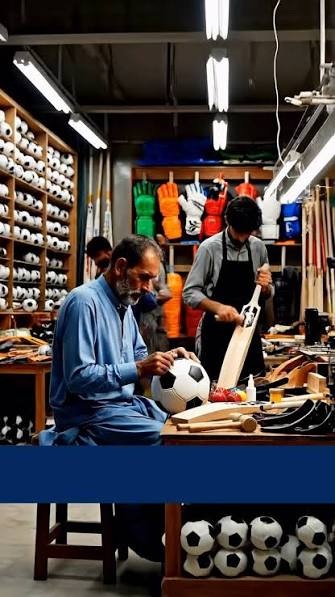
Making of a football in Sialkot
To trace the lineage of Trionda is to uncover the remarkable journey of Sialkot’s sports goods manufacturing industry that fundamentally transformed how the world plays some of its most widely followed sports.
The roots of Sialkot’s sports goods industry take us back to 1883, when local artisans began repairing wooden equipment like cricket bats and hockey sticks for British colonial soldiers stationed in the region. The city’s legendary tryst with football officially commenced in 1918, born from the resourcefulness of a local craftsman who replicated and repaired a worn-out leather ball for British troops. This specialized cottage craft quickly transformed through tight-knit family networks, building classic economies of scale that survived partition and grew exponentially. Today, Sialkot has matured into the undisputed “football factory of the world,” housing over 2,400 registered companies and employing more than 200,000 workers. The city commands a staggering 70% share of the global hand-stitched and premium match-grade football market, exporting between 40 to 65 million balls annually, a monumental industrial footprint that elevates a regional craft into a billion-dollar pillar of national pride.
Fueled by a sprawling ecosystem of over 2,400 registered companies, this industrial engine generates upwards of $450 million in annual export revenue, with recent fiscal data showing football exports alone surging by nearly 20% to cross the $221 million mark. When factoring in specialized protective gear, gloves, and team athleisure, the entire sports equipment sector injects nearly a billion dollars into Pakistan’s economy, proving that Sialkot’s manufacturing prowess is a vital cornerstone of national growth. When global brands look to Pakistan for sports equipment, Sialkot is almost always the exact destination they are dealing with.
Founded in 1991 by Khawaja Masood Akhtar, a civil engineer who left his post at Pakistan Railways to venture into the industrial heart of Sialkot, Forward Sports, the official manufacturers of Trionda, began with modest ambitions. Armed with just a single room and a handful of workers, the early days saw an output of roughly 1,000 hand-stitched balls per month, struggling to find a foothold in an intensely competitive global market. The trajectory of the company changed forever in 1994 when it secured a watershed partnership with Adidas. Driven by Akhtar’s unyielding belief that continuous innovation was the only path to survival, Forward Sports aggressively evolved. They transitioned from traditional hand-stitching to pioneering thermo-bonded technology in 2007, and later introduced automated lamination, laser-cutting systems, and airless mini-balls.
Today, Forward Sports stands as one of the world’s absolute largest producers of footballs, churning out over 20 million balls annually. Trionda marks the fourth consecutive FIFA World Cup official match ball supplied by the company, following the iconic Brazuca (Brazil 2014), the Telstar 18 (Russia 2018), and the Al Rihla (Qatar 2022). The company has truly broken ground socially, integrating a vast network of female professionals into its workforce, providing tailored healthcare and transportation infrastructure to support women’s economic empowerment in the region.
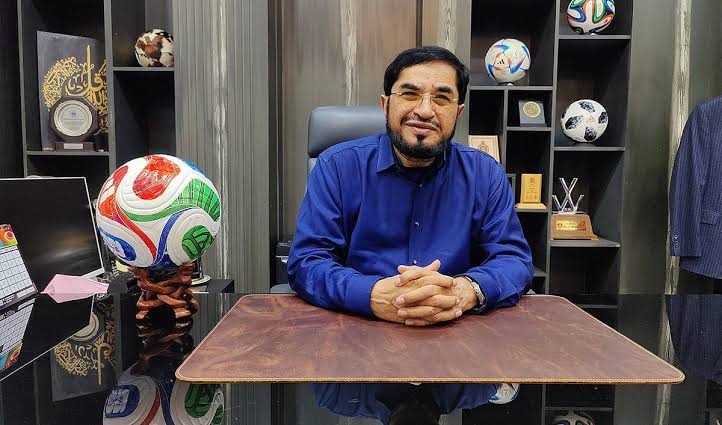
Masood of Forward Sports
Pakistan’s presence at the absolute pinnacle of football design is not a sudden breakthrough. Sialkot has been weaving cultural narratives into high-performance engineering for decades, transitioning seamlessly from the hand-stitched era to state-of-the-art thermo-bonded canvases.
To look back at the last four tournament balls is to trace a map of global cultural history, deeply rooted in Pakistani manufacturing excellence:
Al Rihla (Qatar 2022), meaning “The Journey” in Arabic, signified the rapid, transformative evolution of the game and the cultural odyssey of the first World Cup in the Middle East. Its bold, geometric lines were inspired by the traditional dhow boats, the distinct architecture, and the national flag of Qatar.
Telstar 18 (Russia 2018), paid homage to the original 1970 Telstar, the first ball designed to stand out on black-and-white television broadcasts. It signified a digital renaissance, blending nostalgia with a metallic, pixelated print and incorporating a near-field communication chip for consumer interaction.
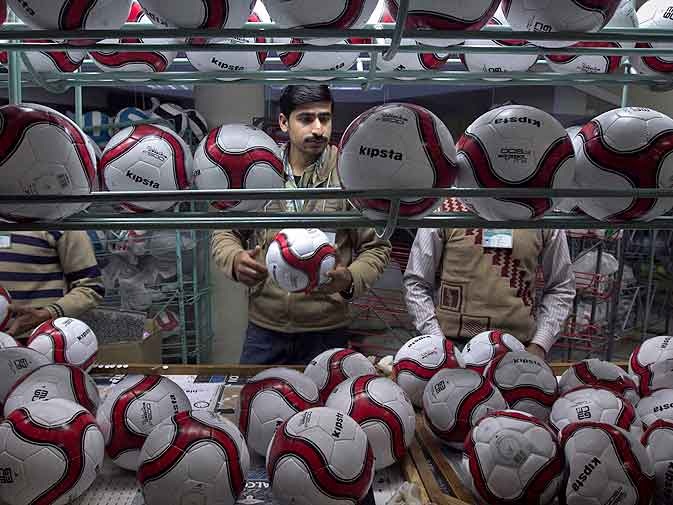
Football warehouse in Sialkot
Brazuca (Brazil 2014) was named through a passionate public vote. Brazuca symbolized national pride and the rhythmic, vibrant lifestyle of Brazil. Its multi-colored, looping ribbons mirrored the traditional wish bracelets worn across the country, capturing the joy and flair of South American football.
Jabulani (South Africa 2010) means “To Celebrate” in isiZulu. This ball signified unity and homecoming for Africa’s first World Cup. Its design featured eleven distinct colors, representing the eleven players on a pitch, the eleven official languages of South Africa, and the eleven diverse communities that welcomed the world.
From the first water-resistant breakthroughs of the Tango España in 1982 to these modern masterpieces, Pakistan has consistently engineered the physical vessels that hold the world’s collective sporting memories.
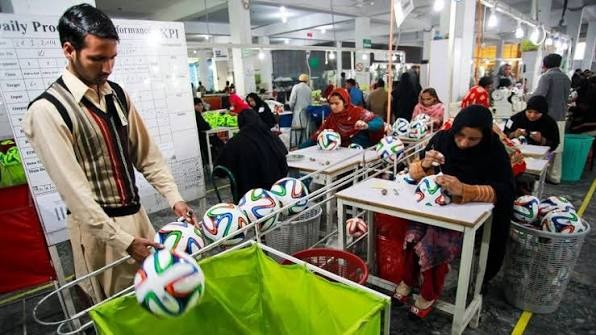
Trionda being made in Forward Sports Warehouse in Sialkot, Pakistan
The naming of a World Cup ball remains an exercise in modern mythology. The moniker must capture the zeitgeist of an era, and Trionda achieves this with poetic precision. Trionda is a fluid linguistic bridge with “Tri” honoring the unprecedented collaboration of the three host nations: the United States, Canada, and Mexico, and “Onda” (the Spanish word for wave) evoking the fluid motion of the game, the emotional tides of the fans, and the cultural currents sweeping across an entire continent.
Trionda’s aesthetic identity is a vibrant reflection of North American energy. The design balances raw visual brilliance, ensuring the ball remains perfectly visible under piercing stadium floodlights and broadcast cameras, with a deep symbolic narrative incorporating blue stars, the green eagle, and the red maple leaf. Long after the final whistle blows, the iconic imagery of the 2026 tournament will forever be framed against the distinct patterns of this ball.
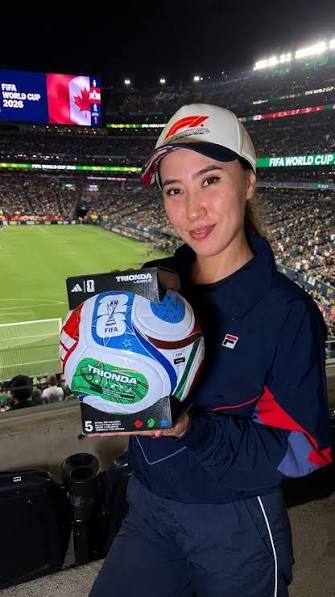
Official FIFA 2026 Football
Modern football is played at a breakneck pace where millimeters dictate destiny. Consequently, Trionda is a marvel of sports science, embedded with state-of-the-art connected-ball technology. The ball houses internal 500 Hz motion sensors that transmit instantaneous spatial data, assisting officials with crucial, split-second semi-automated offside decisions. Beyond the digital microchips, Forward Sports utilizes a revolutionary four-panel design, the fewest ever used on an elite ball, to maximize smooth airflow. The factory subjects the ball to grueling impact tests, firing it repeatedly against metal plates at high velocities to ensure structural integrity. For a world-class striker unleashing a volley or a goalkeeper anticipating a wicked curve, the ball must behave with absolute integrity. It must be a natural extension of the player’s intent.
This is where the magic lies. Trionda successfully marries the cold, objective precision of 21st-century digital technology with the warm, subjective legacy of human craftsmanship.
In the buildup to the tournament, Trionda achieved a milestone that sounds more like science fiction than sports promotion. The official match ball was launched into the cosmos, spending time aboard the International Space Station.
This symbolic journey meant that before Trionda ever rolled across the grass of elite stadiums, it drifted in zero gravity, looking down at the very planet it would soon unite. It is a poetic reminder that football possesses a cosmic reach, drawing humanity together across borders, oceans, and atmospheric lines.
As the whole world gears up to focus on the finale of the FIFA World Cup 2026 in a few days, Trionda becomes immortalized as a testament to the fact that generations of craftsmanship, when translated into modern industrial dedication, can command global reverence. As the world watches the beautiful game reach its crescendo in 2026, it will simultaneously be witnessing the enduring legacy of Sialkot, stitched into the very fabric of football history.
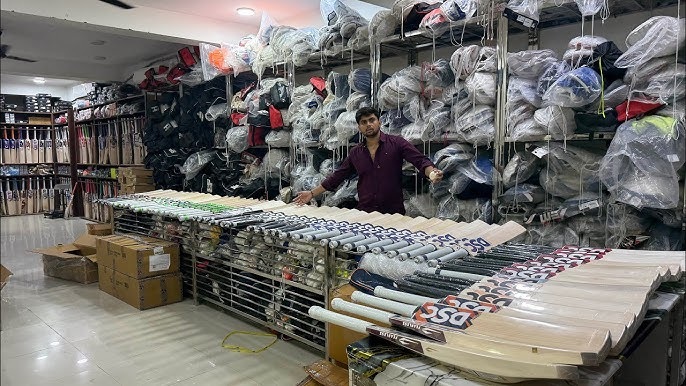
Sports warehouse
As the final whistle blows and the world crowns its new champion, the true, enduring victor will already be resting at the center stage. No matter which nation claims the trophy, the heart of the beautiful game remains beautifully stitched into the legacy of Pakistan’s craftsmanship.
You may also like: