Written by: Prof. Dr Mamoona Khan
Posted on: August 21, 2026 | 
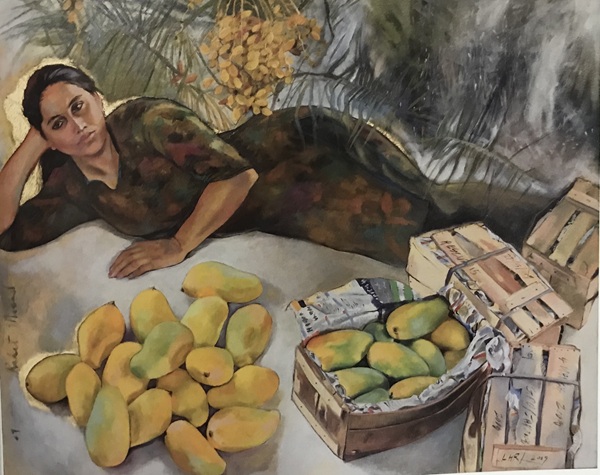
Figure 8
Aesthetics and the appreciation of beauty are traits, unique to our species alone, which distinguish us from other life forms, and that caused enormous progress on our planet. From cave dwellings to the skyscrapers and from murals of Ajanta and Ellora to Altamira, Lascaux and Bhimbetka, down to contemporary artwork, the advancement has been uninterrupted. With the rapid pace of the modern age, interpretation of aesthetics and meaning of beauty have also taken novel turns. Art therefore encountered swiftly changing plethora of “isms”, each one an anti-thesis of the thesis of its former. While artists are sprinting to display the unusual or novel, thawing peripheries of art or non-art, but interestingly in the process, the visual has become subservient to textual interpretations, recognised as conceptual art. Although it is a fact that no work of art, from time immemorial to the present day, has been created without a concept, but a few artists like Prof. Dr Rahat Naveed Masud, though interpreters of modern times, retain elegance of classics for being solid and lasting. Flawless delineation of the figurative is her specialty, enwrapping in depth symbolism, but aspiring the ideal standards of perfection. Trends emerge and fade away with the vanishing trend setters, but classics are for all ages, and so are the paintings of Dr Rahat.
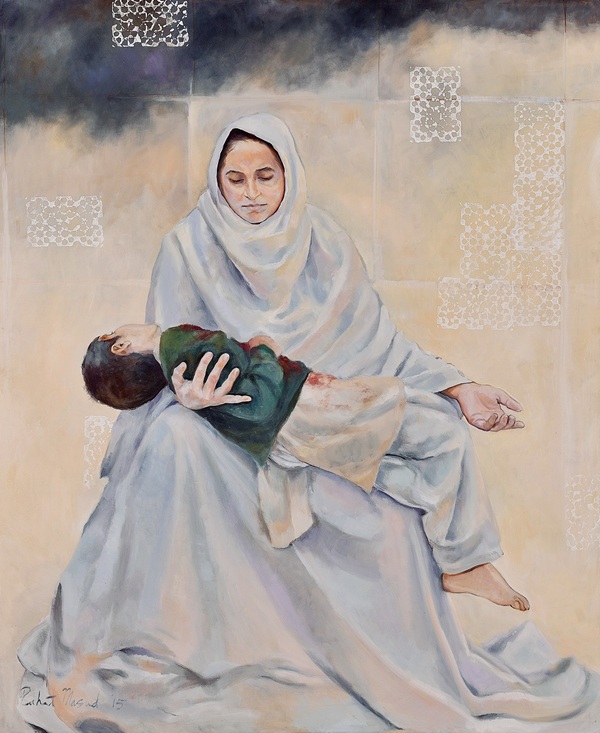
fig 1
Prof. Dr Rahat is a progressive woman, who has served for decades in the College of Art and Design, University of the Punjab, Lahore, as Professor and also as Dean; she views art not as a stagnant commodity but transforming within social, cultural, scientific and technologically changing environs. Comparing life styles of the orient and the occident, she interprets the latter as robotic, analogous is the velocity of their art; quick and ephemeral, while orient like our country is a bit slower but steady, akin are their art forms.
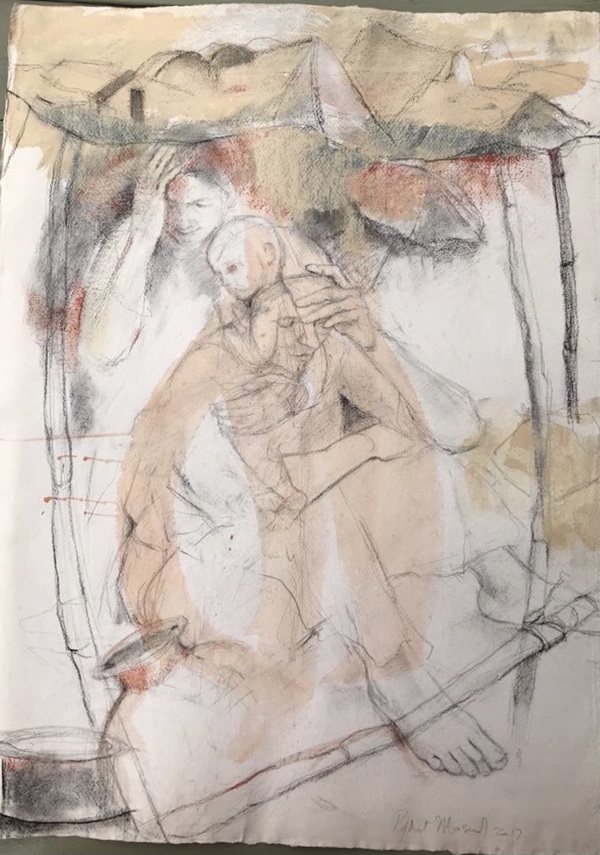
fig 3
She feels that her future was destined for the field of art, for, she gravitated to art from her childhood because of her elder sisters and cousins, all pursuing for the subject and they were excellent in drawing and painting too. She never thought of doing anything else, took Fine Arts in her Cambridge studies from the Convent of Jesus and Mary, Lahore, then joined Lahore College for Women in 1969, for being the only girl’s college offering Fine Arts at undergrad level, then Master’s degree from the Punjab University Fine Arts department, another Master’s in Art and Design from Kingston University, London and then a Doctorate from abroad from the same University. She recalls Ms. Nasim Qazi of Lahore College in high esteem, as a wonderful teacher. She provided her a very strong basis, from starting point to the core principles of art. Knack to learn and capability to impart joined hands to shape the artist named Prof. Dr Rahat Masud
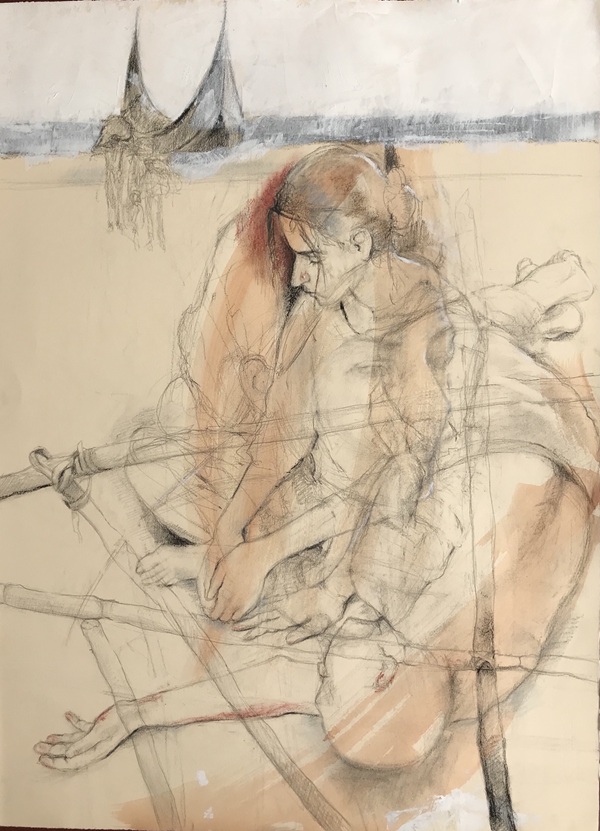
fig 4
She has the signature style, unique of its kind, exhibited anywhere can be recognized at a glance, because it emerged gradually with the dexterity achieved through consistent practice. From the day first when she joined Lahore College, apart from the scholarly top-tiered teachers, she dedicatedly worked to acquire proficiency in her chosen subject because she seems to have set the bars very high. Always trailed the challenging tasks, learning to capture scenes from bird’s eye view, comparing with eye-level vista, thinking, facing problems, solving them but always after arduous tasks. Perhaps inherited from her father Nasim Hasan, an advocate by profession, and active participant of Pakistan movement, remained secretary of Muslim League at Montgomery, used to talk about receiving trains of refugees, narrating heart-aching stories. She saw him working tirelessly for eighteen hours a day, not only for his profession but for the newly established Pakistan as well, extremely patriotic environment prevailed in her house. She recalls the disciplined life of her father, because of his understanding of the challenges of life in the light of the Holy Quran, which he used to quote at various occasions. In the same context, he laid the foundations of Gung Maḥal, an institute for the deaf and dumb children, inaugurated by Muhtarma Fatima Jinnah. He was striving at various forums to uplift the newly born country, without expecting rewards. At one instance when the Award Committee for decorating workers of the Pakistan movement wanted to add his name in the list of the nominees, he declined to accept. Brought up of Dr Rahat was in this milieu that made a strong impact on her life and her creative endeavours. She never seems to have pursued for the trendy or short lived that quickly ascend and even more swiftly vanish. Her paintings reflect stability and bespeak her arduous attachment to the field, where figurative dominates while retaining modernism, but with universal standards of beauty.
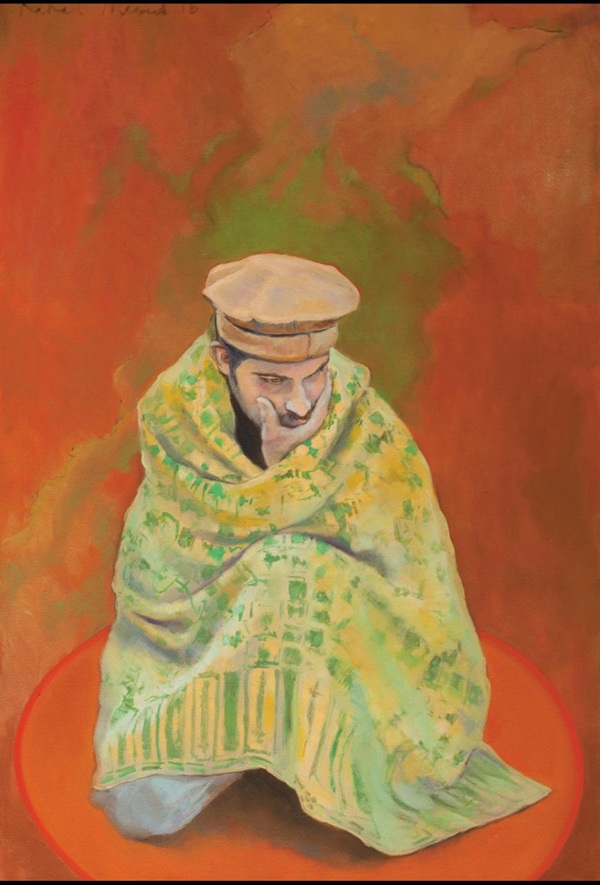
fig 5
Modern aesthetics, where beauty and weirdness are synonyms is not in the dictionary of Dr Rahat, her gentle and mellow personality, reflective in her works, conveys complicated or even heinous very expressively, but with ease. Her reaction to the most condemnable incident of APS, Peshawar is not loud but piercing, and philosophical too, fig.1(home page). Taking the universal theme of human sufferings, a mother holding in her lap the bleeding dead son, inspired from Michelangelo’s Pieta, which in Italian language stands for pity, compassion and piety. A passive-mother, draped in the rob of piety, holding the wounded lifeless child, having no strength even to cry but her hands narrate the story; the left denoting helplessness and the right a symbol of holding the most precious even while it has expired. The artist has not distorted anything, we can look at the painting for hours and appreciate its minute details; little grim on eyebrows, sealed lips, frozen posture of the mother, bespeak the heinous brutality one cannot imagine in the so called civilized modern-age. Apparently, her paintings entice for the epitome of manual dexterity but closer analysis reveals an array of philosophical meaning. Background of the very painting symbolizes the fragmented Muslim world, facing brutal intrusions, for which she used wood-block prints of the typical Muslim geometric motif, sporadically stamped on the solid wall of the checker-blocks, creating impression of piercing grilles, and looming dark clouds emerging from the upper right, narrate the entire story. A large number of her paintings file the traumatic socio-political conditions causing unease in the sensitive souls of creators like Dr. Rahat.
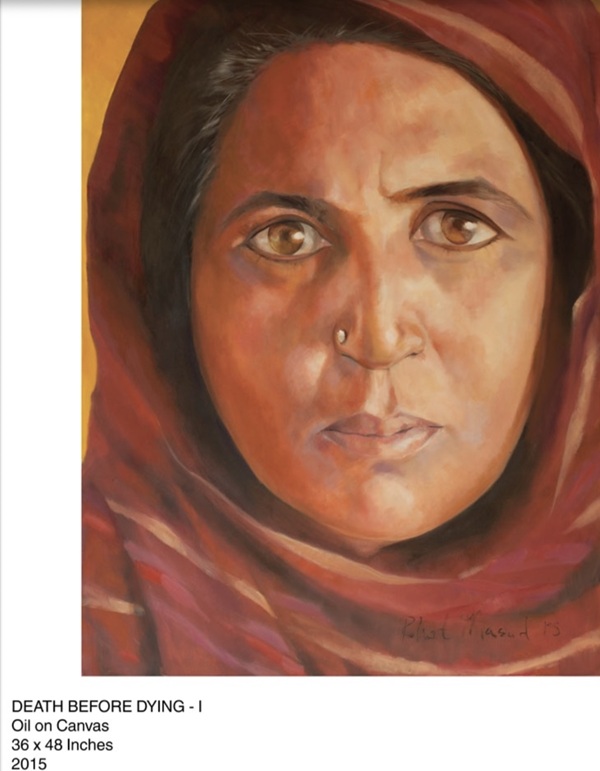
fig 6
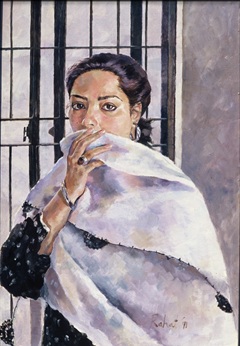
The so-called Islamization of the Zia’s regime, when logic was quelled and reasoning stifled, making the future of art bleak, Dr Rahat displayed her self-portrait, fig.2, mouth wrapped over with a dupatta, while eyes speaking the untold story. It was a reaction against the decree of a students’ union representative about “what and what not to teach.” Apparently, a self-portrait of the art-educationist and artist, with all the accessories; crochet lace dupatta, wearing an agate ring, silver bangle and ear rings but dread of the alarming circumstances, where you can’t speak are expressed through her visage and bars of the closed iron-grilled window.
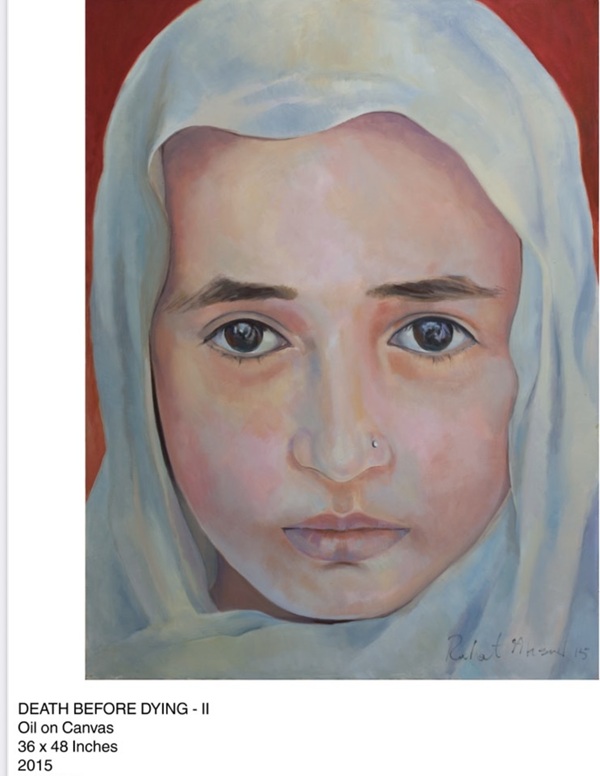
fig 7
Mild gestures and a portrait, mostly self, reflect her profound concerns against iniquity, violence, turmoil, both national and global that she calls as the ‘human condition’ in contemporary times. It reminds the famous saying of Friedrich Nietzsche, ‘Tragedy shows that wisdom is a crime committed on nature.’ Her drawings of Rohingyan Women, figs.3-4, narrate the story of helplessness and misery, while about the terrorist attacks in the beloved Pakistan when unsurety and uncertainty prevailed and discriminating a terrorist from a patriot was hard. She painted “In a Limbo”; a Pakistani, clad in the regional cap and shawl, crouching in the blood-red environs with a map of Kashmir at his back, questioning himself, “am I a terrorist?”, apparent from his expressions, gesture of the hand and bodily posture, fig.5. Similarly, the ‘Death Before Dying-I and the Death before Dying-II, figs.6-7, are huge-scale portraits, denoting horror of frequent bomb-blasts, reflected in the eyes of the bold face of the woman and also in the expression of the innocent, respectively, not sure about the next moment. Artist’s allegiance to the country is evident from various paintings, proving her being well versed about its conditions.
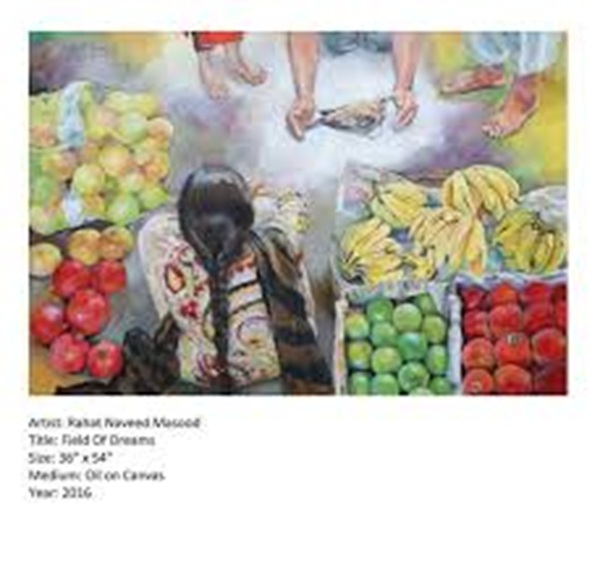
fig 11
اے ارض وطن: “O Beloved Homeland” is another theme she addressed widely, denoting affluent resources of the country and deprivations of its dwellers, fig.8. Piles of fruits, within crates and outside but idle youth, not pursuing to reach out and utilise the riches, which are being misused by the enemies because crates are inscribed with dates when Lahore was hit by bomb-blasts. Another one of the same series, fig.9, with opulence and variety of fruits and an injured bird being protected by a few hands, while the rest are idle spectators, including the young female sitting amidst bounties the beloved land is offering to her. Denizens of the country are not facilitated to improve their living standards and they themselves are in a state of deep slumber; bare-feet of a male and a female around the injured bird. Well braided neat and clean young female, not pursuing for anything, though encircled by the bounties the land is bestowed with.
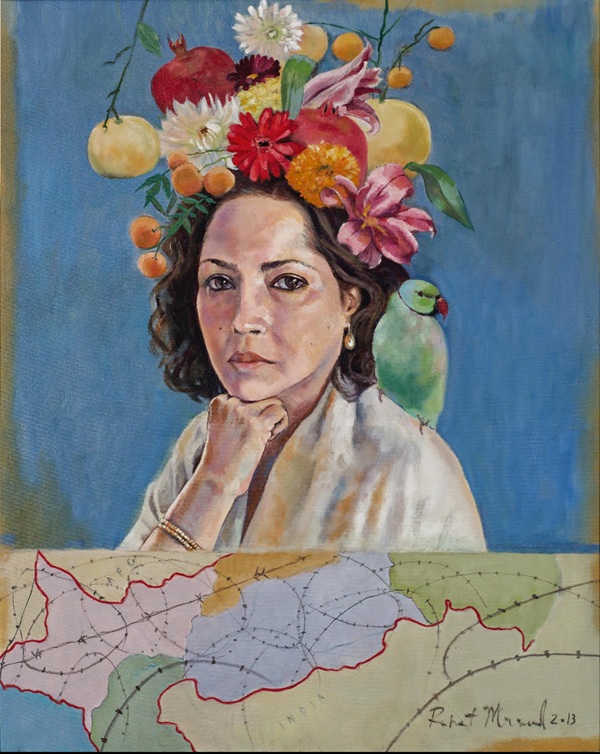
fig 9
Very impressive is Tumult-a Garden, fig.10, a contrasting phrase, represent map of Pakistan entangled with barbed wires, while its personification is a female crowned with fruits, flowers and a parrot on the left shoulder, ear and wrist are adorned with golden jewelry, but with a grim and mysterious expressions. Again, a similar theme while novel in expression. The painting reflects the artist’s deep-rooted spirit of Nationalism; her inceptions of infancy are expressed gently. She kept a strong eye on the changing circumstances of the country that started the voyage speedily but at a certain point of time stopped proceeding ahead, denoted by a fallen young man from a galloping steed, still licking his knee, fig.11. Although the situation represented is grim but there is hope. The man surrounded by a few fruits, flowers and ripe wheat-stalks, is not injured, surrounded from all-around by green colour of Pakistani Flag, while in the background on the golden patch of land is the aspiring high Minar-i Pakistan. A message that it will rise up and take speed again.
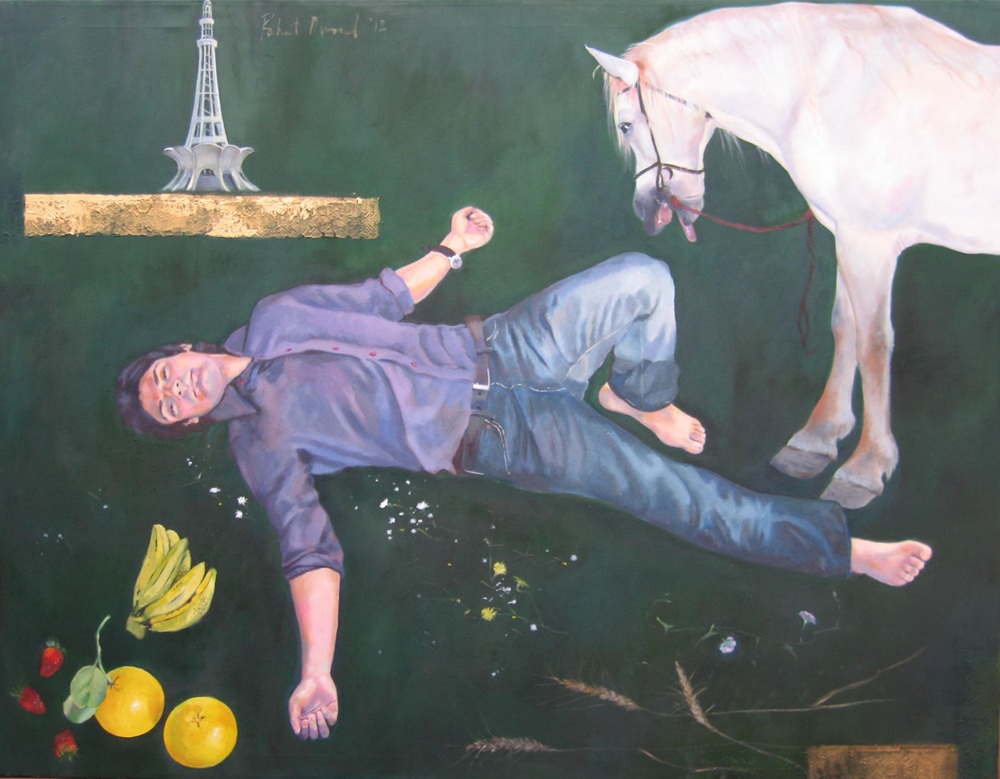
fig 10
Wassily Kandinsky rightly said “Colour is the keyboard, the eyes are the hammers, the soul is the piano with many strings. The artist is the hand that plays, touching one key or another purposively, to cause vibrations in the soul.” Only one key of the artist Dr Rahat Naveed is touched in this article, there are many more to be explored yet.
You may also like: