Written by: Muhammad Hamza
Posted on: February 12, 2026 |  | 中文
| 中文
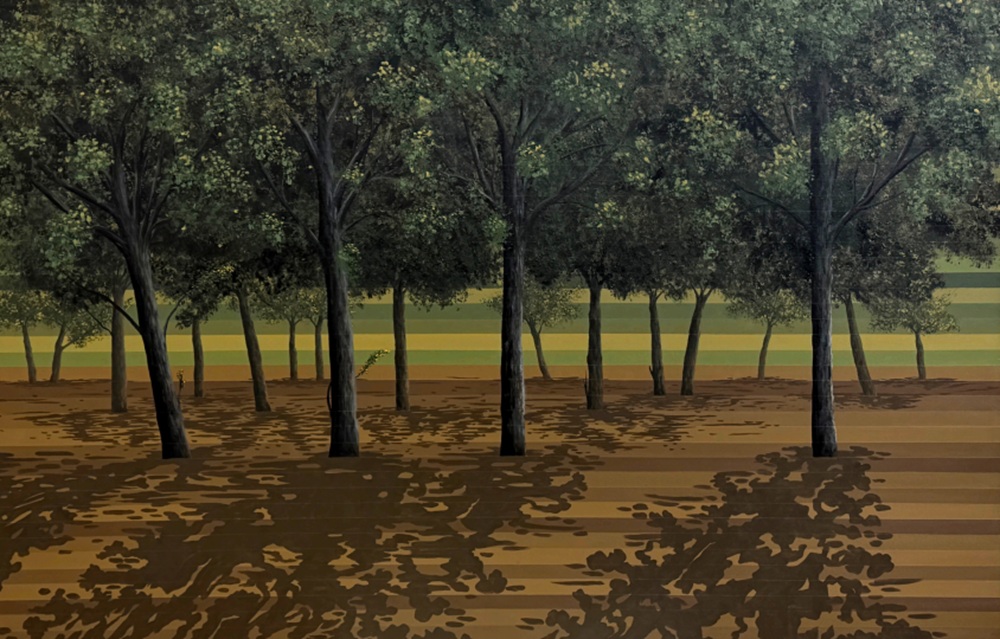
The Long Ground
In the contemporary landscape of Pakistani visual arts, the emergence of Hadia Hassan signals a profound shift toward a more contemplative and minimalist approach to the natural world. Hassan’s practice does not seek to document the geography of her surroundings, but rather to distil the essence of the land into a psychological experience. Her solo exhibition, The Land As An Interval, held at Ejaz Art Gallery, presents a body of work that exists in the delicate suspension between memory and observation, Hassan invites the viewer into a space where atmosphere takes precedence over description, and silence becomes a visual medium in itself.
Hassan’s work is rooted in the concept of the "interval," a pause or a state of transition. For her, the land is not a fixed, static site to be observed from a distance; it is an "in between" space that is neither fully remembered nor directly seen. This philosophical stance is realized through her use of acrylic on canvas, where she employs reduced elements and minimal structures to create imagined landscapes. The paintings remain intentionally unresolved, serving as open vessels that only becomes "complete" through the viewer’s personal connection and interpretation.
Below, we examine six pivotal artworks from this exhibition that define Hassan's mastery of stillness and atmospheric depth.
In Where It Rests, Hassan establishes the foundational tone of the exhibition. The composition is a masterclass in restraint. The artwork suggests a place of finality or perhaps a temporary halt, yet it avoids any definitive markers of location. The viewer is met with a soft, diffused horizon where the earth and sky seem to bleed into one another.
The strength of Where It Rests lies in its ability to hold emotion without defining it. The subtle gradations of color suggest a fading light, perhaps the onset of dusk or the early haze of dawn. By removing excess detail, Hassan forces the eye to slow down, encouraging a form of "slow perception" that is central to her practice. The title itself implies a physical and emotional grounding, inviting the viewer to find their own place of rest within the canvas.
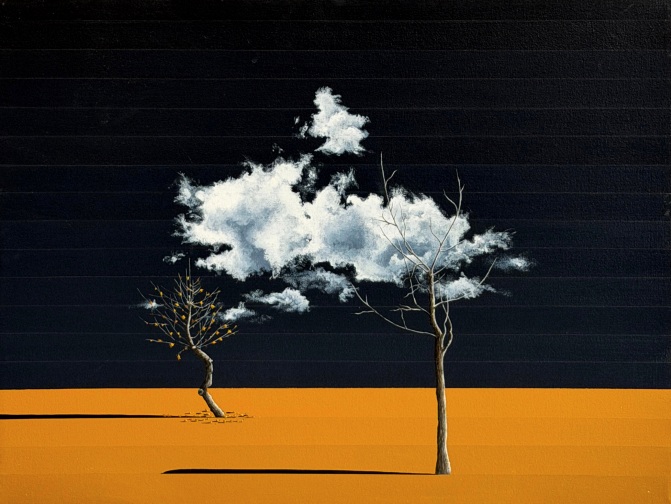
Where It Rests
Little House At Dusk introduces a rare architectural element into Hassan’s minimalist world. However, the "house" is not a domestic study but a structural symbol of presence and absence. Rendered with minimal lines, the house sits as a lonely sentinel within a vast, darkening landscape.
The use of color here is particularly evocative. The "dusk" is not merely a time of day but a heavy, atmospheric weight that settles over the composition. The house serves as a point of focus as a "fixed site" that Hassan simultaneously undermines by surrounding it with an expansive, unresolved environment. It evokes a sense of nostalgia for a place that may only exist in the artist’s memory, reflecting the exhibition's theme of the neither fully remembered nor directly seen.
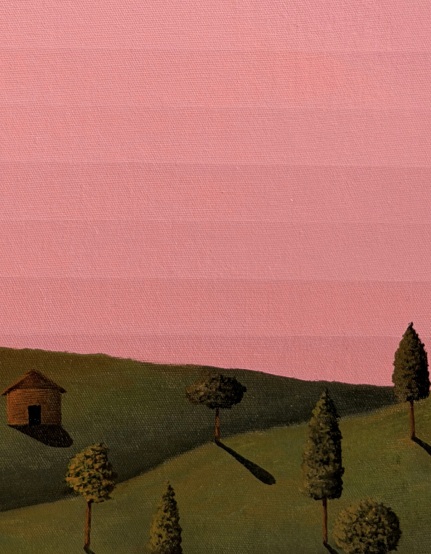
Little House At Dusk (detail)
The diptych format of Passing Bird allows Hassan to explore the concept of distance and the "interval" across two canvases, a pause in the sky. The separation between the two panels emphasizes the physical space and the time it takes for a movement to occur.
This work highlights Hassan's interest in presence and absence. The bird’s flight represents a momentary existence within the eternal stillness of the landscape. The vastness of the acrylic washes creates a sense of profound silence, where the only movement is the viewer’s eye jumping the gap between the canvases. It is a vivid reminder that in Hassan’s world, meaning emerges quietly through attention.
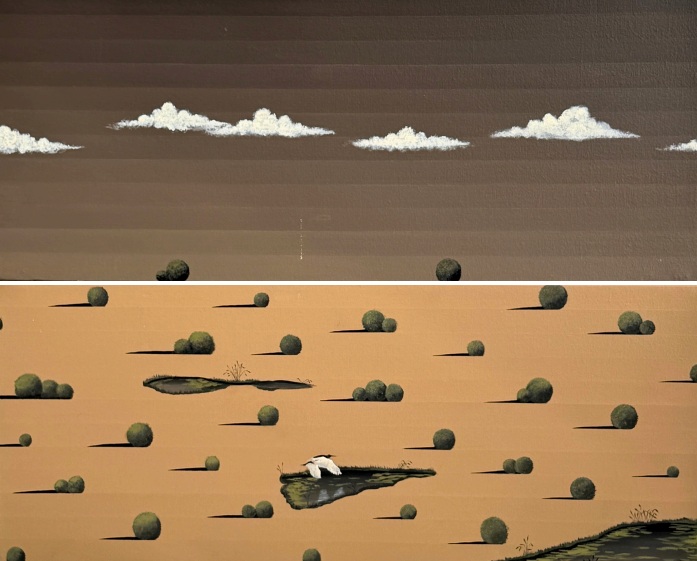
Passing Bird
Long Afternoon is perhaps one of the most atmospheric pieces in the room. The title suggests a stretching of time, a sentiment mirrored in the elongated horizontal composition. Here, the landscape is reduced to layers of light and shadow, capturing the specific quality of time when the sun is low and the day feels interminable.
In this piece, Hassan’s minimal structures are at their most effective. There is a sense of immense distance created through subtle shifts in tone rather than through perspective lines. The painting acts as a space to pause within, reflecting the artist's desire for the work to unfold slowly. The Long Afternoon is not just a subject; it is an emotional state of suspension.
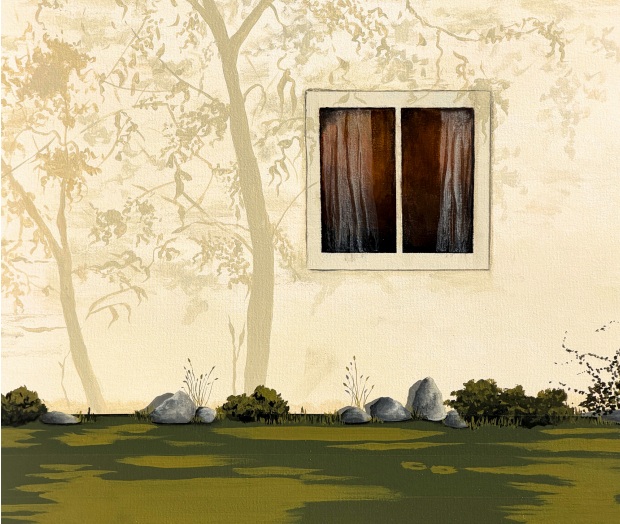
Long Afternoon (detail)
With Air Feels Heavy, the artist moves from the visual to the tactile. The painting seeks to capture the density of the atmosphere; the humidity, the heat, or perhaps the psychological weight of a quiet moment. The brushwork is more pronounced here, creating a textured surface that suggests the thickness of the air itself.
Rather than depicting a clear view, the composition feels hidden, as if the landscape is being viewed through a veil of mist or memory. This work perfectly encapsulates Hassan’s philosophy that atmosphere should take precedence over description. It is an unresolved piece that asks the viewer to feel the landscape rather than simply look at it, allowing personal experiences of heaviness to fill the voids left by the artist.
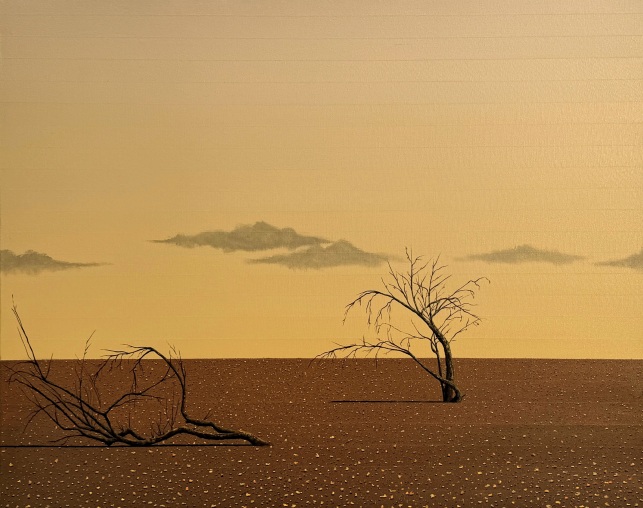
Air Feels Heavy
The Long Ground serves as an anchor for the exhibition, a large-scale exploration of the earth as a continuous, unfolding interval. The composition is dominated by the expanse of the land, which Hassan treats not as a specific location but as a psychological territory.
Hadia Hassan’s The Land As An Interval is a significant contribution to contemporary landscape painting in Pakistan. Through these six works, we see an artist who is deeply committed to the power of the minimal. Hassan does not seek to overwhelm the viewer with detail; instead, she offers a retreat into stillness. Her paintings are not windows into another world, but mirrors for our own internal landscapes. In a world that is increasingly loud and fast paced, Hassan’s work provides a necessary interval a space to breathe, to pause, and to reconnect with the quiet complexities of existence.
You may also like:
From the Horn of Africa to Bahria Town: Habesha Café Brings Centuries of Coffee Culture to Rawalpindi
(October 15, 2026)