Written by: Dr. Dushka H. Saiyid - Posted on: May 20, 2014 |  Comments | 中国 (Chinese)
Google Translation: اُردو | 中文
The future lies with integrative medicine, which focuses on healing and has a holistic approach to it, combining the mind, spirit and the body rather than dealing with the symptoms of the disease. Its defining principles are that the patient and practitioner are partners in the healing process, and takes into consideration both mind, body and spirit. It is not the same as alternative medicine, but strives to combine the more scientific alternative medicine with conventional medicine in order to facilitate the body’s healing response. What distinguishes integrative from traditional medicine is that the former focuses on diagnostics while the traditional medicine treats the symptoms only.
The American Association of Integrative Medicine was founded in the 1990s, and the Pakistan equivalent has been founded this year in 2014. Dr. Mobashir Bhatti, a California based doctor is the moving spirit behind it, and its current President. As head of the Pakistan Association of Integrative Medicine or PAIMNET, Dr. Bhatti is aiming to train 1000 doctors in holistic and ethical medicine. He will give Continued Medical Education (CME) abroad as an incentive to the 100 tehsil doctors that he plans to train, each one of who has 250 doctors working under him. PAIMNET plans to establish an online network of doctors, so that a doctor unable to treat a patient in a rural area can consult a board of doctors and, under their guidance, treat the patient. He also plans to establish Evaluation Centers in the main cities of Pakistan, with doctors trained to evaluate whether the patients can be treated within Pakistan or will have to go abroad.
Dr. Mobashir Bhatti is also introducing gene and stem cell therapy to Pakistan with the help of two Chinese doctors with expertise in these fields. Dr. Bhatti hopes to open an American Pakistan China Medical Research Center, using American technology with Chinese experience. One of the doctors who is expected to come to Pakistan to treat patients is Dr. Li Dinggang, who trained at the Johns Hopkins University in the US. He treats patients with the gene therapy drug called Gendicine, manufactured in Shenzhen by a Chinese company with the name of SiBiono. It works through activating the p53 gene, which suppresses the cancerous tumor. It is injected into the tumor, and a virus carries the p53 gene into the cancer cells. Once the p53 gene is reactivated, the cancer cells die and the tumor shrinks.
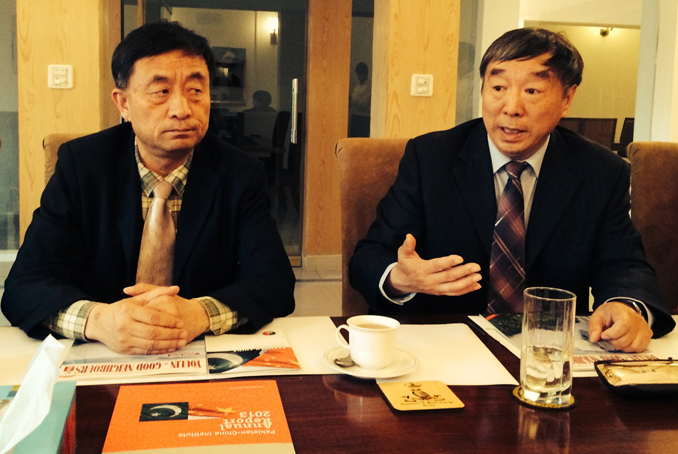 |
(l-r) Dr. Yu Deng Wei and Dr. Li Dingang |
Dr. Peng Zhaohui founded the company SiBonio, when he returned from the University of California in San Diego. Countering the western criticism that the testing of the drug has not been comprehensive enough, he says that when the drug was approved in 2003, it had only been tested on just over a hundred patients, and not over a long-term period either, because of its short-term effectiveness. Now, he argues, over 4,500 cases have been tested over a six-year period. It is also argued that Dr. Peng’s research has not been transparent enough, and he has not published in English medical journals, and restricted himself to Chinese medical journals. However, foreigners are arriving at the Haidian Hospital in Beijing in droves, especially as the cancer treatment at Haidian costs a fraction of what it costs in the US. Such is the demand that the hospital is opening a 50 bed international center.
If Dr. Li has treated over 1000 patients with gene therapy, Dr. Yu Deng Wei has treated over 10,000 patients with stem cell therapy. He successfully cured his father, who is in his 90s, of Parkinson’s disease and who is now able to lead an almost normal life.
While critics in the West continue to raise doubts about the thoroughness of the clinical testing of Gendicine, which failed to get the approval of the FDA in the US, China has speeded up its research in biotech. In 2006 it raised its spending on biotech research from 1.3% of its GDP to 2.5%. As a result China is attracting not just American cancer patients but also American researchers.
If Dr. Mobashir Bhatti manages to spread integrative medicine in Pakistan through his project for training of doctors, and introduces cutting edge treatment for cancer through gene and stem cell therapy with the help of Chinese doctors, Pakistan could be at the cusp of a revolution in the field of health. The government, both at the federal and provincial level should seize this opportunity to transform the dismal state of healthcare in the country.