Written by: Hurmat Majid
Posted on: January 9, 2026 |  | 中文
| 中文

Talha Chahour and Anmol Baloch
Neeli Kothi arrives on Hum TV with the kind of confidence that demands attention. In a television landscape increasingly saturated with formulaic domestic dramas and predictable romantic entanglements, the promise of a mystery-laden narrative centered on inheritance, buried secrets and a mansion with a haunting past feels like a necessary departure. After its first weeks on air, however, what remains most striking about Neeli Kothi is not what it reveals but what it withholds. This is a drama that understands the power of atmosphere and suggestion, one that trades in shadows rather than certainties. Whether this restraint will ultimately serve the narrative or frustrate it remains an open question, but there is no denying that writer Saima Akram Chaudhry and director Anjum Shahzad have crafted something that feels distinct, even if its full shape has yet to emerge.
At its core, Neeli Kothi centers on a young woman, played with admirable composure by Anmol Baloch, who inherits an old mansion, the titular Neeli Kothi, and in doing so inherits a history she did not ask for and cannot escape. The premise is deceptively simple: a woman, a house, secrets buried in its walls. But the execution suggests ambitions beyond mere Gothic pastiche. This is not a horror story dressed up as family drama, nor is it a romance using mystery as narrative scaffolding. Instead, Neeli Kothi positions itself as something more layered: a meditation on how the past refuses to stay silent, how family histories become prisons, and how the act of uncovering truth can be as dangerous as leaving it buried.

Anmol Baloch and Atiqa Odho
The mansion itself functions as more than setting. It is rendered as a character in its own right, oppressive and magnetic in equal measure. The production design deserves particular credit for resisting the temptation toward theatricality. The Neeli Kothi is not a haunted house in the conventional sense, all creaking doors and shadowy corridors designed for cheap thrills. It is, instead, a space that feels inhabited by memory, where the architecture itself seems to remember what the living have tried to forget. This subtlety in visual storytelling elevates the material, suggesting that the true horror lies not in supernatural intervention but in the weight of unresolved grief and betrayal.
Baloch's performance as the inheritor of this burden is the drama's most immediately evident strength. She plays the role with a stillness that belies considerable emotional depth. There is an intelligence to her choices, a refusal to telegraph feelings that the script has not yet earned. In early episodes, her character moves through the mansion with a wariness that feels earned rather than performed. She does not overreact to strangeness; she absorbs it, processes it, and the audience watches that accumulation take its toll. This is a performance built on restraint, and in a medium that often rewards the opposite, it stands out as refreshingly adult.
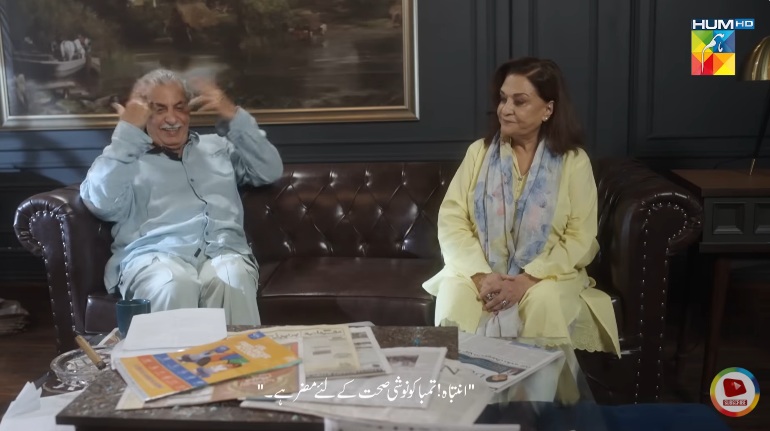
Usman Peerzada and Samina Ahmed
Talha Chahour, in his role opposite Baloch, brings a different energy. His character's relationship to the mansion and its mysteries is less immediately clear, which may be intentional but at times feels underwritten. There is chemistry between the two leads, this much is evident even in the limited interactions available for analysis, but the script has yet to fully articulate what draws them together beyond proximity and circumstance. The romance, such as it is, feels secondary to the larger mystery, which is perhaps as it should be. Still, one hopes that as the drama progresses, the emotional stakes between these two will be given the attention they deserve, lest the relationship feel purely functional.
The supporting cast, populated by veterans like Usman Peerzada, Atiqa Odho and Sahiba, adds considerable weight. Peerzada and Odho, in particular, bring decades of experience to roles that appear central to the mansion's troubled history. What little has been revealed about their characters suggests a marriage marked by creative ambition and emotional compromise, though the specifics remain frustratingly vague. Sahiba's return to television after years in film is noteworthy, and her presence hints at a character whose emotional significance will reveal itself in time. The frustration, for the viewer, is that these actors are clearly capable of more than the material has yet allowed them to demonstrate.
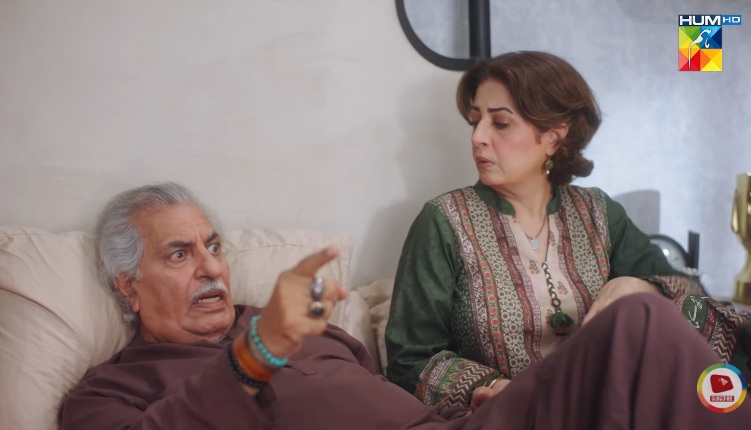
Usman Peerzada and Atiqa Odho
One senses performances waiting to happen, held in reserve until the plot catches up to the talent. Saima Akram Chaudhry's involvement as writer is both the drama's greatest asset and its most perplexing element. Known for her work on lighter, family-oriented fare like Suno Chanda and Chupke Chupke, Chaudhry's pivot toward darker, more psychologically complex territory is bold. The writing demonstrates her characteristic attention to family dynamics and her refusal to traffic in easy villains or saints. Yet there is a curious opacity to the storytelling thus far. Relationships are hinted at but not clarified. Character motivations remain obscure. Even basic questions, who these people are to one another, what happened in this house, why the past matters so urgently, are answered only in fragments, if at all.
This withholding could be read as narrative sophistication, a deliberate choice to let mystery accumulate and meaning emerge slowly. Or it could be a miscalculation, a drama that has mistaken vagueness for complexity. The distinction matters. A mystery that withholds information strategically, that doles out revelation in a way that deepens rather than confuses, earns its audience's patience. A mystery that simply refuses to commit risks losing that audience altogether. At this early stage, it is difficult to know which Neeli Kothi will prove to be.
The pacing is deliberate, even languorous. Scenes unfold with the kind of patience that suggests confidence in the material, but also raises questions about sustainability. In an era where audiences are conditioned for immediacy, Neeli Kothi's insistence on taking its time is either admirable or commercially risky, depending on one's perspective. There is something to be said for a drama that refuses to explain itself too quickly, that trusts viewers to sit with uncertainty. But there is also a fine line between tension and stasis, and Neeli Kothi walks that line carefully, sometimes perilously.
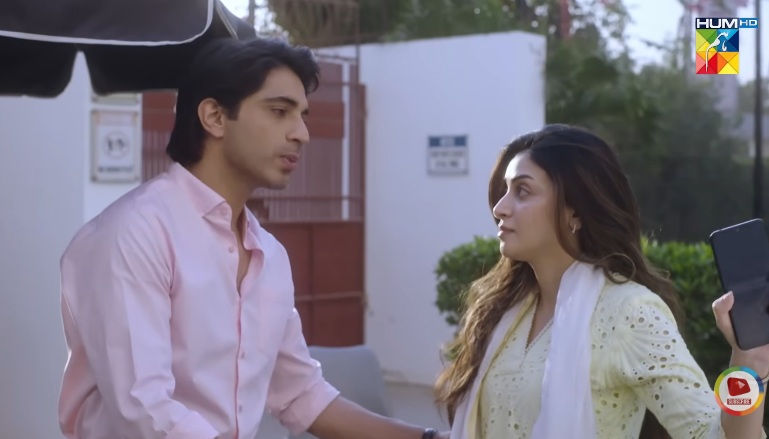
Talha Chahour and Anmol Baloch
Director Anjum Shahzad's work is visually assured. The camera lingers on faces, on architecture, on the play of light through dusty windows. There is an attention to mood and texture that elevates the production beyond standard television fare. The color palette, muted blues and greys punctuated by occasional warmth, reinforces the sense of a world caught between past and present. The technical execution is polished without calling attention to itself, which is precisely as it should be. The drama looks and feels substantial, which is no small achievement given the constraints of television production.
Audience response has been mixed, which is perhaps inevitable for a drama that demands more than passive viewing. Social media reactions suggest a fanbase intrigued by the premise and invested in the lead pairing, but also growing impatient for clarity. The drama's refusal to provide easy answers has been both praised and criticized, often by the same viewers. This ambivalence is telling. Neeli Kothi is not designed to please everyone, and there is integrity in that choice. But a drama must also deliver on its promises, and the question remains whether this one will.
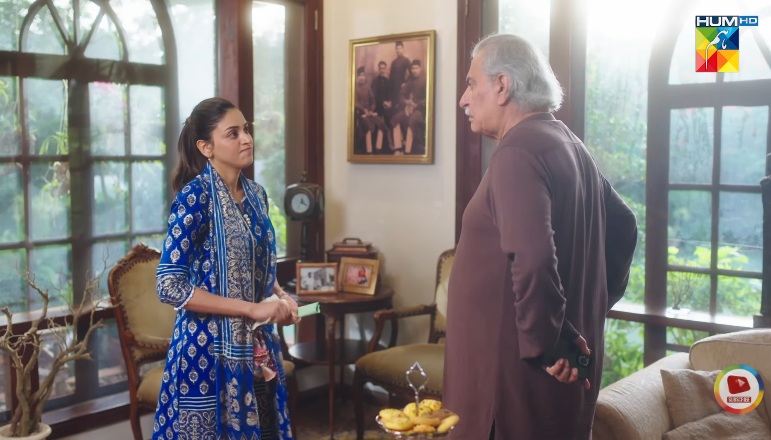
Usman Peerzada and Anmol Baloch
What Neeli Kothi has established, beyond doubt, is atmosphere. It has created a world that feels haunted not by ghosts but by memory, by choices made decades ago that continue to reverberate. It has assembled a cast capable of carrying complex material and a production team willing to take visual and narrative risks. What it has not yet done is fully reveal itself. The bones of something compelling are visible, but the flesh remains stubbornly absent.
For now, Neeli Kothi exists in a state of potential. It could develop into a drama of genuine psychological depth, one that uses its mystery framework to explore family, legacy and the impossibility of escaping the past. Or it could collapse under the weight of its own ambiguity, becoming a drama that promised much and delivered obfuscation. The difference will lie in execution, in whether the withholding proves purposeful or merely evasive.
As it stands, Neeli Kothi is worth watching for anyone interested in Pakistani television that attempts something beyond the expected. It is a drama of mood and suggestion, anchored by strong performances and elevated by thoughtful production. Whether it will ultimately satisfy is a question only time, and future episodes, can answer. For those willing to sit with uncertainty and trust the process, it offers intrigue. For those seeking immediate gratification, it may prove frustrating. Either way, it cannot be accused of being ordinary and in television, that alone is worth something.
You may also like: