Written by: Emma Alam
Posted on: June 17, 2026 | 

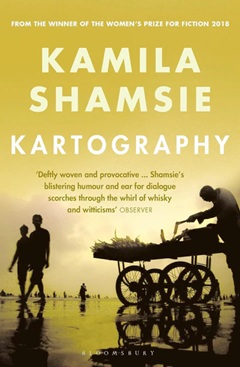
Front cover of Kartography by Kamila Shamsi
A limited number of modern Pakistani novels depict the subtle connection between individual realms and historical narratives of nations as persuasively as does the ‘Kartography’ by Kamila Shamsie.
The setting of this fiction is the unpredictable landscape of Karachi in the twilight decades of the modern age. This book is a comprehensive examination of nostalgia, individuality, companionship, affection, and the intangible barriers that polarize communities.
These words by Raheen point towards an urban solastalgia:
“Every other city in the world only showed me its surface, but when I looked at Karachi, I saw the blood running through and out of its veins...”
The novel Kartography remains exceptionally connected to the current scenario. It revolves around two childhood friends Raheen Ashraf and Karim, who develop a romance in the latter part of the fiction.
As the leading characters reveal the deeply concealed familial truths, they are compelled to question harsh realities regarding their parents, metropolis, and themselves. The key achievement of the novel is its vivid depiction of Karachi not only in the form of context, but also as a living and breathing character.
Karim's obsession with maps and topography reflects a strong phenomenon in understanding the metropolis and interpersonal bonds. He emphasizes that if Karachi can be plotted on an atlas, then it can be analyzed accurately. However, the book explains the flaws of this notion: that the feelings of masses, deep-seated historical trauma, and societal rifts cannot be mapped.
The paradigm of remembrance shows a significant role in the chronicle. The writer demonstrates how history denies being shrouded and proves its existence in fostering the present situation. Actions and choices of forefathers resonate across the existence of next generations. Hence, Kartography becomes a contemplation of the inherited past. Emotional bonding and companionship are explored by the writer with mastery and delicacy. Moreover, the courtship between Raheen and Karim is neither idealized nor exaggerated.
In substitution for overt sentimentality, Shamsie induces affection as a delicate yet complex behavior, which is sensitive to misconceptions, hidden truths, and outside influences. Even in today's world, Kartography is strongly relevant to the current scenario. Around the globe, communities face social, political, and cultural division.
Eventually, this story explores an unreachable goal of demarcation between past and present, individuality and community, affection and bereavement. With the help of its multi-dimensional characters and deep alignment with the cityscape of Karachi, the narrative serves as an index to showcase how citizens make the way through a world paved by grand systems.
Regardless of the boundaries, the novel eventually unfolds the likelihood of companionship spanning societal, cultural, and civic barriers. It advocates that sympathy, affinity, and affection can confront the intangible walls that segregate societies.
After more than two decades of its release, the novel Kartography is still convincing and a must-read book. Its narrative summons readers to reevaluate topographies not only actual, but symbolic as well; through the means they comprehend their nucleus of urban life, the bygone years, and most importantly, their individuality.
The novel encompasses urban solastalgia as collective psychological grief, a social yearning for an abode that once was known as the city of lights and dreams.
You may also like: