Written by: Muhammad Hamza
Posted on: May 29, 2026 | 
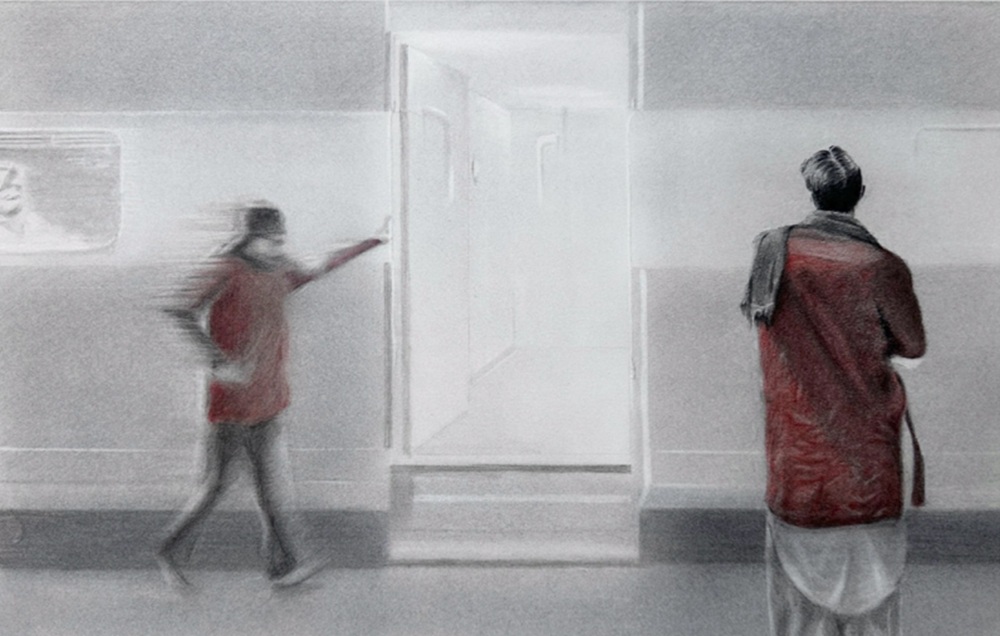
Aik Dou Teen (One Two Three) by Adnan Ali Umrani
The Orchard in Islamabad presents Inner Migrations, a show that brings three artists together to explore quiet changes inside us. Adnan Ali Umrani, Ghulam Hussain Soomro and Muzamil Chandio use simple lines, marks and shapes to talk about memory, movement and how we see ourselves. The works feel calm yet full of life. They remind us that real travel often happens in the mind, even when our feet stay still.
Syed Faraz Ali curated the exhibition with care. He chose pieces that feel like personal diaries drawn on paper and canvas. The gallery owner, Roma Larek, has turned The Orchard into a peaceful spot where art feels close and easy to live with. Her space lets visitors sit with the works and let their own thoughts wander.
Adnan Ali Umrani draws old railway stations from Pakistan’s past. These places, built long ago, mix waiting and rushing in one spot. The kinetic figures are the epitome of his work, where movement in figures matches up with the tone of his medium.
Mulaqaat Aur Chehal Pehal shows a long platform at night. People stand in small groups under dim lights. Some walk, others wait. The soft charcoal lines make everything feel alive but gentle. You can almost hear low voices and the far sound of a train. It captures the lively meetings that happen every day in these stations.
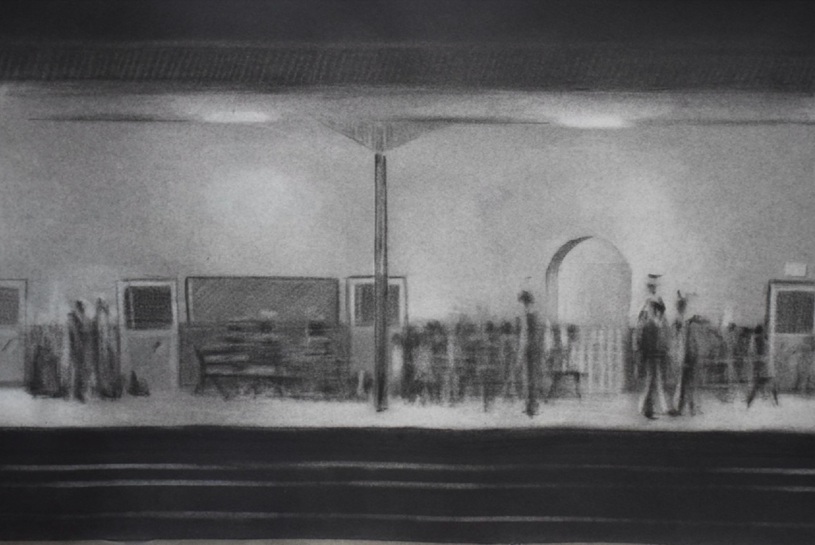
Mulaqaat Aur Chehal Pehel by Adnan Ali Umrani
In Aik Dou Teen, two figures appear in a plain hallway. One person in a red shirt points toward an open door while moving fast. The other stands still with his back to us, wearing a patterned shawl. Turbid & blur on the moving figure shows how time slips away in ordinary moments. Adnan makes us feel the push and pull between going and staying.
Khamosh Faslaa places a lone man on a platform edge. He looks across empty tracks toward hills and a slow train. The drawing uses dark shades to create distance. The land feels wide and quiet. It speaks of inner space more than miles. Viewers might think about their own quiet waits in life.
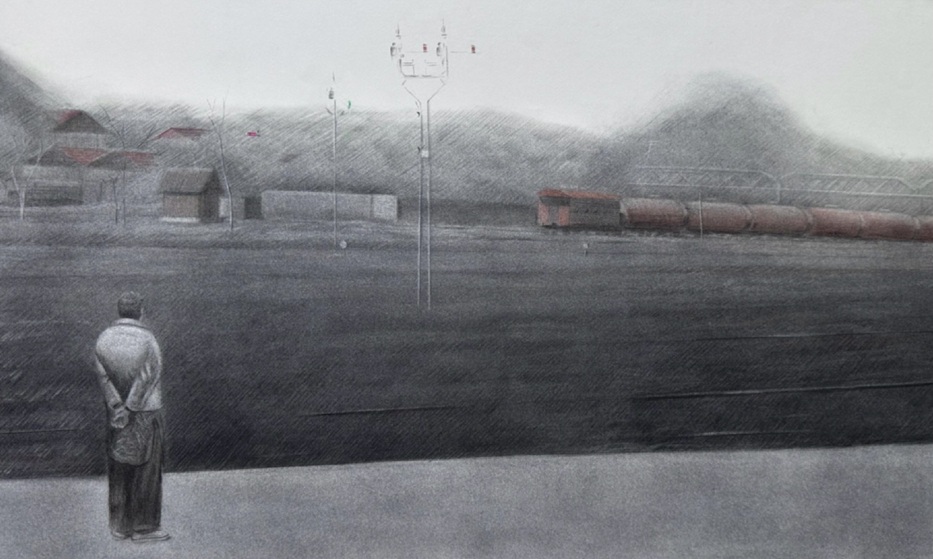
Khamosh Faslaa by Adnan Ali Umrani
Chaltay Chaltay adds speed to the mix. A car rushes past a simple building with motion lines that streak across the paper. The station behind stays clear and steady. Adnan shows how daily travel keeps everything flowing. His drawings use mostly black and white with small touches of warm color. This choice keeps the focus on light, shadow, and human presence. Through these station scenes, he turns everyday travel into a meditation on time and connection.
Ghulam Hussain Soomro works with woven paper and canvas to create patterns that feel both old and new. He mixes traditional craft with fresh ideas about memory and space. Hand-Dyed Silence looks like a hanging cloth covered in tiny red and black marks.
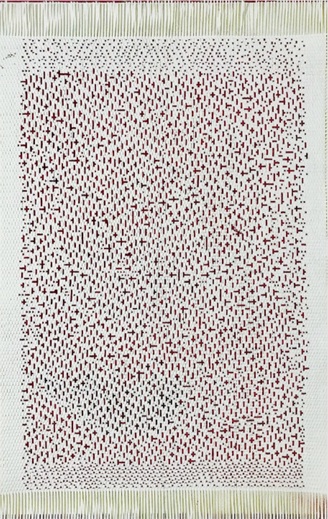
Hand-Dyed Silence by Ghulam Hussain Soomro
There’s a certain memory lane that seeps into each weave, errors that are embedded throughout, maybe a few paper cuts that also make the cut to the final piece. They fade from dark at the bottom. The piece suggests a silence that holds many small stories inside.
The Illusion of Stillness plays tricks with the eyes. Black and white squares stretch and bend across the surface. At first it looks flat. Then it starts to move and pull the gaze inward. The pattern creates a sense of depth that never settles. It matches the show’s theme perfectly. What looks still on the outside holds constant small shifts within. the leftover edges really do create that infinitive feel that can’t be unseen.
Veil of the Divine offers a simpler but stronger moment. A golden circle sits on a black field with a short white line inside. The circle feels like a window or a shield. Gold adds a soft shine against the dark. The work feels spiritual without being loud. Ghulam’s pieces use texture and careful placement to make viewers slow down. His art turns ordinary materials into quiet spaces for reflection. Memory appears here not as clear pictures but as repeated marks that build over time.
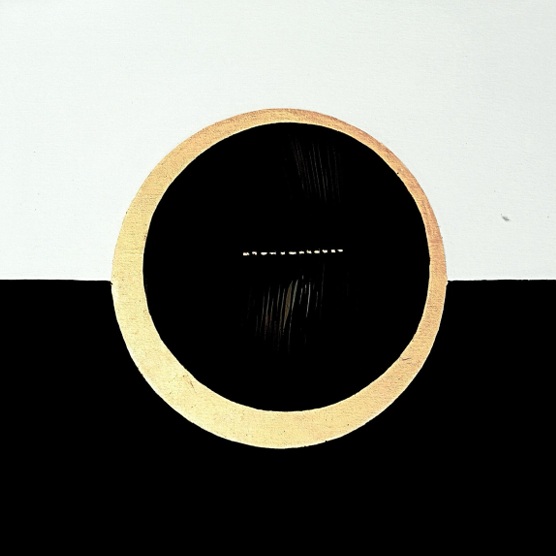
Veil of the Divine by Ghulam Hussain Soomro
Muzamil Chandio builds faces and figures from thousands of straight lines. He mixes this strict method with loose, childlike touches. The result feels fresh and honest. Scream shows a face made entirely of horizontal black lines. Bright red and yellow streaks cut across it like sudden emotion. The mouth opens wide. The eyes look straight out. It captures a raw inner shout that many people carry but rarely show.
DOLL turns a simple toy shape into something more. Lines form a body while yellow, blue, and purple paint drips and splashes around it. The figure looks playful at first. Yet the heavy lines give it weight and presence. It feels like a memory of childhood mixed with adult thoughts. Chandio invites us to see how we build our own images of self.
Self Portrait uses the same line system but adds blue and orange dots. The face emerges slowly as the eye moves across the canvas. Some areas stay clear while others blur into patterns. It shows how memory changes shape each time we look back. The work feels personal without telling a full story. Viewers can find their own faces in it.
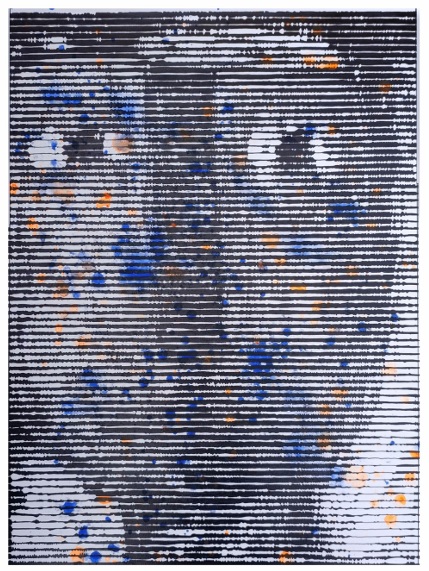
Self Portrait by Muzamil Chandio
PEERU continues the line play with dark and light marks plus yellow and orange splashes. The image shifts between a clear figure and pure pattern. It questions what we really see when we look at someone or at ourselves. Chandio’s method keeps control in the lines while letting color and dots run free. This mix creates tension that feels alive. His works prove that simple marks can hold big ideas about perception and growth.
All three artists share a love for line and restraint. Adnan’s stations feel like real places where inner journeys begin. Ghulam’s patterns turn stillness into something that breathes. Muzamil’s portraits show faces built from memory itself. The black-and-white base in many pieces keeps the focus sharp. Small bursts of color add warmth and feeling without taking over. The exhibition title Inner Migrations fits every wall.
Movement here is not about trains or cars alone. It lives in the mind—shifting, waiting, remembering.
Visitors walk through the gallery and sense a shared mood. The works ask us to pause. They show how daily life holds quiet transitions. A platform, a pattern, or a lined face can open doors inside. The show proves that drawing remains a powerful way to explore who we are. It connects the artists’ personal stories to something bigger. People from Sindh and beyond bring their roots into the art. Yet the feelings stay universal.
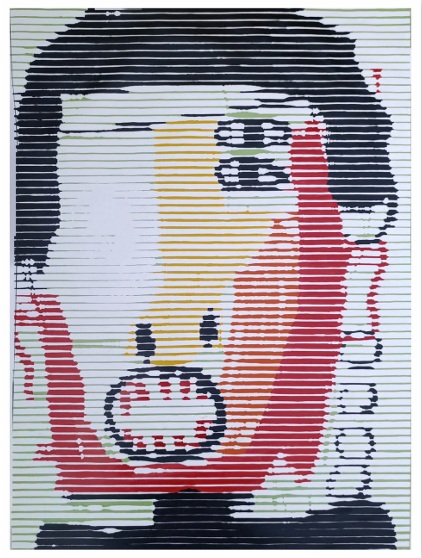
Scream by Muzamil Chandio
Inner Migrations runs as a gentle invitation. It does not shout or demand. Instead, it offers space to notice small changes within. Adnan, Ghulam, and Muzamil each find their own path through line and form.
Together they create a show that feels complete yet open ended. In a busy world, this kind of art matters. It reminds us to look inside, to notice the migrations happening every day in silence. Kinetic energy flows through those artworks as a foreseen consequence and it settles in with gentleness as always.
The Orchard has given Islamabad something special: a place to reflect, to remember, and to move forward in small, meaningful steps.
You may also like:
From the Horn of Africa to Bahria Town: Habesha Café Brings Centuries of Coffee Culture to Rawalpindi
(October 15, 2026)