Written by: Muhammad Maroof Atif
Posted on: August 08, 2025 |  | 中文
| 中文
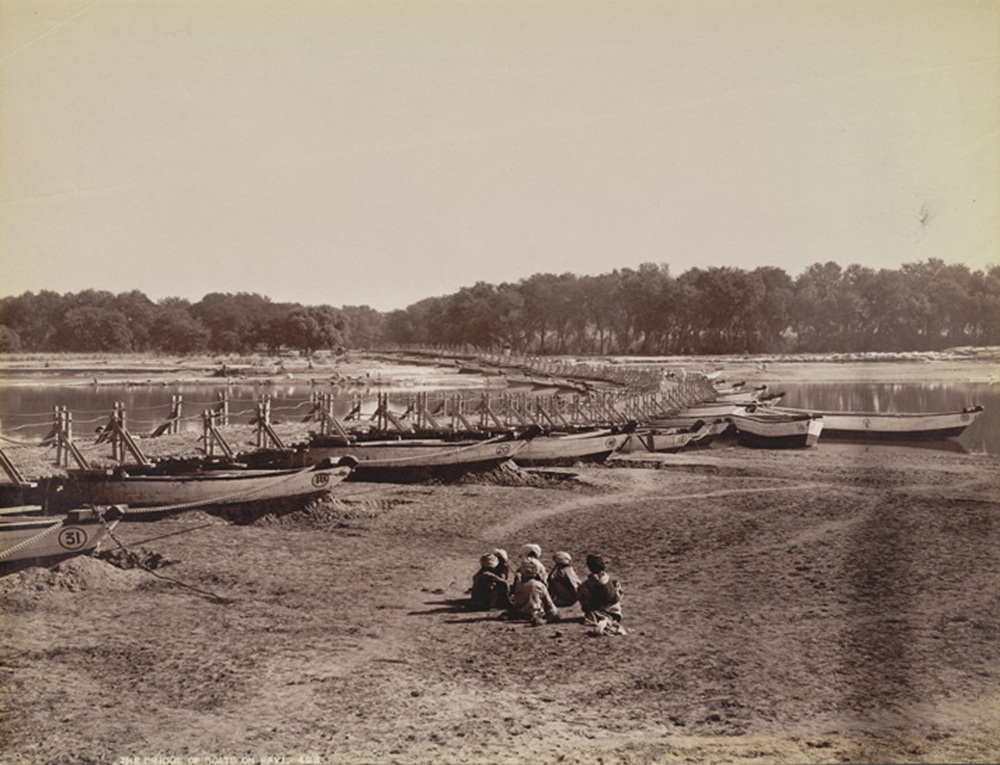
Bridge of boats on the Ravi taken by an unknown photographer in 1880.
The Ravi River, one of the five lifelines that gave Punjab its name, begins in the Chamba district of Himachal Pradesh, India, and snakes its way through the plains of Pakistan before joining the Chenab. Historically, this river did more than just flow; it carved out lives, cultures, and entire cities. For centuries, Lahore’s existence has been shaped by the Ravi’s bend, its rhythm echoing in the gardens of the Mughals, the irrigation channels of farmers, and the lives of those who built homes near its banks.
In the early 20th century, the Ravi was a robust waterway. Between 1922 and 1961, it carried an average of seven million acre-feet of water annually. That figure has since plummeted to 0.3 million acre-feet in 2009-2010, according to hydrological studies conducted by Hashmi and his team at UET Lahore in 2016.
Lahore, too, has grown, but in a direction that increasingly ignores the river. The city’s footprint expanded from just over 400 square kilometers in 1973 to nearly 1,700 square kilometers by 2020. Aerial analysis by the Lahore Development Authority and urban planning researchers from the University of Punjab shows how this expansion has consumed former wetlands, agricultural belts, and villages along the Ravi. The city now sprawls across an area that houses more than 13 million people, growing at a rate of over 2.5% annually. As the city has grown, especially westward and northward toward the Ravi floodplain, the river has been squeezed between real estate projects, industrial zones, and highway corridors.
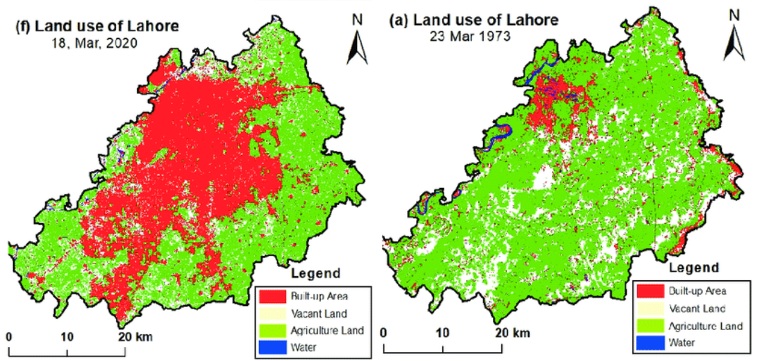
A comparative study of Lahore indicating land usage growth towards the River Ravi
However, the story of Lahore’s growth is incomplete without acknowledging what it has left behind. And what it has left behind is a river that once shaped it: physically, economically and spiritually. Today, regrettably, as urban towers rise and land prices surge, the Ravi continues to shrink, both in volume and in Lahore’s collective memory.
On the contrary, for most of Lahore’s history, the Ravi was not just a river. It was the city’s pulse. Farmers used its water to nourish their fields, birds flocked to its wetlands, and children splashed in its shallows during summer.
One of the most glaring factors in the Ravi’s decline has been the untreated sewage. As of 2023, Lahore generates more than 540 million gallons of wastewater daily. The vast majority of this (nearly 90%) is discharged directly into the Ravi without treatment. The largest contributor is the Hudiara Drain, a once-natural watercourse that now carries toxic waste from factories, homes and hospitals. Residents living near the drain describe the smell as unbearable, and doctors in surrounding areas have reported rising cases of skin disease and gastrointestinal illness. What was once a river of life is now classified as “biologically dead” in several environmental surveys.
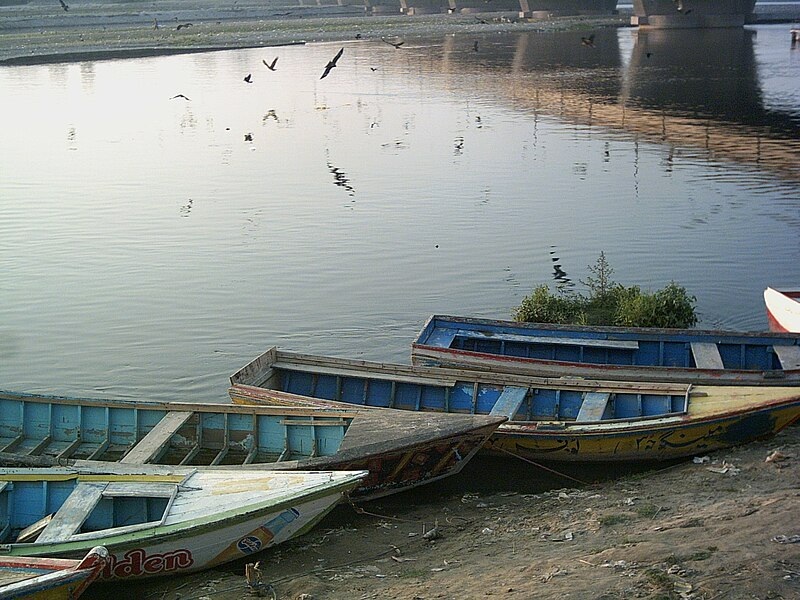
Boats in the polluted River Ravi in Lahore.
Then there is industrial pollution. The Ravi’s banks, once dotted with mango orchards and farmland, are now crowded with brick kilns, leather tanneries and steel factories. A 2020 study by WWF-Pakistan found high concentrations of lead, arsenic, chromium and other heavy metals in the river water. These pollutants, often discharged without regulation, do not just poison the river. They enter the soil, affect groundwater quality and endanger the health of entire communities downstream.
Urban overreach is just as harmful. Lahore’s real estate boom pushed housing societies and commercial zones right up to the edge of the floodplain. This narrowed the river’s natural corridor, disrupted drainage patterns, and led to flash floods during heavy monsoon rains. Satellite maps from the past 30 years show how housing developments have crept over the very land that once absorbed seasonal floods. Not only does this increase flood risk, it also deprives the river of the space it needs to flow and recharge groundwater naturally.
The informal housing crisis plays its own part. Slums have emerged along the Ravi’s edge, many built without access to proper sanitation. These settlements often rely on the river for washing, cleaning and even drinking water, further compounding pollution levels. At the same time, local fishing communities, once dependent on the Ravi, report dwindling catches. Species like the Indian rohu and freshwater shrimp, once abundant, are now rarely seen.
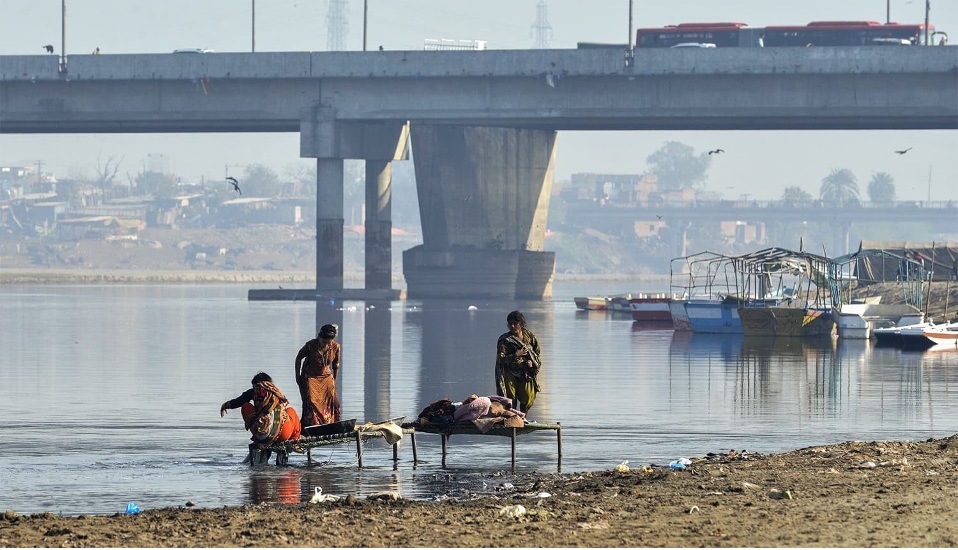
A few women stand in the polluted waters of the Ravi River.
Lastly, overextraction is another silent killer. As Lahore’s population grew, so did its demand for water. The city’s reliance on groundwater, especially through private borewells, has increased dramatically. Because the Ravi no longer flows steadily, the aquifer beneath Lahore is not replenished. The result is a sinking water table and saline intrusion in many parts of the city.
Each of these issues (sewage, industry, encroachment, slums, overfishing and groundwater depletion) might seem separate. But together, they form a tangled knot of urban neglect. The Ravi’s decline is not natural. It is the result of human choices, made over decades, that slowly turned a river into a shadow.
In recent years, as the decline of the Ravi has become impossible to ignore, a number of initiatives have been launched to reverse decades of ecological damage. The most prominent among them is the Ravi Riverfront Urban Development Project (RUDA), a multibillion dollar effort launched by the Punjab government in 2020. The plan envisions transforming 46 kilometers of riverbank into a modern urban corridor, complete with new forests, wastewater treatment plants, housing, and recreational areas. RUDA has promised the planting of six million trees and significant aquifer recharge, positioning itself as a blend of urban renewal and environmental stewardship.
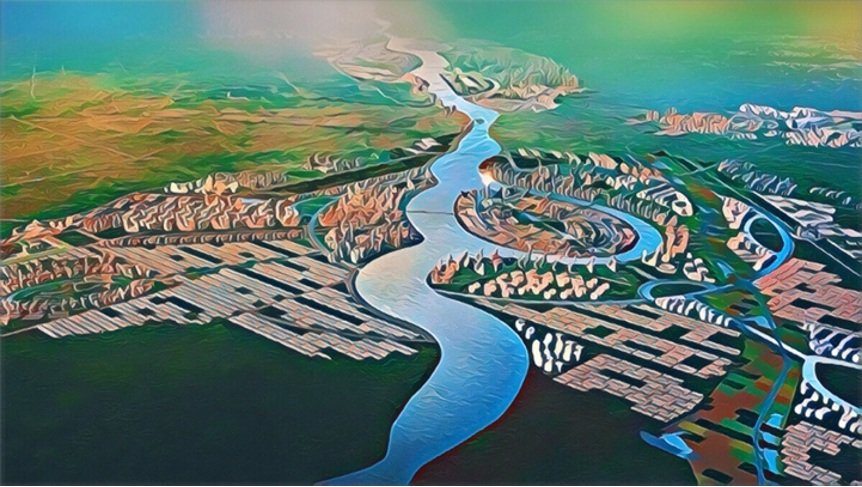
Plans of RUDA, showcasing immense growth around the river and water rejuvenation.
However, critics argue that RUDA appears to prioritize real estate interests more than ecological rehabilitation. Several court petitions have raised concerns about the project’s environmental clearances, its lack of transparent public consultation, and the potential displacement of thousands of residents from riverbank communities. Many urban planners and environmentalists believe that without resolving the root causes of pollution and water scarcity, any cosmetic reimagining of the riverfront will fall short of lasting impact.
In contrast to RUDA’s large scale ambitions, smaller and more targeted efforts have also emerged. One example is the Hudiara Drain Rehabilitation Project, which focuses on improving solid waste management and reducing industrial effluent entering the river through the Hudiara Drain. These localized efforts, though often underfunded and slower to implement, show how a combination of infrastructure upgrades and community-based planning can begin to ease the ecological burden on the Ravi.
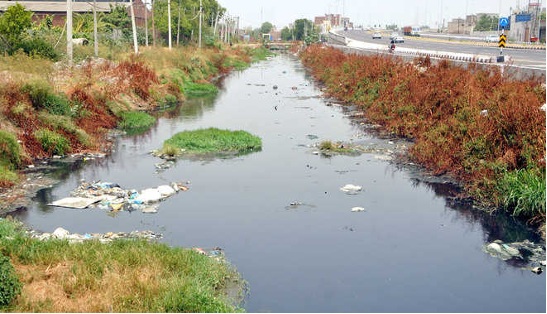
Picture showing the Hudiara Drain, reports of immense stench recorded.
On a diplomatic level, Pakistan has also renewed its focus on upstream water diversions under the Indus Waters Treaty. Officials are reviewing how India’s increased water use from the Ravi and other eastern rivers has compounded Lahore’s water challenges. While progress is still slow and uneven, these layered responses suggest that Lahore is beginning to reckon with its river, not just as a neglected resource, but as a test of its environmental future.
In short, the river that was once a centerpiece of civic and ecological life, now marks the outer edge of the city’s imagination. It is no longer the heart but the forgotten hem. Lahore’s planners increasingly viewed the river as a boundary, not a backbone. Its flow, once central to the city’s water table and ecology, is now reduced to a polluted thread. What was once a source of renewal now serves as a dumping ground.
You may also like: