Written by: Zulfiqar Ali Kalhoro
Posted on: November 05, 2025 |  | 中文
| 中文

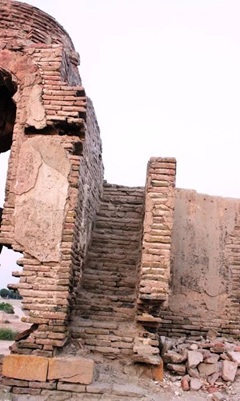
The shrine of Sain Kala at Barki Budhal, Gujar Khan. (Picture credits to Zulfiqar Ali Kalhoro)
Gujar Khan is home to several shrines that have long shaped the region's socio-economic and religious fabric. These sacred spaces are deeply woven into the everyday life, culture, and identity of local communities, drawing visitors from near and far. Among these revered sites, the shrine of Sain Kala Qadiri Naushahi at Barki Budhal in Gujar Khan stands out as particularly prominent.
According to Sharif ul Tawarikh, Vol. 3, No. 5, by Syed Sharif Ahmad Sharafat Naushahi (1971:119), Sain Kala was the son of Namdar Khan, who moved from Peshawar and settled in Beval. Namdar Khan's wife, Bibi Jamil Bano, was a virtuous woman. He (1971:120) mentions that Namdar Khan also married in Beval. However, Sain Kala was born to his first wife, Bibi Jamil Bano. After the death of his father, Sain Kala, along with his mother, Bibi Jamil Bano, migrated from Beval to Barki Budhal. Ishtiaq Ahmad Naushahi (2021), who has researched the Naushahi saints of Gujar Khan tehsil, writes in "Gujar Khan Men Faizan-e-Naushahiyya" that Sain Kala migrated from Takkal village with his sister, Qasiar Bano, to Barki Budhal.

Grave of Sain Kala at Barki Budhal, Gujar Khan. (Picture credits to Zulfiqar Ali Kalhoro)
One learns from Syed Sharif Ahmad Sharafat Naushahi's book a detailed account of Sain Kala Qadiri Naushahi, who once went in search of his spiritual mentor to Kasur. Later, he learned that he would have his spiritual master in Pothohar. He subsequently found his spiritual master, Shaikh Khair Muhammad Qadiri Naushahi, at Jabba village in Gujar Khan. Shaikh Khair Muhammad Qadiri Naushahi was a deputy of Syed Mir Kalan Badshah. He was a famous Qadiri Nauhshahi mystic who preached Qadiriyya-Naushahiyya Silsila in Gujar Khan. Responding to his teachings, many people became his disciples. Sain Kala Qadiri Naushahi was his leading disciple. Barki Budhal village emerged as a vibrant center of the Qadiriyya-Naushahiyya silsila during the lifetime of Sain Kala and continued to flourish under the spiritual leadership of his descendants.

Shrine of Mian Khair Muhammad Qadiri Naushahi in Jabba village. (Picture credits to Zulfiqar Ali Kalhoro)
Many people became disciples of Sain Kala Qadiri Naushahi. According to Syed Sharif Ahmad Sharafat Naushahi (1971:124), some of his prominent deputies and disciples included Khalifa Fatehuddin of Pind Bainso, Sain Karamuddin of Bhagwal, Sain Qadir Bakhsh Kashmiri of Mansoor Wali, and Mai Kalu Sahiba from Chak Beli Khan. I have visited the shrines of all these mystics, except for those of Sain Qadir Bakhsh Kashmiri and Mai Kalu Sahiba.
The shrine of Sain Qadir Bakhsh Kashmiri is located in Mansoor Wali in Wazirabad. I attempted to find the shrine of Mai Kalu Sahiba in various villages in Chak Beli Khan but was unsuccessful. During my search, I was informed that the female mystic bearing that name is not present throughout Chak Beli Khan tehsil. However, I did come across a shrine dedicated to a female mystic along the Rawat-Chak Beli Khan Road, though not much is known about her.
I visited the shrine of Khalifa Fatehuddin, located in Pind Bainso village in Kallar Syedan tehsil. Muhammad Hanif Hanfi, a noted Punjabi Pothohari poet from Changa Bangial village, also accompanied me. The most popular shrine in Pind Bainso village belongs to Khalifa Fatehuddin Majuzb Barqandazi Pothohari, as he was called by the earlier writers who wrote about him. The earliest writer who briefly mentioned him was Syed Sharif Ahmad Sharafat Naushahi. According to Sharif ul-Tawarikh Vol. 3, No. 6 by Syed Sharif Ahmad Sharafat Naushahi (1971), Khalifa Fatehuddin Mazjub Barqandazi Pothohari was initiated into the Qadiri Naushahi Silsila by Sain Kala Qadiri Naushahi (d. 1863) of Barki Budhal village in Gujar Khan.

The shrine of Khalifa Fatehuddin at Pind Bainso village. (Picture credits to Zulfiqar Ali Kalhoro)
Muhammad Hanif Hanfi (1999:227), the author of Ruh Da Rishta, believes that he was popularly known as Sain Fatu. Khalifa Fatehuddin Majzub Barqandazi, also known as Pir Fateh Ali and, to the local community, as Khalifa Sahib, was associated with the profession of shoemaking (Kafshdozi) in Pind Bainso village. He used to frequently visit his spiritual master, Sain Kala Qadiri Naushahi, at Barki Budhal village in Gujar Khan. He used to do chores for his spiritual master and later repaired the shoes of residents of Barki Budhal. He was a beloved disciple of Sain Kala and was known for his simplicity and piety. He was a true mystic who never left his profession as a shoemaker after attaining spiritual prowess.
I also visited the shrine of Sain Barkhurdar in Nala Musalmana's Mohra Kunwan village, which is located about 2 km east of Pind Bainso village. He was a disciple of Khalifa Fatehuddin, alias Sain Fatu. It is said that Sain Barkhurdar used to grind wheat at Chakki of Khalifa Fatehuddin Majzub Barqandazi and became his disciple. Sain Barkhurdar was also known for his piety in his village. Sain Barkhurdar's son, Sain Eddu, was also an eminent mystic of the village.
It is not known when Khalifa Fatehuddin Majzub Barqandazi died. Apart from Khalifa Fatehuddin, Sain Karamuddin was also an eminent disciple of Sain Kala Qadiri Naushahi. His shrine is located in Bhagwal Mehr Khan near Krumb Baloch village in Gujar Khan. I also visited this shrine with Muhammad Hanif. There is a beautiful tomb built over the grave of Sain Karamuddin. Sain Karamuddin died in 1918, as per the inscription on his grave. There are two graves inside the tomb that belong to Sain Karamuddin and Muhammad Shafi, son of Muhammad Ghaus (d. 1999). There are also a few other graves in the tomb's verandah.

The shrine of Sain Karamuddin in Bhagwal Mehr Khan village. (Picture credits to Zulfiqar Ali Kalhoro)
Sain Kala Qadiri Naushahi died in 1863, leaving behind two sons, Sain Ghluam Hussain and Sain Ghulam Rasool. After the death of Sain Kala Qadiri Naushahi, Sain Ghulam Rasool became the sajjada nashin (custodian) of the Darbar of his father and continued his legacy. He was also a khalifa (deputy) of his father, Sain Kala Qadiri Naushahi. He was also known for his piety and was popularly called ‘Topi wali Sarkar’. According to Sultan Mehmood Qadiri Naushahi, the son of Haji Muhammad Siddiq and grandson of Said Rasool Qadiri Naushahi, Sain Ghulam Rasool had numerous disciples. Among his most prominent followers were Mian Ahmad Bakhsh from Chak 91- Bhatian (Sargodha), Shaikh Feroze Din from Gakhar Mandi, and Mian Muhammad Fazil from Watalian village in the Jhelum district.
Sain Ghulam Rasool died in 1933 and was buried next to his father. He had two sons: Sain Said Rasool and Sain Muhammad Khan. Sain Said Rasool became the second Sajjada nashin of the shrine of Sain Kala Qadiri Naushahi. Sain Said Rasool continued the legacy of his grandfather, Sain Kala. He had three sons: Haji Muhammad Shafi, Haji Muhammad Siddiq, and Muhammad Sadiq.

Graves of Sain Kala and his family at Barki Budhal. (Picture credits to Zulfiqar Ali Kalhoro)
After the death of Sain Said Rasool, his son Haji Muhammad Shafi became the third sajjada nashin of Sain Kala Darbar. He passed away in 2004, leaving behind three sons: Muhammad Shafiq, Haji Muhammad Riaz, and Muhammad Farooq. Haji Muhammad Riaz Qadiri Naushahi succeeded him as the fourth sajjada nashin of Sain Kala Darbar.
The shrine of Sain Kala Qadiri Naushahi remains a deeply revered sacred space for his devotees. It is among the most prominent Qadiri-Naushahi shrines in the Gujar Khan tehsil. During the annual festival, the site draws devotees and visitors from regions far beyond the Gujar Khan tehsil.
You may also like: