Written by: Fiza Husnain
Posted on: June 22, 2026 | 
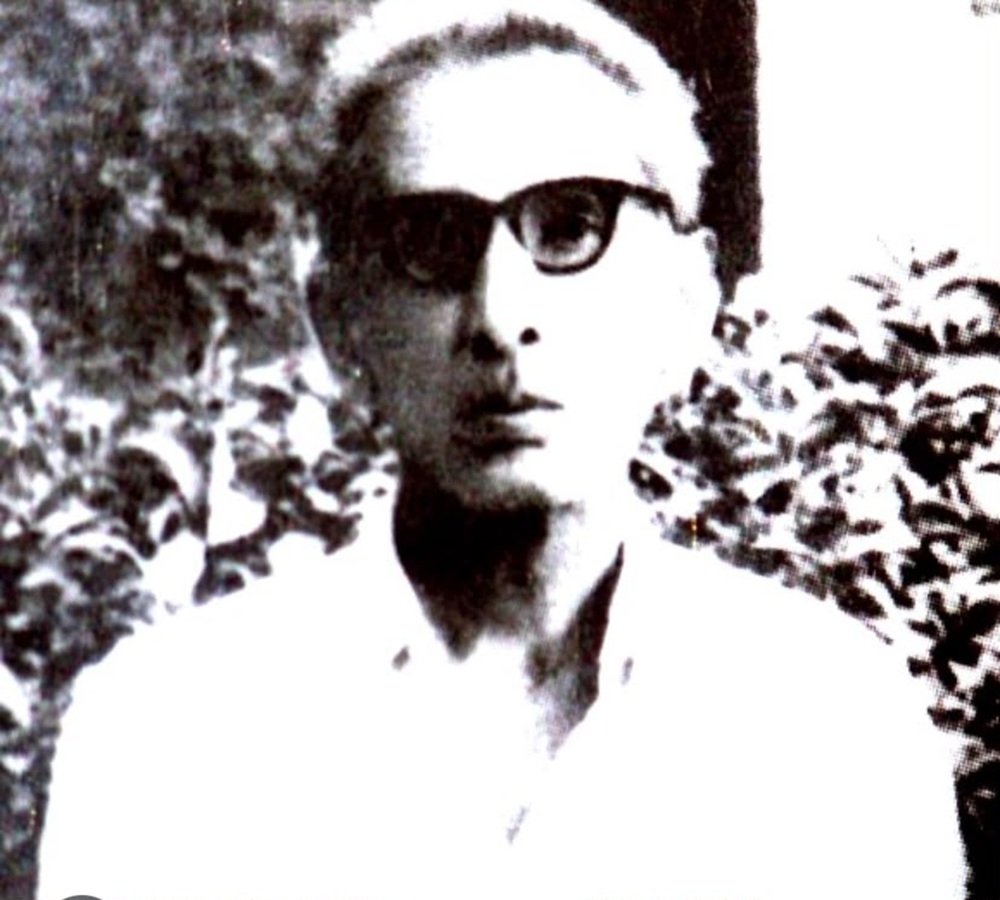
To be sensitive and receptive is to be haunted by the idea of your own absence in this material world, that might strike you in absolute mundane but it has the power to jolt you whatsoever.
Main Roz Idhar say guzarta hu kon dikhta hy Main jab idhar say na guzron to kon daikhay ga? This is the pathway I cross every single day, unseen, unnoticed Who is going to register my absence once I stop passing this way
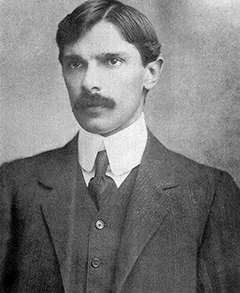
This is Majeed Amjad for you. In his work a peculiar kind of literary justice lingers. Sixty years of life, a single publication, away from the limelight of mushairas of Lahore, cycling to a government food-department office, he was the poet the literary world chose not to see or maybe it was his own choice to stay hidden, maybe he wanted to be discovered after his absence. And yet the manuscript pages found stacked in his small apartment after his death in 1974 contained some of the most original, philosophically dense, and sensuously precise verse in the Urdu language.
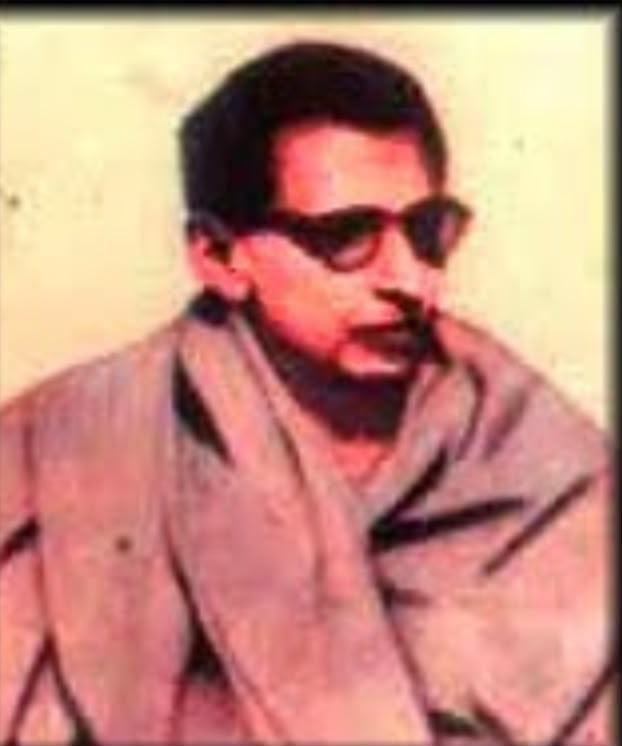
Majeed Amjad
His belated recognition is not merely a story of injustice; it is, itself, an aesthetic fact. Amjad is a poet whose meaning deepens precisely because it was withheld from easy circulation. To speak of the aesthetics of Majeed Amjad is to speak of a sensibility that refuses all available categories. He was not a Progressive, or a Marxist like Faiz, though he despised colonial exploitation. He was not a jadīd (modernist) in the manner of Noon Meem Rashid, whose symbolic obscurities and mythological architectures were antithetical to Amjad’s direct, earth-rooted language. He was not a ghazal poet, though he wrote some remarkable ghazals. He was, in the most literal and unromantic sense, his own tradition a tradition of one, forged in the canal-lit solitude of provincial Punjab, answerable to nothing except the precise weight of Experience. “He wrote poetry for himself, not for an outside human audience. There is a haunting subjectivity in his verse, and then there seems to be a cultivated solitude that by dint of romantic irony serves as his companion.”
The first and most immediately recognizable dimension of Amjad’s aesthetic is his relationship to the visible, tactile, tangible, natural world. Scholars have compared him to Wordsworth, and the comparison, while imprecise, captures something true: Amjad’s attention to the natural world is not decorative but epistemological. He does not use nature as metaphor in the conventional Urdu ghazal sense, where bahār (spring) and khizāṅ (autumn) are pre-coded with fixed significance of either meeting or losings the beloved.
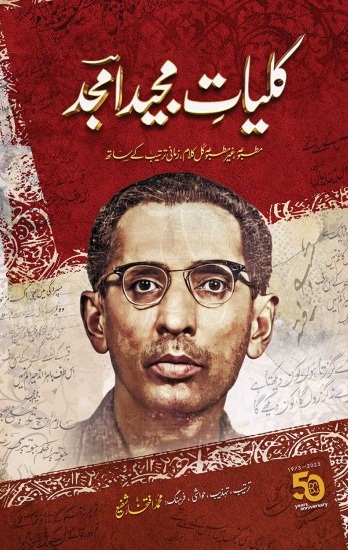
Kulyat-e-Majeed Amjad
Instead, he confronts actual trees, the specific, stately trees along the canal road in Sahiwal and finds in their felling by municipal axes a grief that is simultaneously personal, ecological, and cosmic. This movement from the hyper-local to the universal is Amjad’s defining aesthetic gesture. A brick on a pavement addresses children across time. A dry field becomes a meditation on divine indifference. In his famous poem Kuṅwāṅ (The Well), the water wheel turns ceaselessly while fields go un-watered the divine musician on his cart, absorbed in his melody, indifferent to whether the water reaches its destination. A eulogy of dying nature while the world keeps moving. The image is devastating in its plainness. No mythological scaffolding, no Persianate abstraction. Just the wheel, and the thirst. Research on Amjad’s imagery notes that he functions like a painter specifically compared to the classical landscape tradition of Ustad Allah Bakhsh, engaged in a practice that is neither static nor superficial. His images do not illustrate ideas; they constitute them. This is a fundamentally different aesthetic from the Urdu tradition of mazmūn āfrīnī, the art of elaborating a received theme, and it places Amjad closer to an imagist and phenomenological traditions in Western modernism, though he arrived there independently, through the pressure of his own perception.
If the visible world is Amjad’s grammar, time is his subject. Comparative studies place him alongside the Persian poet Sohrab Sepehri as a poet for whom time is not a philosophical abstraction but a lived, bodily reality something felt in the bones. But where Sepehri tends toward the mystical dissolution of temporal boundaries, Amjad’s treatment of time is tragic. Time in his poetry is inexorable, irredeemable, often cruel, and cruelly indifferent. It neither redeems nor condemns; it simply continues with all it complexity and deterrence. The title of his only published collection, Shab-e-Rafta, or the Night That Has Gone, is itself a temporal elegy, a lament of bygone night. Every title in his corpus points toward loss, passage, the irreversible: Shab-e-Rafta Ke Ba’ad, After the Night That Has Gone.
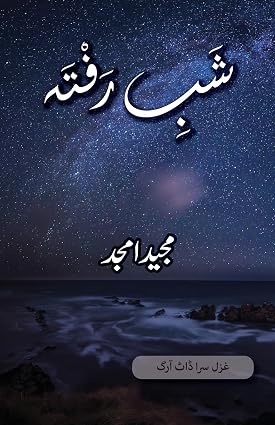
Shab-e-Rafta by Majeed Amjad
Main ek Pal kay Ranj.e. farawan main kho gya Murjha gaye Zamany myry intezar main I have lost myself in momentary grief While the time itself weathered away waiting for me to
Amjad’s sense of time draws on a deep reservoir of Punjabi agricultural experience, the cycle of sowing and harvest, the season that does not come, the crop that fails as well as the broader catastrophes of his historical moment: partition, decolonization, the obliteration of a way of life. His tragic temporality is not individualistic self-pity. It is a philosophical position: the world is not arranged for human flourishing, and to pretend otherwise is to lie.! The wheel turns, but the fields are dry. No harvest, no threshing floor, no grain. The aesthetic force here lies in the gap between motion and consequence, between divine industry and human want. This is Amjad’s existential irony, and it pervades his entire oeuvre with the consistency of a worldview.
Amjad’s formal choices are inseparable from his philosophy of language. Beginning in traditional ghazal and nazm forms, he moved progressively toward free verse not really the symbolist, free verse of Rashid, which uses formal dissolution as a vehicle for mythological intensity, but a quieter kind of freedom: the freedom to let a perception complete itself in exactly the number of words it requires, no more no less . Linguistic scholars have analyzed this as a practice of foregrounding; systematic deviation from standard grammar and syntax to produce aesthetic and semantic effects. His language is notable for its prevalence of Indic-vocabulary, which keeps it close to the spoken rhythms of Punjab and away from the Persianized register that dominates high Urdu literary culture. This linguistic choice is itself an aesthetic manifesto. Amjad refuses the prestige of the cosmopolitan Urdu literary center. He writes from Sahiwal, in the words of Sahiwal, about the experience of Sahiwal and insists, without argument, that this constitutes the universal. His localism is not provincialism; it is a theoretical position about where authentic experience resides. Not in the abstract, not in the mythological, not in the ideological but in the specific pressure of shadow falling across a specific body on a specific afternoon.
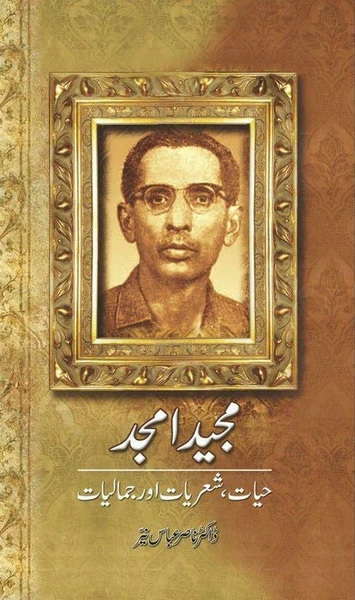
Majeed Amjad - Hayat, Shairyaat, aur Jamaaliyat by Dr. Nasir Abbas Nayyar
The Dawn essayist on his centenary described needing “a new vocabulary close to the earth” to describe him. This captures something essential: Amjad’s aesthetic cannot be decoded through the existing critical apparatus of Urdu literary studies, which was built primarily to analyze ghazal conventions, Progressive social realism, or modernist symbolism. He requires diverse tools that can account for the poetry of radical presence, of the particular as universal, of solitude as a form of knowledge.
Finally, it is impossible to write about Amjad’s aesthetics without acknowledging the aesthetic dimension of his marginality. He was overlooked not because his work was inaccessible or eccentric, but because his work refused to market itself refused the mechanisms by which literary reputation is constructed and sustained: the literary group, the ideological affiliation, the mushaira performance, the self-promotion. He resisted all forms of performity. He worked and reworked his poems alone, rarely releasing them, accumulating manuscripts that were only discovered after his death. This is not merely a biographical fact; it is an aesthetic statement about the relationship between art and institutional recognition. Academic research has confirmed what intuition suggests: his marginalization was a product of literary politics and geography, not artistic inadequacy. The poet who lived in Sahiwal could not attend the Lahore salons; the poet who joined no movement received no Movement's advocacy. And yet the absence of advocacy produced a peculiar purity a body of work entirely unbeholden to fashion, entirely answerable only to experience and craft. Amjad’s aesthetics are, in this sense, the aesthetics of integrity: not purity as abstinence, but purity as the refusal to falsify. What remains is a voice of extraordinary distinctiveness: grounded in Punjabi earth, haunted by time, alert to every stray bird and shadow, speaking a language that is both intimate and philosophically serious. To read Majeed Amjad is to inhabit a solitude that turns out, astonishingly, not to be lonely at all because it is furnished, floor to ceiling, with the whole weight of the world.
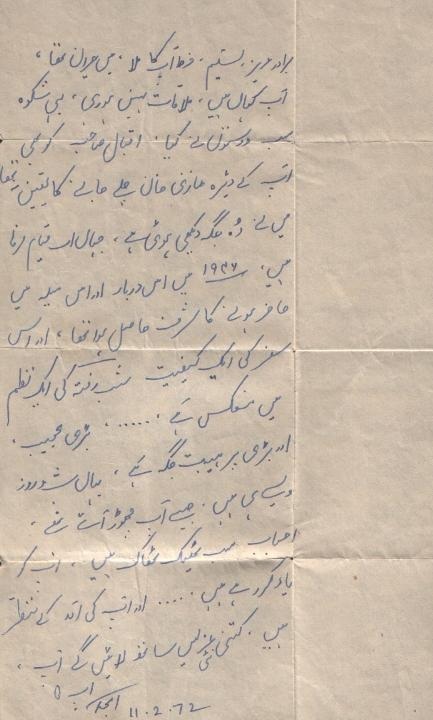
Majeed Amjad's poetry in his own handwriting
Like his verse Bary saliqay say Dunia ny myry dill ko diye Wo ghao jin main tha sachaiyo’n ka charcha bhi This world has bestowed me with pain so elegantly, the pain with bitter echo of truth with it.
He is a poet who would not let you sit alone with grief; he will also inform you of the truth that comes with grief.
You may also like: