Written by: Prof. Dr. Mamoona Khan
Posted on: January 29, 2026 |  | 中文
| 中文
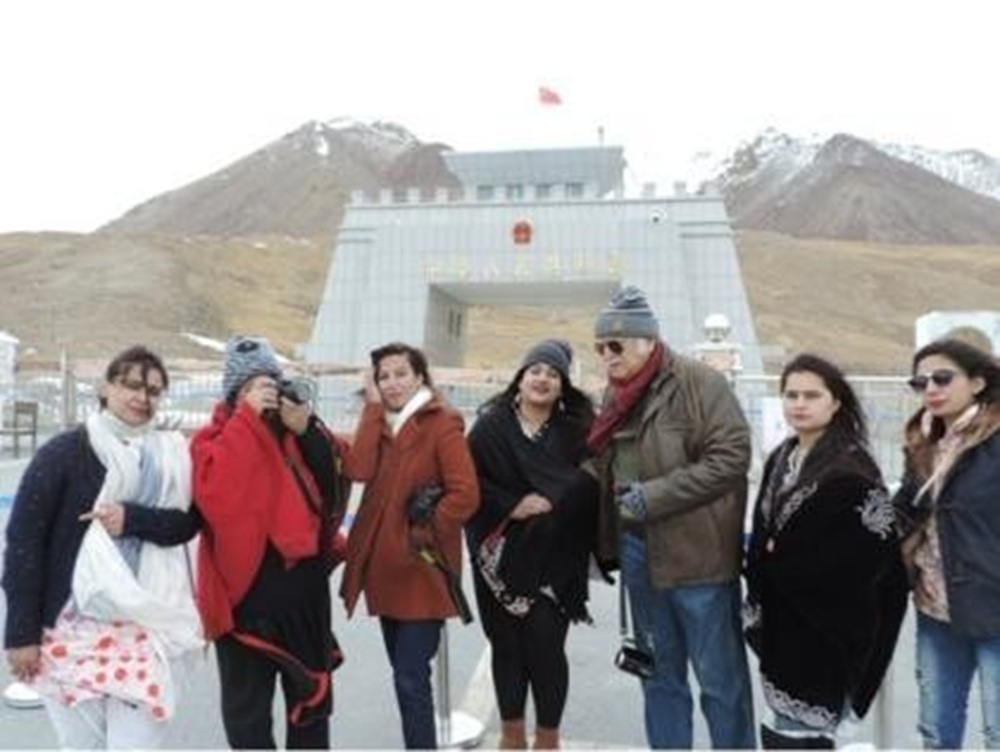
Dr. Shaukat Mahmood with students at Khunjerab Pass in 2020.
Great people are not born great but their conduct makes them eminent, analogous to a genius. Interpreted similarly by the modern intellectuals, as Thomas Elva Edison’s (1847-1931) insightful statement, “genius is 1% inspiration and 99% perspiration.” While Albert Einstein (1879-1955) elaborated further and defined, “genius is taking the complex and making it simple.” Both the quotes reflect upon the lives of the two universal giants; one stressing on hard work and the other on culmination of hard work. Combining both formulates the intellect of Prof. Dr. Shaukat Mahmood, better famous as Maxim, the personage to be discussed in this article. A professor by profession, a renowned cartoonist, a writer of books and hundreds of articles, reflected on Pakistan television upon architectural edifices of Pakistan from 1994 to 1998, made thousands of cartoons from 1958 to date in national and international magazines and newspapers, etc. It is difficult to analyze and encompass his traits within a few lines; this article will focus only initiation of his journey as Maxim and as a Professor.
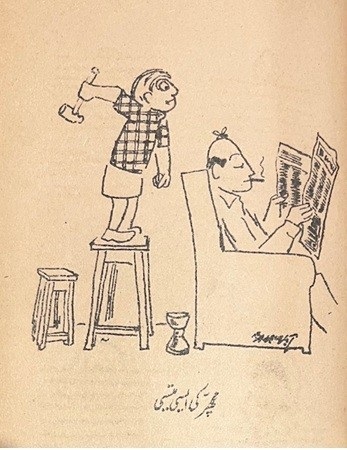
A cartoon from Dhol ka Pol, 1961, by Dr. Shaukat Mahmood
Born in Peshawar in 1940 in a family of six siblings, he being the youngest. Recalling 1947, when his father was an income tax officer and posted in Dehli, while they were in Gujrat, lost all contacts for a few months with their father because he had to arrive in a train which was brutally massacred. He recalls grimness of the situation from August to October when he arrived safely after bearing many hardships. In 1948, within one year he was posted and transferred rapidly, first in Gujrat, then Rawalpindi and eventually to Lahore where laid the destiny of his children. He recalls those days’ first his was given accommodation in a deserted school, then the family was shifted to government quarters on Multan Road, 48-B was the number of the quarter, he still vividly remembers. Nearby this quarter there was a primary school in one of the small quarters, he was admitted there. Finally, government provided them an upper story of a vacated house left behind by a Hindu family. The house was on Onkar Road in Krishan Nagar. Most of the housed and havelis were lying vacant and deserted providing scary scenes. Krishan Nagar was an upcoming project of Hindus and most of them still retained the enamel-plated saying, “Build your house in Krishan Nagar”. Discussing honest nature of his father, he recalls that many people asked him to claim for a house which was meant for the immigrants from India but he refused to do so.
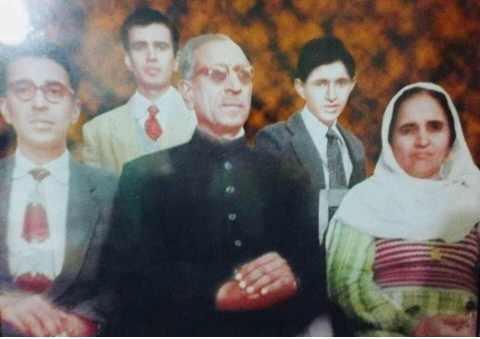
Dr. Shaukat Mahmood (second from right) with his parents and elder brothers.
Dr. sahab passed matriculation in 1956 with 1st division from the Chishtiya High School, Krishan Nagar, which still exists there, and his father aspired him to get admission in G. C. Lahore, the most prestigious academic institution, opting the field of medical or engineering but he was offered admission in Arts and humanities. Allah was paving the way of his future discourses. So, he completed intermediate and graduation in 1960 with a Certificate of Merit, opting Fine Arts and Economics as the main subjects. After the retirement of his father begins his journey as Maxim the cartoonist.
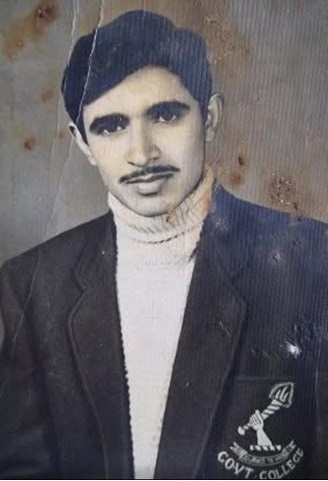
Young Shaukat Mahmood as a student of Government College, Lahore, in 1956-62.
In the quest to support the entire family because pension of his father, as an honest man was very meager, though retired from a respectable position. Shaukat Sahib met his teacher Professor Khalid Iqbal at the Fine Arts Department of Punjab University; to find a way for him to continue his studies. Many eminent personalities from every walk of life used to visit Khalid Sahab like Faiz Ahmed Faiz, Bashir Mirza, Shakir Ali, Munir Niazi, Hanif Ramay, Anwar Ali, Moeen Najmi, Safdar etc. Hanif Ramay in those days used to publish Nusrat, a weekly magazine and Khalid Iqbal Sahib inquired Shaukat Sahib about his capacity to make cartoons and he agreed that he would try, although he had not done it before Thus, he got his first employment for Rs.50 per month to make cartoons for the center-spread of the magazine Nusrat. So, he had to make almost 50 cartoons a month. Here, he found an opportunity to meet eminent people of various fields, like writers, poets, artists, etc.
He used to sign his cartoons by writing his full name but Munir Niazi the famous poet in the times to come, suggested him to formulate some sobriquet instead of writing the full name. It was a time when one of the books of the Russian writer Maxim Gorky was published by Maktaba-i Jadeed of Hanif Ramay. Munir Niazi suggested him the epithet Maxim Shauki, then gradually it was filtered out to Maxim only, which I think is proved in future as the most relevant title, fit for his personality and endeavors. Wise sayings/maxims are spread in the best way through a sense of wit which is embedded in the personality of Dr. Sahib.
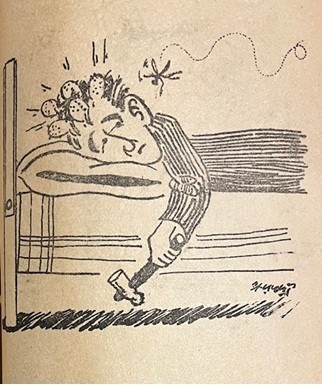
A cartoon from Dhol ka Pol by Dr. Shaukat Mahmood.
Munir Niazi further introduced him to the magazine, Director, which was a filmi magazine and he had to make cartoons on filmi songs that strengthened his humorous sagacity. He was offered a stipend of Rs.150, but added with another work. He had to answer the questions of people forwarded to the magazine because it was a common practice of different magazines and still exists in a few that people send questions on various issues or notions and the editor had to answer them. Laughingly he described that a few questions were forwarded by people and the rest he had to formulate himself and also their answers because certain amount of space was to be filled in, necessarily. Interesting part of the story is that after sometime his pay was stopped but he continued to contribute both ways. Feeling ashamed, the editor one day called him and said, “you are keeping on contributing even being not paid, please have this key and take my car as you remuneration of so many months”. It was an old Fiat-600, which added funny incidents in his witty nature, like, he recalls that water in the carburetor used to boil out during their journeys but still he attended with his family two weddings in Gujrat and Sialkot on the same car. Stopped, cooled, refilled the carburetor and began for the destination again, because it was in his cool nature, “not to surrender before odds.” The culmination occurred when one day he was travelling with an elderly relative, sitting with him on the front seat and suddenly floor of the car collapsed and the seat started dragging on the road. He again laughed and said, “it was an end and the car was sold.” At this point Dr. Sahib stopped for a while, smiled and said that the purpose of narrating those incidents is to tell our younger generation about the facts of life, greater positions are not achieved over night, continuous struggle makes the journey rewarding.
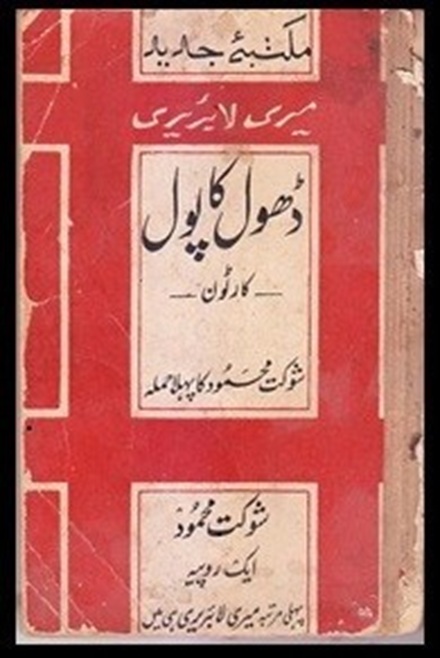
First published book on cartoons, Dhol Ka Pol, by Dr. Shaukat Mahmood.
Civil and Military Gazette, famous as C&MG was another daily newspaper, published simultaneously from Lahore, Karachi and Simla, where Dr. Sahib started contributing his cartoons further with a pay of Rs. 250. Its office was on the Mall Road, where the famous Panorama Center exists now. Amusingly, he told that making cartoons for three different places gave him enough salary to support his mother, father and even contribute in the fees of his elder brothers, which he was doing from the day first when he was earning only Rs. 50. Again, recalls some humorous incidents. After gaining ample amount of money, he along with his friend Safi Sardar, his one-year junior in the university, used to have some luxury amusements. They went to the Beadon Road, adjacent to the C&MG and bought One Chatank Gajar ka Halwa (1/16kg. dissert of carrots), both enjoyed eating that very little amount of halva. Sometimes they used to drink lassi (a sweat drink: mixture of yogurt and water), this time from Old Anarkali. After regular visits, the shopkeeper got acquainted with him and one day frankly asked them to sit inside the shop to enjoy the drink. While sitting inside, their gaze struck on the large flat terracotta plates called koonda in Urdu (in which milk was fermented to create yogurt), placed one over the other. Both were shocked to see mice freely running over them. He again laughed at their last visit to the shop and to lassi.
Time passed on and Dr. Sahib completed Masters in Fine Arts from the University of the Punjab, Lahore, with 1st class 1st position and a Gold Medal and joined UET, Lahore as a lecturer in December, 1962 in the Architecture department. He is amongst the founding fathers of the Architecture Department of UET. Many memorable incidents of his journey at both the institutions are worth reading, and will be shared in the next article. But just a glimpse of his rapid growth from a lecturer to a Professor and Dean Architecture and Planning, where he won scholarship to study in UK, first he joined Heriot-Watt University, Edinburgh for his M.Sc. in Environmental & Architectural Conservation then University of Edinburgh for his Ph.D., in Islamic Architecture. The world-renowned scholar Prof. Dr. Robert Hillenbrand had the privilege to become his supervisor at Edinburgh University. He still remembers him in golden words. While presenting him a book, posted from Edinburgh on 2nd December 2025, he wrote inside the cover page, “With profound respect, admiration and lasting affection-and with heartfelt thanks for lots of happy memories-to a Ph.D. student in a thousand.” Once, Sir Shaukat Mahmood said a good student is always ahead of his teacher like Plato who was a student of Socrates, Aristotle, the student of Plato and Alexander the student of Aristotle, and so is he.
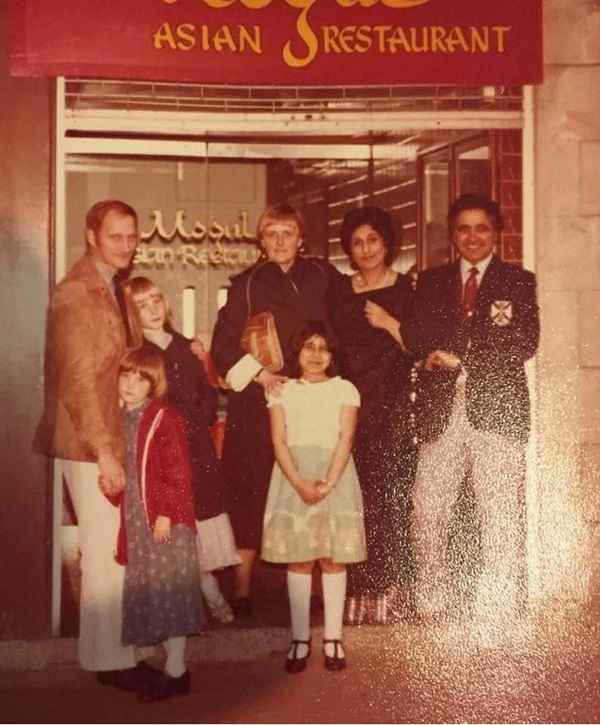
Dr. Shaukat Mahmood and his wife with Prof. Dr. Robert Hillenbrand and his family.
Reminiscences of his last days in Edinburgh, when the local community arranged a farewell in a nearby hotel, and also invited his teacher Dr. Robert Hillenbrandt. Many people delivered speeches along with his teacher, who audaciously said, “Shaukat do not go back, you are not made for Pakistan.” It seems true, because after contributing in the education sector in Pakistan for not less than eight decades, when he applied for the status of Professor emeritus, no one supported him, not colleagues; most of them his students, and even not the VC of the Punjab University.
You may also like: