Written by: Tehzeeb Hussain
Posted on: October 28, 2026 | 
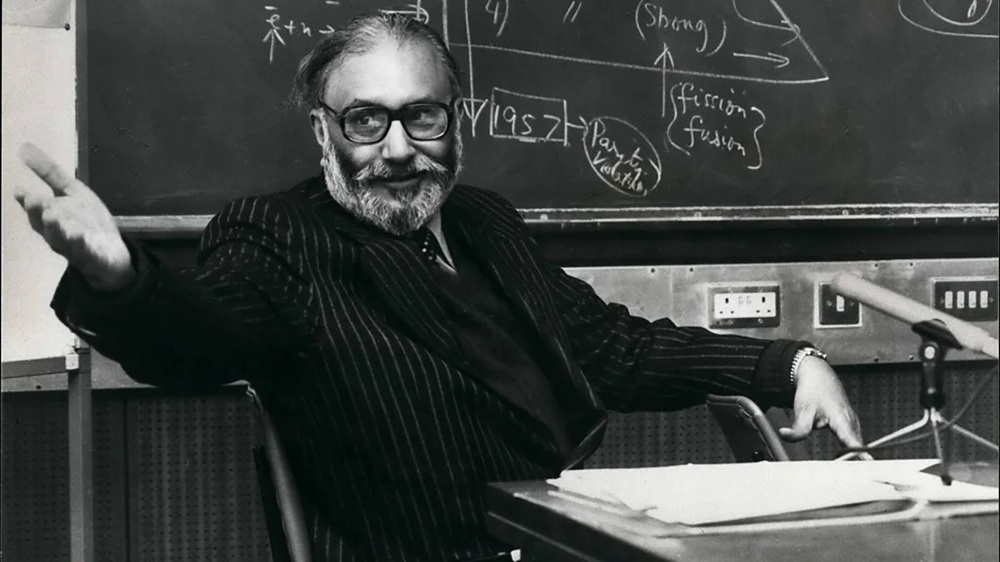
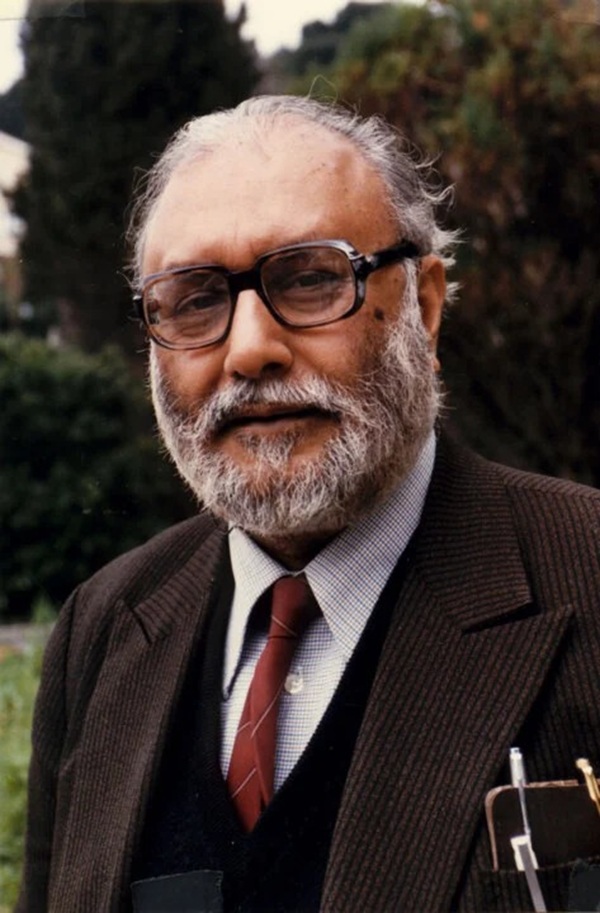
Salam teaching at the Imperial College, London
The world celebrated Abdus Salam’s 100th birthday on 29 January, 2026. The most important celebrations were organised by the Abdus Salam International Centre for Theoretical Physics (ICTP), the institute was a brainchild of Abdus Salam, which organised year-long events, beginning on 27 January and ending on 21 October, to commemorate Salam’s centennial birth anniversary. Major events organised by ICTP included four: Salam Distinguished Lectures 2026, Lecture Tour in India (23rd February in Bengaluru, 25th February in Delhi, 28th February and 2nd March in Mumbai), The Trial of Abdus Salam (play), and many other events in different fields of Physics.
Other ceremonial events were commemorated at Imperial College London, Magdalen College, Oxford University, The World Academy of Science dedicated its 17th General Conference at Rio de Janeiro to Abdus Salam, and others. In Pakistan, there were no significant official events organised by the government, but there were a few independent events organised, which included one at The Black Hole in collaboration with ICTP and Physics Without Frontier (PWF, Pakistan), another at COMSATS University under the title “Living Among Giants,” and the last one, “A Noble in Exile: Abdus Salam’s Physics, Faith, and Global Vision,” a lecture by Pervez Hoodbhoy. Additionally, many newspapers, magazines, and world-renowned institutes of Physics published articles with themes revolving around Abdus Salam’s work, life, his contribution to science, and his timeless legacy in the world of science. These written works included “Celebrating 100 years of Abdus Salam” by Eleannor Barrand, and “Celebrating 100 Years of Abdus Salam: A Lasting Legacy in Theoretical Physics” by World Scientific. These events signify how much Abdus Salam meant in the world of Physics, in particular, and of Science, in general. This piece is an effort to bring his marvellous achievement into the spotlight.
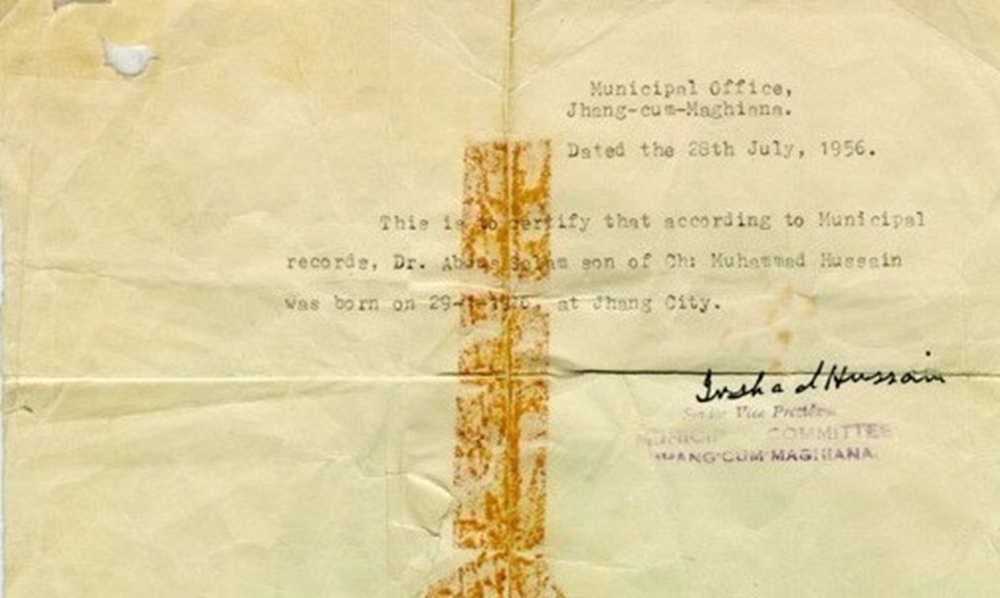
Salam’s Birth Certificate. The image has been taken from Dawn's report on Salam, published in 2018
The greatness of Salam can be substantiated with three dimensions: first, his extraordinary rise despite the humble circumstances he was born in; second, his contribution to physics’ most fundamental problem in which he unified two forces, electromagnetic and weak, of the four forces that exist in nature; and third, his ability to translate his love for physics into tangible institutions and his struggle for the development of science in the Third World. What Salam achieved in seventy years of his life is quite a dream for the majority of the people in the world, even many people working in the field of Physics.
Abdus Salam was born in a place named Jhang in Pakistan. Jhang is known for two people in Pakistan: one is Heer – a cultural symbol of love in Punjab – and Salam – a symbol of a fine scientific mind. He was born to a very humble family, and it is said that his town had no access to electricity, so he studied under candlelight. In Salam’s own words, he introduced himself during a speech he delivered in Stockholm: his father was a teacher and educational official in the Department of Education, and his mother was a housewife. He had 6 brothers and 1 sister. His family was by no means rich. From these circumstances, where he did not have resources to get the best education in his own country, living in a place without access to electricity, growing up in a newly created country which was filled with myriad crises, and despite facing religious persecution at home and racism outside it, he went on to become one of the most famous people in the world and marked his name among the greatest minds humanity ever produced.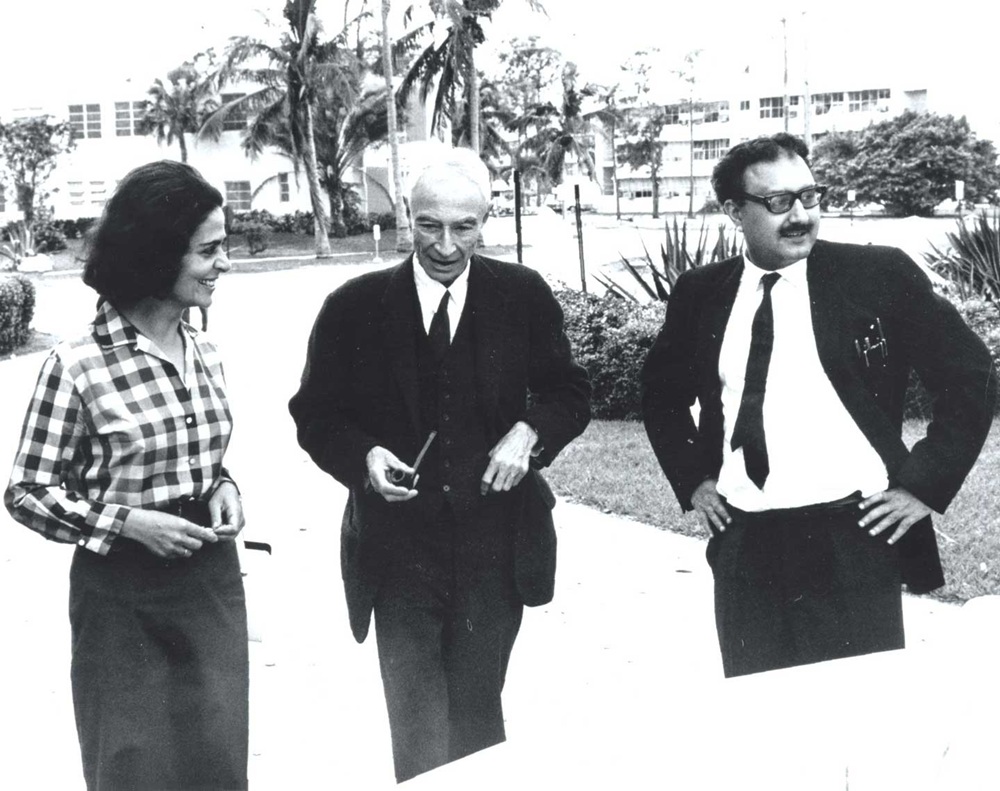
Oppenheimer with Dr. Salam, accompanied by Sveda Noor, at the University of Miami - 1965. The photo has been taken from salamexhibition.uk
In the field of Physics, Salam’s contribution partially solved one of the most fundamental problems in our understanding of the universe, that is to understand the origin of all the forces that govern the physical interaction and determine the behaviour of matter in our universe. Those four forces are: 1) strong force, 2) weak force, 3) electromagnetic force, and 4) gravitational force. Abdus Salam, working for almost two decades, laid out a mathematical foundation of what is now known as the Standard Model of Particle Physics, in which his main contribution was the unification of two forces of the universe. Salam proposed that the origin and carriers of electromagnetic force and the weak force are the same and theorised it in electroweak theory – the term “electroweak” was coined by Abdus Salam. For this work, he was awarded the Nobel Prize in 1979, which he shared with Sheldon Glashow and Steven Weinberg.
During his career, after completing his PhD in Theoretical Physics in 1952, at the age of 26, from the University of Cambridge, he spent his life working as a professor, researching in theoretical physics in Pakistan and beyond, and establishing institutes around the world. After returning to Pakistan in 1952, he initially served as the professor of mathematics at Government College; alongside he chaired the Department of Mathematics in University of Punjab. But he left Pakistan for Cambridge in 1954 after anti-Ahmadi riots that set the country on fire. After returning to Cambridge, he served as a professor, but later moved to Imperial College, where he taught and set up the Department of Theoretical Physics. While in exile, his love for his country never diminished. In the 1960s, when the atmosphere in Pakistan became suitable, he returned and began working on multiple projects and played a key role in many of the scientific institutes and organisations that we see in Pakistan today.
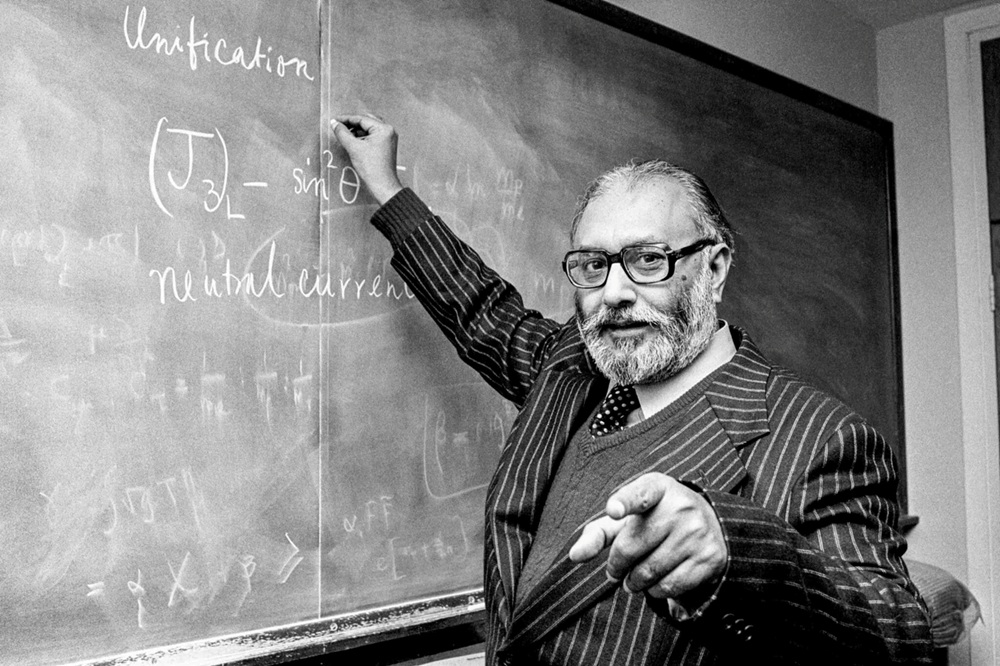
Salam teaching his electroweak theory. The image has been taken from Imperial College London's blog post on his centennial birth anniversary
In 1961, Salam, as a Scientific Advisor for the Government of Pakistan, advised Ayub Khan to establish a space agency, which led to the establishment of the Space and Upper Atmospheric Research Commission (SUPARCO). Later, he participated in the creation of the Pakistan Atomic Energy Commission, Pakistan Research Reactor (PARR-I) which is located in Pakistan Institute of Nuclear Science and Technology (PINSTECH), Nilore, Pakistan Academic of Science, International Nathiagali Summer School (a project aimed at bringing together scientists from different developing countries to provide an opportunity to learn from each other), and National Centre for Physics (which was created late in 1990s but the original idea of the centre was of Abdus Salam). Abdus Salam was also the central figure during the initial phase of Pakistan’s Project-706, the nuclear project of Pakistan. On the advice of Zulfiqar Ali Bhutto, he left for the United States to avoid the 1971 Indo-Pak war but returned in 1972-73 with scientific literature and calculations necessary to develop a nuclear bomb. In 1974, when Pakistan officially began its efforts to acquire nuclear power in response to India’s nuclear test the same year, Salam prepared a team of scientists and utilised the institutions that he already established to work towards making Pakistan a nuclear power.
Internationally, Salam contributed to many programs and the establishment of organisations that worked toward creating a scientific culture of research, but his most significant contribution was the creation of the International Centre for Theoretical Physics in 1964. The objective of the centre was to create a platform where nuclear research was to be conducted, with the mission to provide opportunities for countries where science was still in a developmental phase. The institute was renamed the Abdus Salam Institute of Theoretical Physics in 1997. Today, the institute has a presence in South America as ICTP-SAIFR (South America Institute for Fundamental Research), in Africa as ICTP-EAIFR (East Africa Institute of Fundamental Research), and in Asia as ICTP- Asia Pacific, located in Beijing, China, and it provides generous funding for research in Physics and the promotion of science in these regions. Through this cross-border presence, the institute is living up to the spirit of Abdus Salam, who believed that science is a universal heritage and that access to it should transcend borders, empowering minds everywhere to contribute to humanity’s collective progress.
Abdus Salam is remembered as one of the most important Physicists of the 20th century, an ambassador of developing science in Third World countries, a prolific life who had the ability to materialise his visions in the form of institutes, and a person of great intellect who understood cultural and scientific realities equally. He lived a truly incredible life despite his circumstances and the difficult times he faced in Pakistan and abroad.
You may also like: