Written by: Maysum Khan
Posted on: October 27, 2026 | 
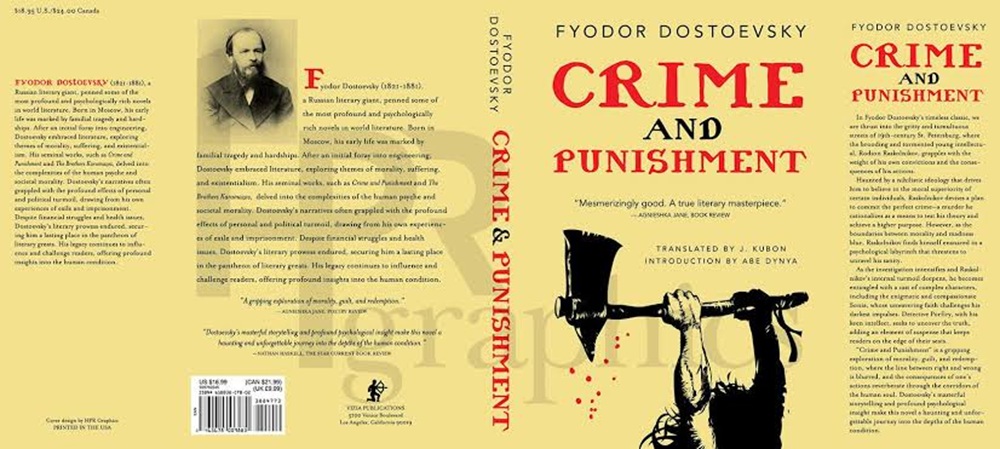
Sleeve of Fyodor Dostoevsky's psychological novel Crime and Punishment
Can a person truly escape the guilt of a crime, or does the conscience continue to haunt them long after the deed is done? This question lies at the heart of Fyodor Dostoevsky’s Crime and Punishment, a novel that explores the human mind, moral responsibility, and the struggle between right and wrong. Dostoevsky is known for his ability to portray human emotions and inner conflicts realistically. Through his writing, he shows how a person’s circumstances, ambitions, and decisions can shape their behaviour and influence their sense of right and wrong.
Published in 1866, Crime and Punishment is one of Dostoevsky’s most celebrated works. The novel follows a young man whose decision to commit a crime leads him into a painful struggle with his own conscience. Through his experiences, Dostoevsky explores guilt, the limits of reason, and the possibility of redemption. Rather than focusing solely on the crime itself, the novel examines the emotional and psychological consequences of human actions, making it a powerful and lasting reflection on human nature.
Published in 1866, Crime and Punishment is set in the stifling summer heat of St. Petersburg and follows Rodion Raskolnikov, a brilliant but impoverished former law student. Living in a cramped room, he becomes obsessed with the idea that extraordinary individuals can break moral laws for a greater purpose. Believing himself to be one of them, he decides to test his theory by murdering Alyona Ivanovna, a pawnbroker who exploits the poor. However, when her half-sister Lizaveta unexpectedly enters, he kills her as well. Although he steals a few valuables, he never uses them. Instead, he becomes consumed by fear, paranoia, and self-loathing, finding himself unable to escape the burden of what he has done.
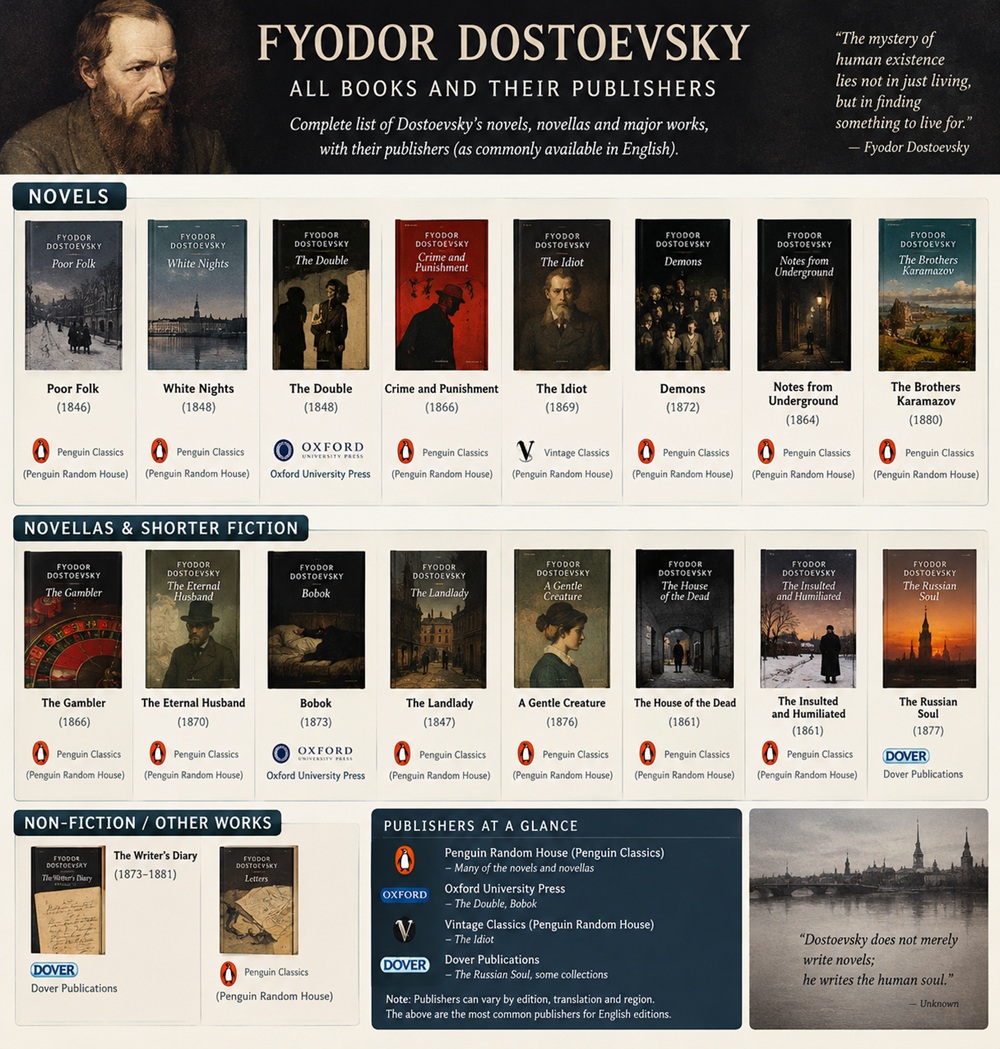
Dostoevsky’s books and their publishers
As the story progresses, Raskolnikov meets Sonia Marmeladova, a compassionate young woman who turns to prostitution to support her impoverished family. Despite her circumstances, she retains her kindness and faith, offering him a sense of understanding that he struggles to find elsewhere. Meanwhile, Porfiry Petrovich, the investigating magistrate, grows suspicious of Raskolnikov and uses psychological questioning to challenge his explanations. Raskolnikov’s sister, Dunya, considers marrying the manipulative Luzhin to help her family, while his loyal friend Razumikhin provides support and companionship. Eventually, unable to bear his isolation, Raskolnikov confesses to Sonia, who urges him to accept responsibility for his actions. He later surrenders to the authorities and is sentenced to eight years of penal servitude in Siberia, where Sonia follows him. In the epilogue, his emotional walls begin to crumble, opening the way for love, personal change, and the possibility of spiritual renewal.
Crime and Punishment is a powerful example of psychological realism, as it explores how a person’s thoughts, emotions, and beliefs shape their actions. Rather than portraying crime as a simple struggle between good and evil, Dostoevsky delves into the motives and inner conflicts that can lead someone to commit a terrible act. Raskolnikov is a complex character who cannot be described as entirely good or evil. Although he is intelligent, proud, and capable of compassion, his desire to rise above his poverty and his belief in his own superiority lead him to justify murder.
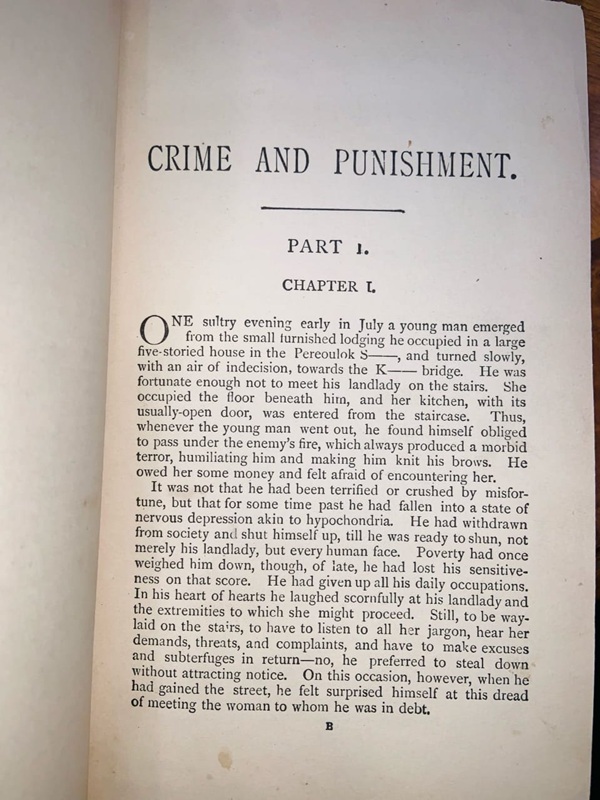
Opening page
One of the novel’s greatest strengths is its portrayal of psychological suffering. After committing the murders, Raskolnikov becomes anxious, confused, and increasingly isolated. His feverish episodes and troubled state of mind reveal how deeply the crime affects him. As the story progresses, his inner struggle becomes just as important as the investigation itself. Through Raskolnikov’s experience, Dostoevsky suggests that people cannot easily silence their conscience or escape the consequences of their actions simply by convincing themselves that they were justified.
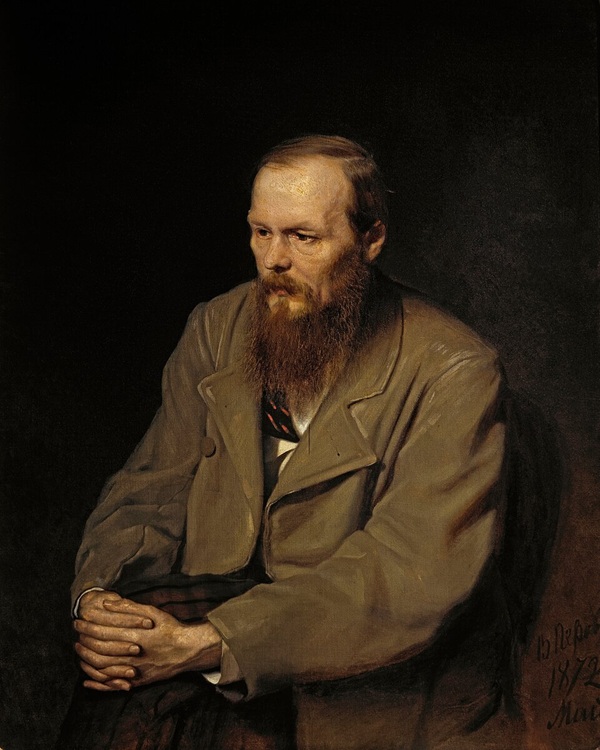
Portrait of Fyodor Dostoevsky
The novel also challenges the belief that violence can be justified for the greater good. Raskolnikov convinces himself that killing a supposedly worthless person might benefit society. However, his actions expose the danger of believing that some individuals have the right to decide whose life has value. His theory overlooks the dignity of human life and the moral consequences of treating others as expendable.
Another important aspect of the novel is its portrayal of poverty and social inequality. The harsh living conditions in St. Petersburg, the struggles of the Marmeladov family, and the pressure Dunya faces to secure her family’s future reveal how financial hardship can limit people’s choices. Through these characters, Dostoevsky presents a society in which poverty often forces individuals into painful and difficult situations.
Dostoevsky’s vivid descriptions and gripping dialogue help readers understand Raskolnikov’s troubled mind and experience his fear, confusion, and inner struggles. However, some of the lengthy philosophical discussions and repeated descriptions of his thoughts can make the story feel slow at times. Even so, the depth of the characters and the realistic portrayal of human emotions make the novel a memorable and thought-provoking read.
Although the novel’s emphasis on religion and spiritual redemption may not appeal equally to every reader, its exploration of human psychology remains deeply relevant. Dostoevsky does not offer easy answers to the questions he raises. Instead, he encourages readers to reflect on the dangers of pride, the limits of reason, and the importance of taking responsibility for one’s actions. It is this combination of psychological depth and moral complexity that makes Crime and Punishment such a lasting and thought-provoking work.
The central message of Crime and Punishment is that no one can escape moral responsibility simply by relying on intelligence, ambition, or the belief that their actions serve a greater purpose. Through Raskolnikov’s journey, Dostoevsky challenges the idea that certain individuals are entitled to place themselves above ordinary moral laws. The novel reminds readers that every human life has value, regardless of a person’s wealth, social status, intelligence, or usefulness to society.

Crime and Punishment TV series, 2007
Dostoevsky also explores how guilt can become a punishment in itself. Raskolnikov’s inner suffering begins long before he faces the law, showing that the burden of a guilty conscience can be more painful than physical punishment. Yet the novel does not leave him without hope. Through suffering, love, and Sonia’s compassion, he begins to recognise the possibility of change and redemption. Despite her own hardships, Sonia becomes the moral heart of the story, showing that kindness and faith can offer a path towards healing and a new beginning.
More than 150 years after its publication, Crime and Punishment remains relevant because it explores questions that people still struggle with today. One of its central concerns is whether a good purpose can ever justify terrible actions. This question continues to arise in discussions about ideology, extremism, and the abuse of power. Raskolnikov’s isolation, resentment, and belief in his own superiority reflect how people can become so convinced of their ideas that they begin to believe ordinary moral rules do not apply to them.
The novel’s influence on literature and philosophy is equally significant. Its deep exploration of human psychology helped shape the modern psychological novel and influenced later writers, including those associated with existentialism. Its continued adaptations for theatre, film, and television also reflect its lasting appeal. Ultimately, readers continue to return to Crime and Punishment because it raises difficult questions without offering simple answers. It encourages us to reflect on our own beliefs, the consequences of our choices, and what happens when our convictions come into conflict with our conscience.
Crime and Punishment remains a powerful literary work because it explores the consequences of crime beyond the act itself. Through Raskolnikov’s struggles, Dostoevsky shows that intelligence without compassion can lead to moral blindness, while Sonia’s kindness demonstrates the healing power of love and humility.

Portrait of Rodion Raskolnikov, the troubled protagonist of Crime and Punishment
Despite some weaknesses, including the novel’s coincidences and hurried epilogue, its psychological depth and enduring message make it a remarkable achievement. Ultimately, Dostoevsky reminds us that our actions carry consequences and leaves us with a timeless question: can we truly find peace without coming to terms with ourselves?
You may also like: