Written by: Fatima Bercha
Posted on: November 16, 2026 | 
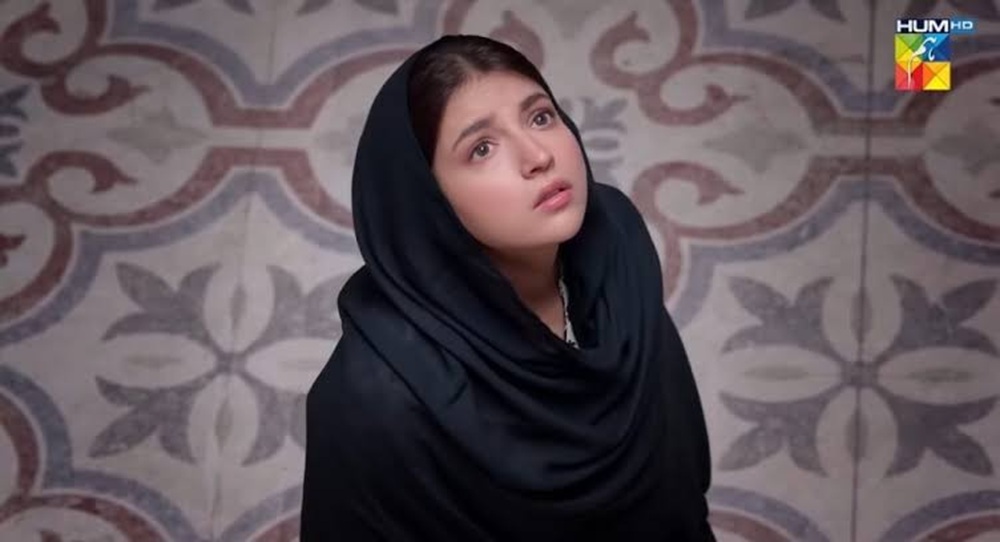
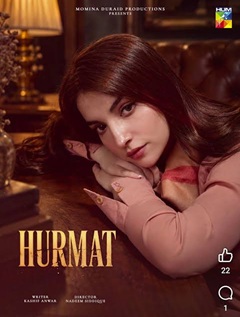
Hurmat looks beyond the walls of her home, longing for a life and opportunities that remain out of her reach
Family honor is considered a form of collective identity in many traditional households and something that must be protected through obedience, conformity, and adherence to established social expectations. However, for women, this understanding of honor comes with restrictions on education, mobility, personal relationships, and the freedom to make independent decisions. HUM TV’s ongoing drama Hurmat, written by Kashif Anwar and directed by Nadeem Siddiqui, brings this familiar yet important social conflict to the screen.
Starring Dananeer Mobeen in the titular role, the drama follows a young woman whose aspirations for higher education and independence clash with her father’s rigid authority. While its premise follows a familiar Pakistani television narrative, Hurmat raises a question that deserves more attention: when does the desire to protect family honor become a justification for controlling another person’s life?

Akram’s strict control over his daughter leaves little room for discussion, disagreement or personal choice
Rather than treating women’s freedom as an act of rebellion, the drama offers an opportunity to reconsider the relationship among family values, individual dignity, and personal autonomy. At the center of Hurmat is a young woman who wants to pursue higher education but finds herself trapped by the restrictions imposed by her father, Akram (Ali Tahir). Despite completing her bachelor’s degree, Hurmat is not allowed to continue her education as she wishes. Her father’s controlling behavior extends beyond education to her everyday moments and personal choices, creating an environment in which fear becomes part of family life. Her paternal uncle, a role played by Javed Sheikh, provides an alternative source of support, helping her discover opportunities beyond the boundaries of her home. Her university life introduces her to a different social environment, friendships, and the possibility of developing an identity beyond the expectations imposed upon her. The narrative also introduces Tabish (Shahveer Jafry), whose relationship with Hurmat adds a romantic dimension to the story, but Hurmat wants to pursue a future of her own. The central conflict is established effectively in the drama’s opening. However, the subject demands more than a conventional story of a strict father and an ambitious daughter.
Its real potential lies in examining social attitudes and psychological mechanisms that allow controlling behavior to be presented as parental protection. The Social Message: Rethinking the Meaning of Honor
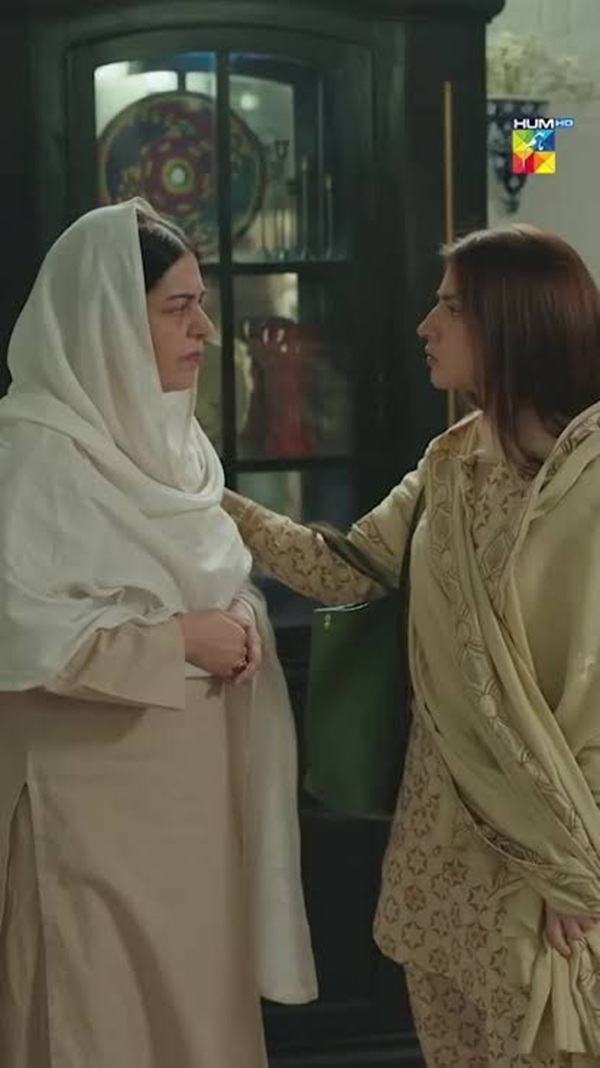
Hurmat and her mother share a household where fear and silence have become part of everyday life
Hurmat’s depiction of the limitations imposed on women’s independence and education within conventional family structures is among its most pertinent features. A daughter’s choices are often viewed as extensions of the family’s reputation rather than as expressions of her personal goals. The well-known phrase “log kya kahengy” frequently becomes a potent tool for social control. While a woman’s personal viewpoint is rarely taken into account, decisions about education, friendships, attire, movement, and marriage may be justified in the name of protection. The drama challenges the audience’s conception of familial honor. An individual’s rights do not always have to be sacrificed to show respect for parents and family customs. A woman’s education or personal development should also not be seen as a danger to her family’s dignity. The issue is not whether parents should guide their children. Parental guidance is a natural part of family relationships. The difference is between control and direction, between caring about a child’s welfare and denying her the capacity to make her own judgments. Hurmat’s greatest societal reference can be found here. Its main role stands in for women who have little control over their own lives but are required to uphold family honor.
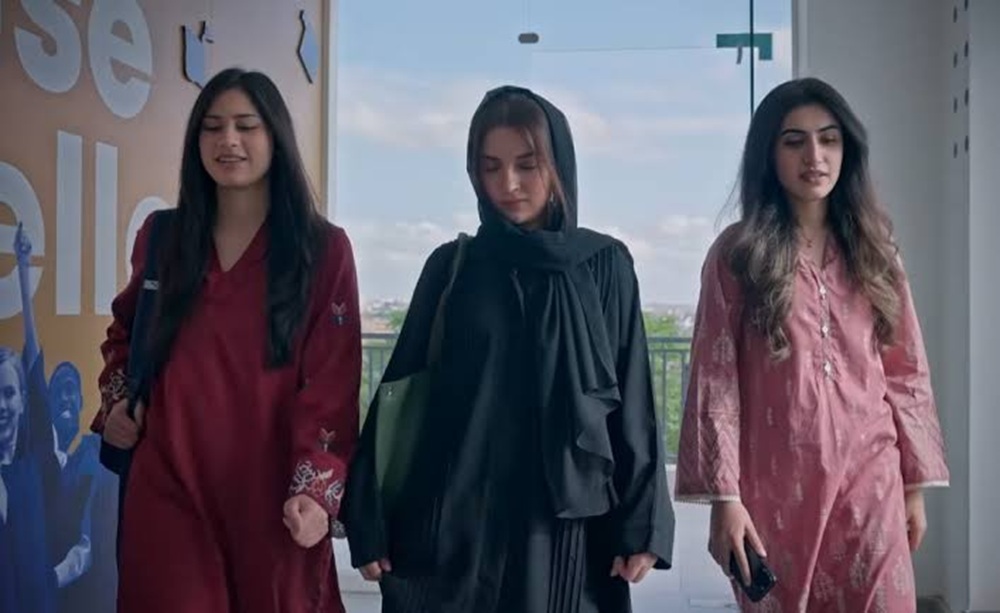
University opens a new chapter in Hurmat’s life, introducing her to experiences and friendships beyond her household
The serial’s emotional core centers on Hurmat’s character. She is trying to forge an identity in a setting where her goals are constantly questioned, not just the permission to go to college. Her battle illustrates the psychological effects of limited childhood freedom and the ongoing pressure to conform to social norms. Dananeer Mobeen approaches the role with emotional sensitivity and vulnerability. Hurmat’s dissatisfaction and anxiety are evident in her portrayal, especially when the character must choose between her goals and the repercussions of defying her father’s authority. Dananeer also explores a more complex emotional spectrum in this character. As Akram, Ali Tahir creates an atmosphere of power and dominance that permeates the home. His portrayal captures the menacing presence of a father whose conception of control is intimately linked to protection. However, the character would benefit from greater psychological depth. Without justifying his actions, examining the sources of his convictions, intentions, and personal fears could make him a more nuanced symbol of patriarchal authority. As Hurmat’s encouraging uncle, Javed Sheikh adds warmth and comfort to the story. His persona offers a crucial contrast to the constrictive atmosphere at home, proving that traditional family structures need not be in opposition to women's independence and education. Attention should also be paid to Uzma Hassan's portrayal of Hurmat's mother. Her role in the home offers a chance to examine the experiences of women who are aware of injustice but are unable to question established family authority. An in-depth analysis of her situation can give the drama a new dimension.
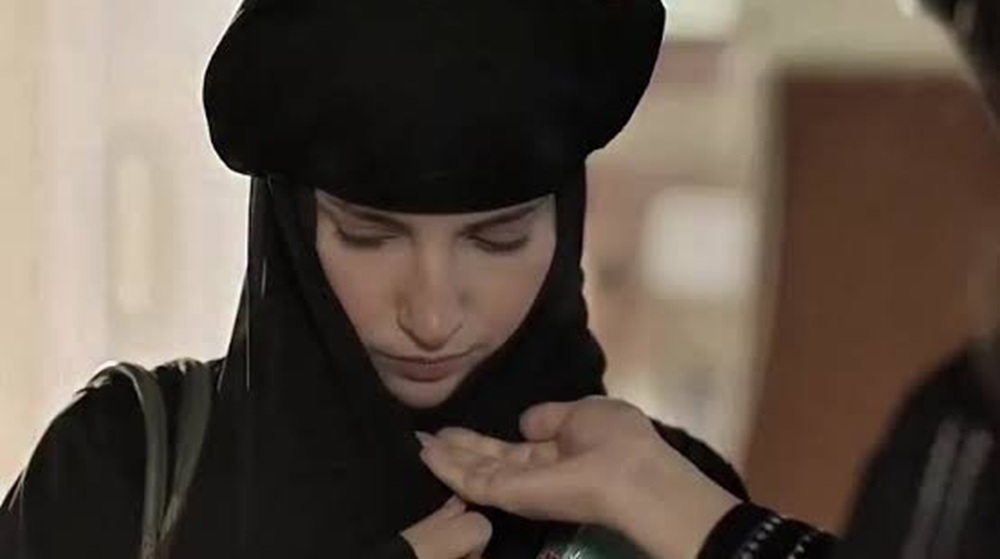
Dananeer Mobeen conveys Hurmat’s uncertainty and emotional distress through a restrained yet expressive performance
Well-known TV actors and celebrities making the move into scripted television are part of the casting. Dananeer Mobeen carries much of the story’s emotional weight, while Ali Tahir and Javed Sheikh provide the experience needed to establish the family conflict. Another intriguing aspect of the casting is Shahveer Jafry’s shift from creating digital content to performing on television. Character development, emotional expression, and language delivery must all be approached differently when transitioning to scripted television. At times, his performance could benefit from greater naturalness and emotional depth. But there is always room for improvement in a serial, and as the story develops, it will be interesting to watch his evolving on-screen persona. Another pleasant aspect is Hurmat's friendship with her university pals, especially Fenny (Mohja Kashif) and Kainat (Raheen Basharat). Their conversations lend a lighter, more approachable dimension to an otherwise constrictive family setting. Since female friendships are frequently underdeveloped in television stories, their inclusion is appreciated.
In the past, Kashif Anwar has worked on dramas that have examined various facets of interpersonal interactions and personal challenges, including Sabaat, Neem, and Nauroz. He revisits a topic that remains important in Pakistani society with Hurmat. Without needless delays, the first episodes set up the main conflict and make Hurmat's limitations clear to viewers. The story’s emotional tone is reinforced by Nadeem Siddiqui’s direction, which also keeps the familial dynamics in focus. The show, however, has a big obstacle: Pakistani television is already familiar with its theme. Television stories have frequently featured controlling fathers, constrained daughters, and disputes over family reputation. Hurmat's strength will therefore ultimately depend on how differently it tackles these well-known themes.

In Tabish, Hurmat finds a connection that offers her a glimpse of understanding, companionship and the freedom to imagine a life beyond her family's restrictions
The writing must go beyond recurring conflicts and delve deeper into the effects of patriarchal domination. Specifically, Akram's character needs more nuance, while Hurmat's mother needs a more significant narrative presence. Care must also be taken with the romance plot. Finding a supportive man or starting a relationship shouldn’t be the ultimate determining factor in a woman’s freedom. Romance can be part of Hurmat’s personal experience, but it should not take the place of her goals, education, self-discovery, and personal agency.
Hurmat offers a chance to reexamine what honor means in Pakistani family structures and begins with a socially important concept. Its central conflict highlights a crucial difference between limiting personal freedom and defending family values.
The drama's emphasis on women's rights to education and self-improvement is its strongest point. Its appeal is enhanced by Dananeer Mobeen's performance, the seasoned supporting cast, and the portrayal of female friendships. However, there is still room for growth in the old storyline patterns, the need for more nuanced characterization, and the evolving performances of some cast members. Hurmat still has the chance to expand on its main point and go beyond the traditional depiction of family strife as a continuing serial. Hurmat's ability to break free from her father's constraints or achieve happiness via romance shouldn't be the only criteria used to judge its success. A more significant accomplishment would be to demonstrate that she is developing into a person who can make wise choices about her own life.
In the end, family honor should be measured by the dignity, respect, and opportunity a family affords its members, not by how diligently a woman complies with expectations. Independence does not always equate to disobedience; education does not erode a family's honor; and personal development should never be viewed as a threat to a family's reputation. Hurmat poses this dilemma to its audience: Should a woman's honor be determined by the restrictions placed on her or by the freedom and dignity she is granted?
You may also like: