Written by: Muhammad Hamza
Posted on: November 11, 2026 | 
Qadir Jhatial
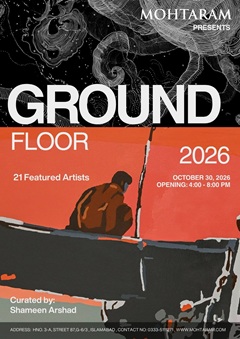
Ground Floor is the first exhibition at Mohtaram Studio in Islamabad. It brings together works by twenty-one artists without forcing them into one single story or style. Painting sits next to a sculpture. Detailed drawing sits next to quiet objects. The show feels like a walk in a park with many elements being explored at one time; it lets different ways of sharing the same space and creates meaning through difference.
Sujjal Kayani
Shameen Arshad curates the exhibition. She is an independent curator, writer, and visual artist. Her approach is careful and open, and she does not push one message. Instead, she allows each practice to keep its own voice while still joining a larger conversation.
Romessa Khan – Life Afloats
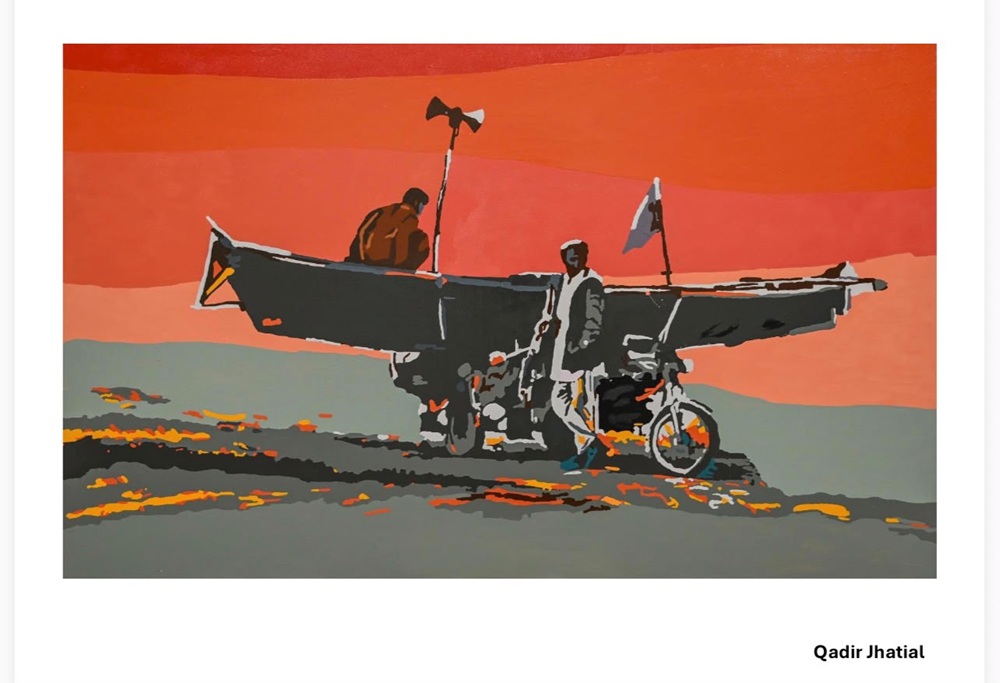
Qadir Jhatial’s paintings and drawings give the show a strong sense of place and travel. ‘In Ark for Dry Land’, a long boat rides on the back of a motorcycle under a bright orange sky. Two figures stand near it. One holds a flag. The land below is dry and marked with fire-like shapes. The work feels both local and mythical. It suggests movement across hard ground and the need to carry something precious. The pop enamel paint on canvas is a vivid contrast within the surface, which brings out the negatives, guiding the viewer through different parts of the artwork as if it’s a kinetic effect.
Qadir Jhatial
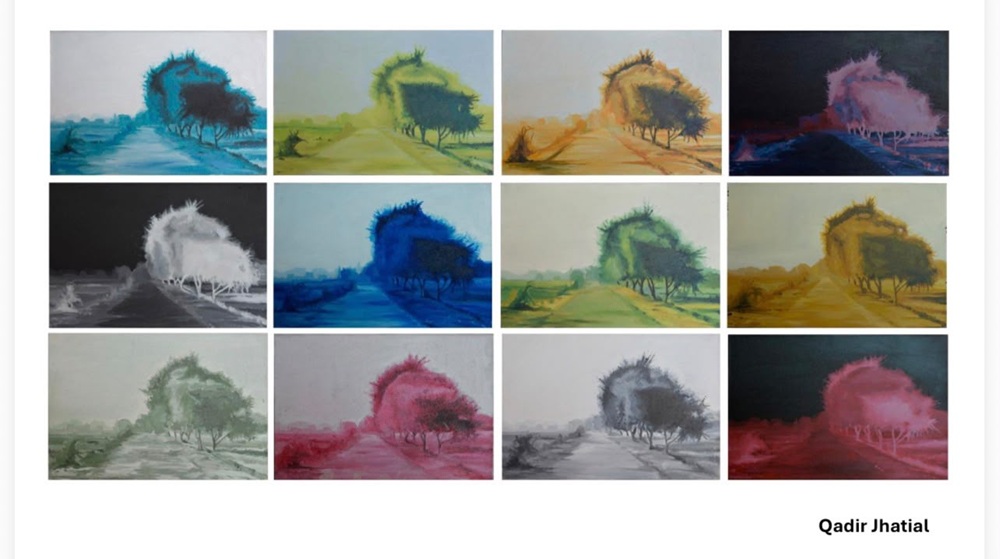
Then we have ‘Boat of the gray earth’, a wooden boat floats in soft gray space. Tools and broken pieces drift around it. The drawing is quiet and full of careful marks. ‘Land scape’ is a set of twelve smaller paintings. Together they feel like weather changing over the same quiet place.
Romessa Khan
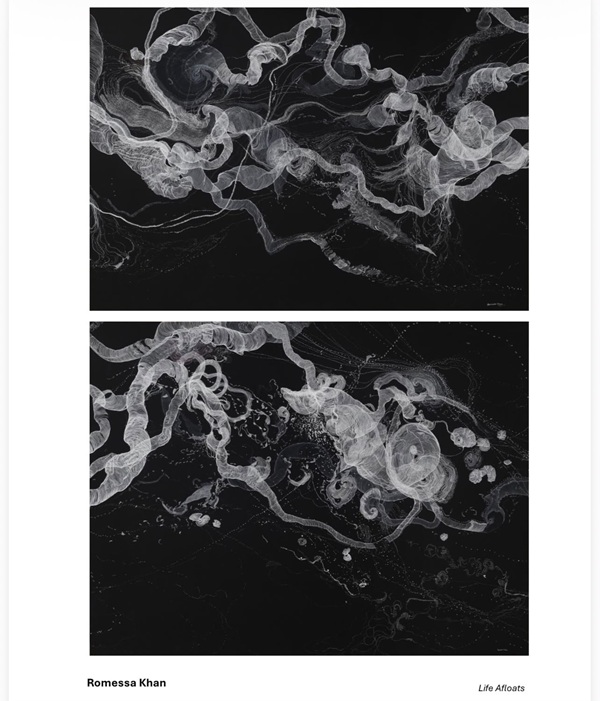
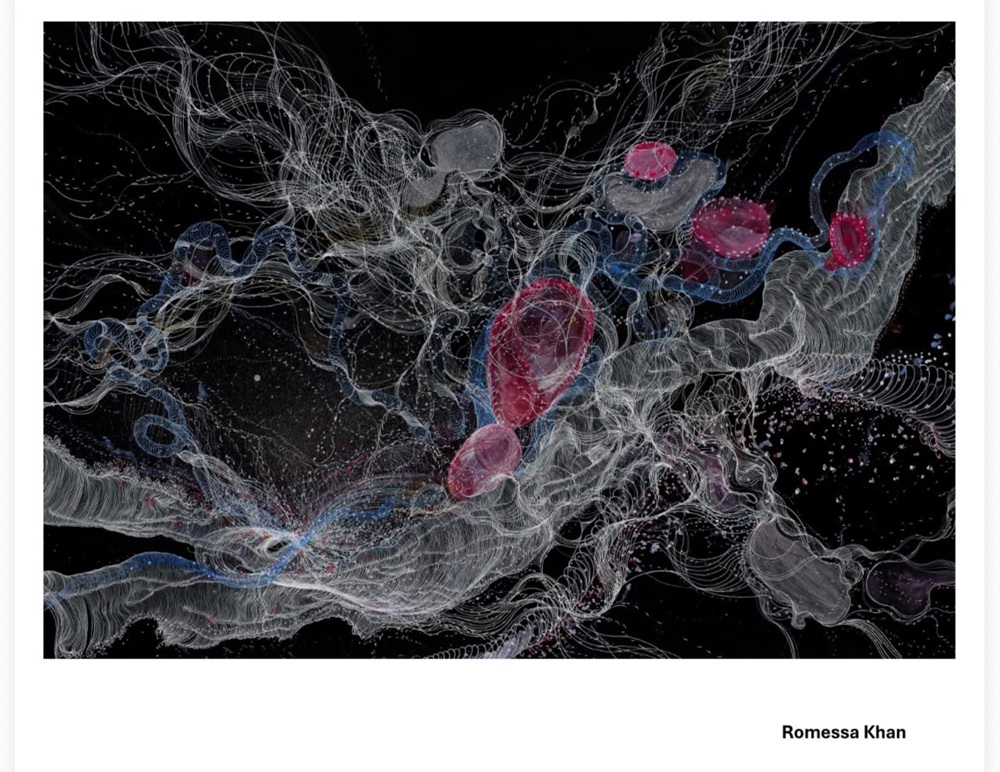
Romessa Khan works with fine lines and floating forms. ‘Evolution’ is a large dark surface filled with white and blue threads that twist and loop. Soft pink shapes appear like cells or soft bodies. The lines feel alive and searching. ‘Life Afloat’ is a diptych of the same kind of drawing. Pale white forms drift across black space. They look like sea creatures or thoughts moving without clear direction. Both works feel delicate and endless. They invite slow looking.
Kazmi Batool
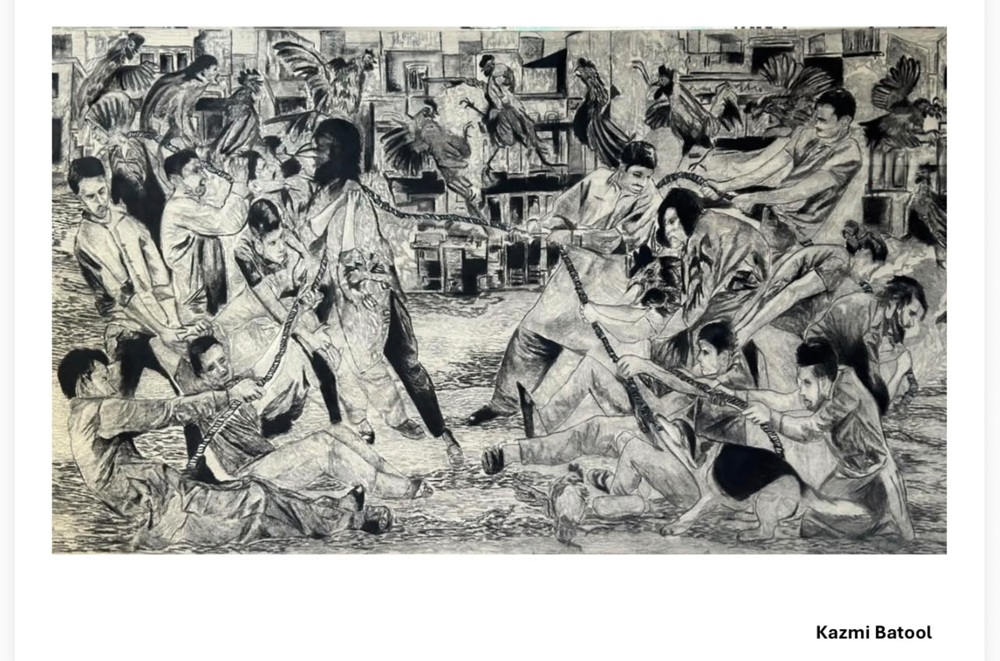
Kazmi Batool’s ‘The subconscious flock’ is quite a kinetic visual treat where the figures are in a movement of their own personal language; the characters wrestle with their respective personalities, and soon it’ll become a memory. There’s gentleness in the artwork when you really dive deeper with your internal voice; one must listen and react promptly enough.
Nisha Hasan
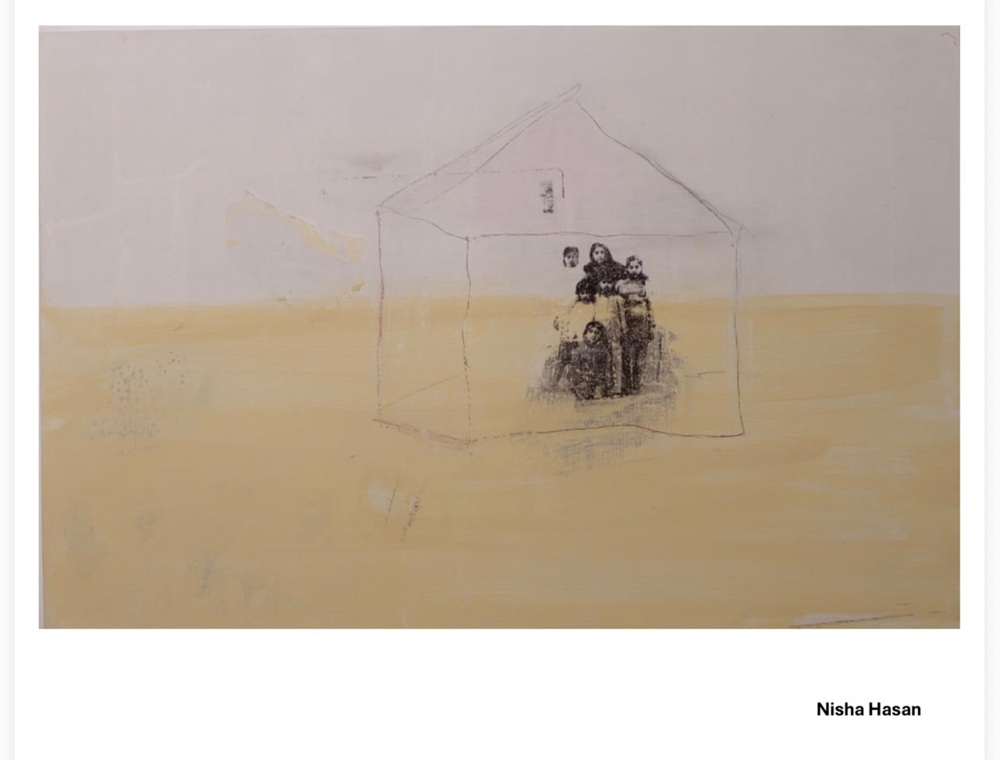
Nisha Hasan’s works are small and quiet but stay in the mind. ‘Room pretext (I) shows a simple house shape drawn on a soft yellow ground. Inside the outline, a family sits close together as in some memorial remembrance; the image is faint and careful. ‘Lament’ is a wooden box with a glass lid. Inside are small white plaster shoes arranged on dark felt. A mirror reflects some of them. The shoes look soft and unused. The box feels like a place for memory or loss that is kept safe but still visible.
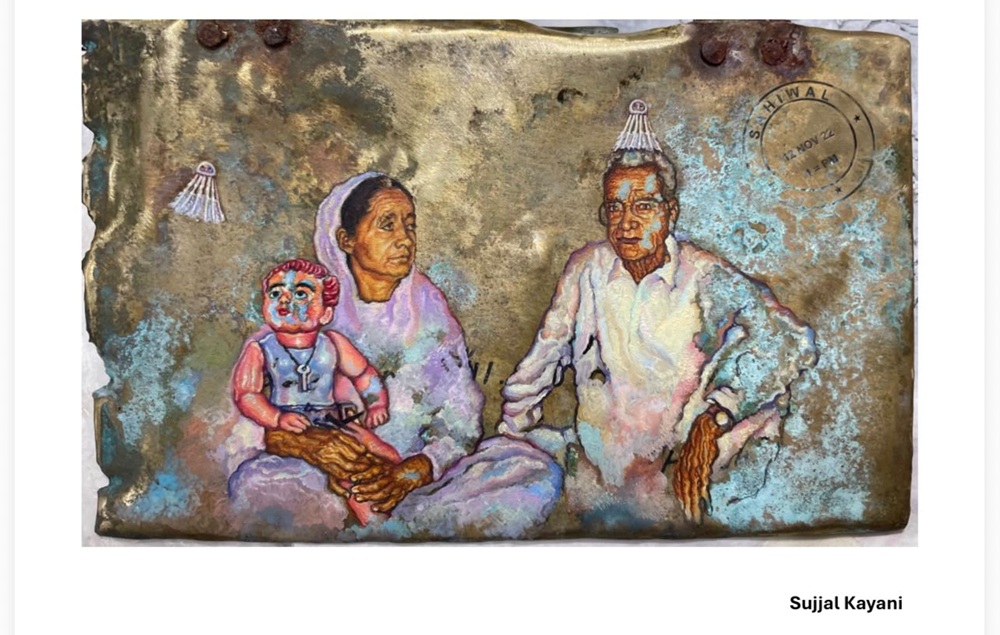
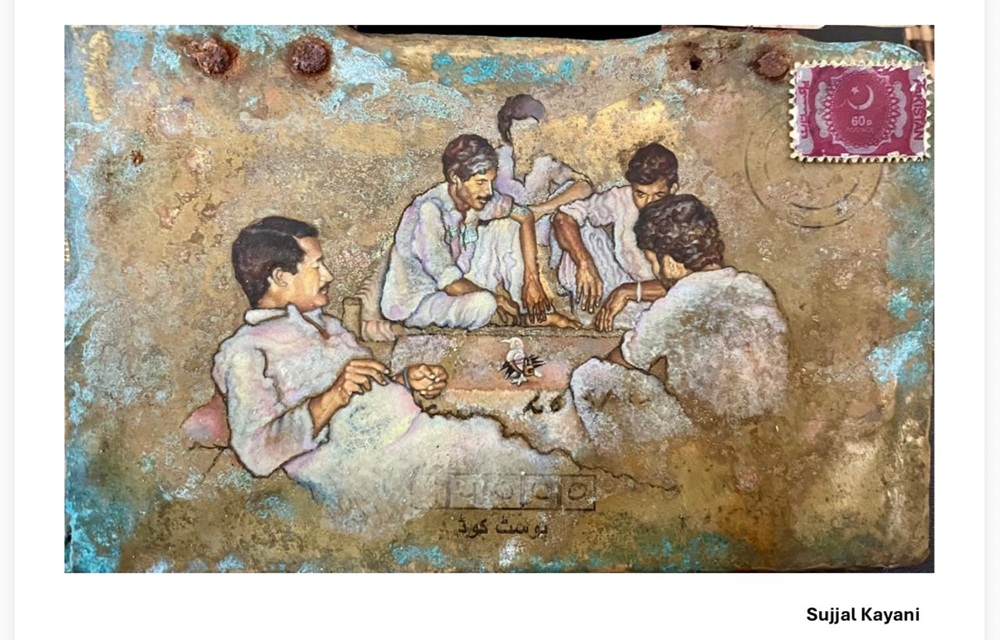
Sujjal Kayani’s two works bring a different kind of intimacy. Both are painted in oil on brass plates that look worn and old.
‘Not a love letter (I)’ shows a family. A woman holds a child on her lap. A man sits beside them. Their faces are calm and steady. The brass surface carries marks and stamps that feel like the edges of an old photograph or a letter that has travelled far.
Sujjal Kayani
‘Not a love letter (II)’ shows a circle of men sitting close together. They lean in as if sharing a quiet game or a private talk. Again, the brass is marked with stamps and signs of age. The paintings feel like small keepsakes. They hold everyday moments and make them feel precious and slightly distant at the same time. There’s a sense of nostalgia for early rural times when people were much closer to each other; the metal surface catches light in soft ways so the figures seem to live inside the object rather than sit on top of it. In fact, it’s an envelope made out of brass sheets, enclosing memories for preservation.
Mahreen Fatima
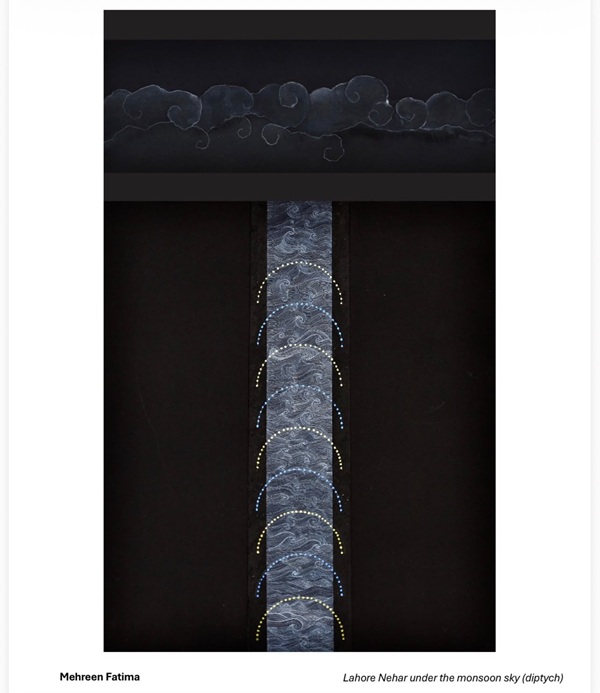
Mehreen Fatima uses gold and dark grounds with great control. ‘Lahore Nehar under the monsoon sky’ is a long vertical strip of blue water shapes set against black. Small gold arcs and dots mark the edges. The work feels like looking down at a canal at night. ‘Nehar pay charh jao nehar say utar kar’ is a gold diptych of trees and a triangular path. The gold shines against the dark paper. ‘Spring and War’ shows a gold comb with a plant growing from its handle. The image is simple and strong. It joins everyday objects with quiet symbols of growth and coherent thoughts.
Shameen Arshad – The Architecture of Leaving
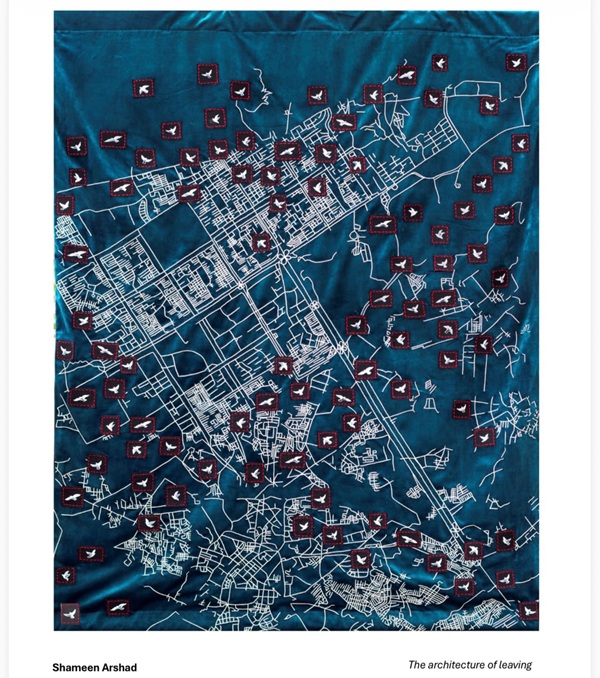
Shameen Arshad’s own works in the show continue her interest in maps, houses and movement. ‘The architecture of leaving’ is a large blue velvet surface covered with a white city map. Small black bird shapes sit inside red squares all over the map. They look like they are leaving or marking places already left. They leave in quiet lines, showing folded paper house shapes drawn in white on dark blue cloth. The border is filled with more house outlines. ‘Outbound’ is a red and black diptych. On the black side, white house forms rise like a city. Pink birds fly across them. On the red side, the same houses are repeated in white outline. The works feel both personal and wide. They speak of leaving home and of the patterns people carry with them, as if pinpointing the memories one could have along their journey.
Tazeen Fatima - Dar Parda Ye Khud
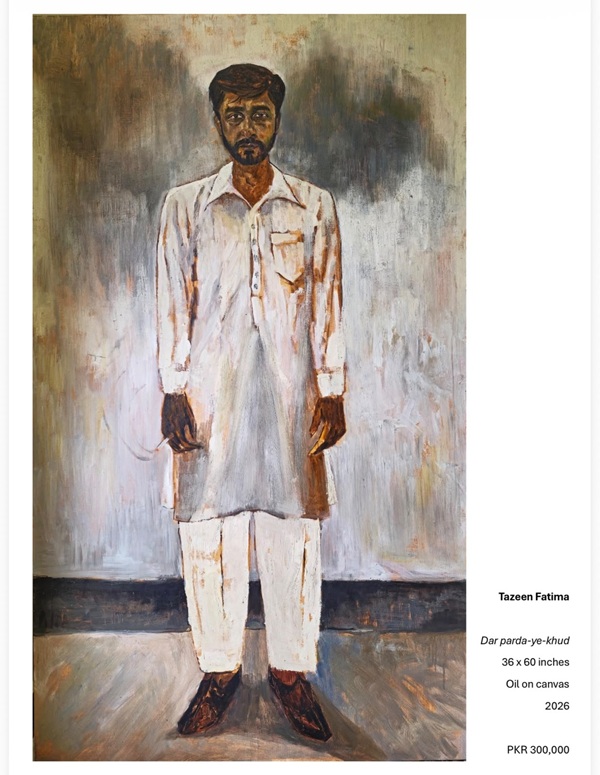
Tazeen Fatima’s ‘Dar Parda Ye Khud’ shows a man standing alone against a soft gray wall. He wears a white shalwar kameez and brown shoes. His face is calm but slightly distant. The paint is thick in places and thin in others. The figure feels solid yet unfinished. The painting holds a private mood. It asks the viewer to look carefully at someone who does not look back.
Babur Gull
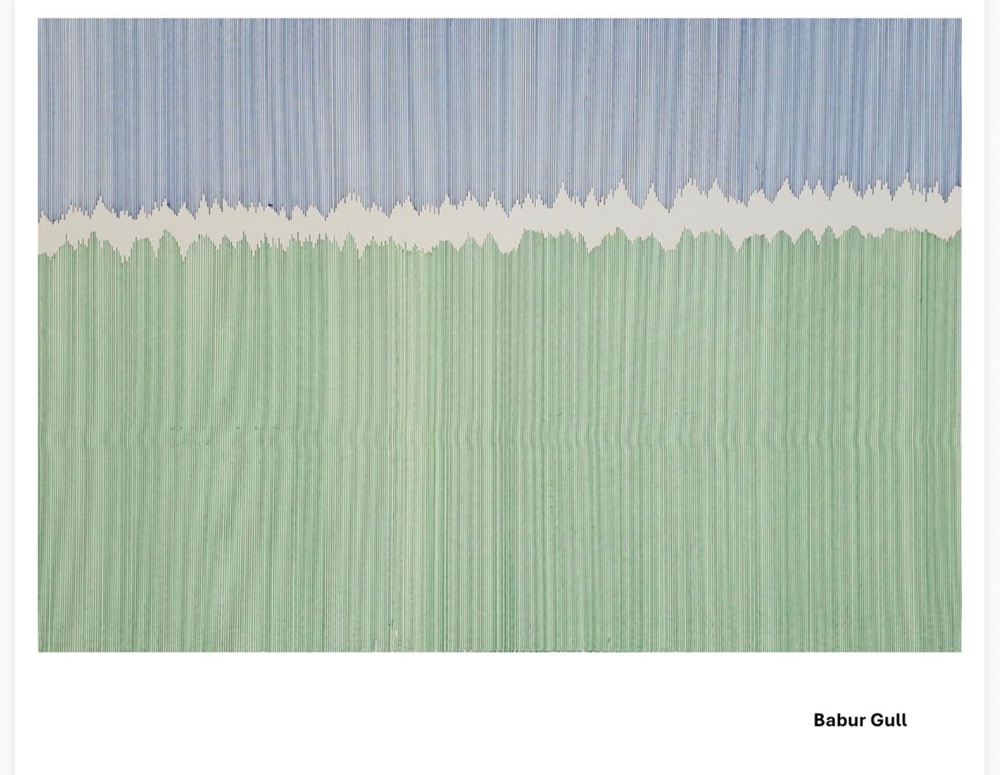
Babur Gull’s two works are made of many thin vertical lines. ‘Common Thread (II)’ has a soft blue upper half and a soft green lower half. A white jagged edge separates them like a horizon or a torn edge. ‘Common Thread (I)’ is wider. Green sides frame a blue centre that also has a torn white edge. The lines are calm and steady. The works feel like time passing or cloth being woven. They are quiet and restful in a show that holds many different energies, a visual immersion that lets the audience trace paths to initiate a dialogue within the lines.
Shanzay Subzwari
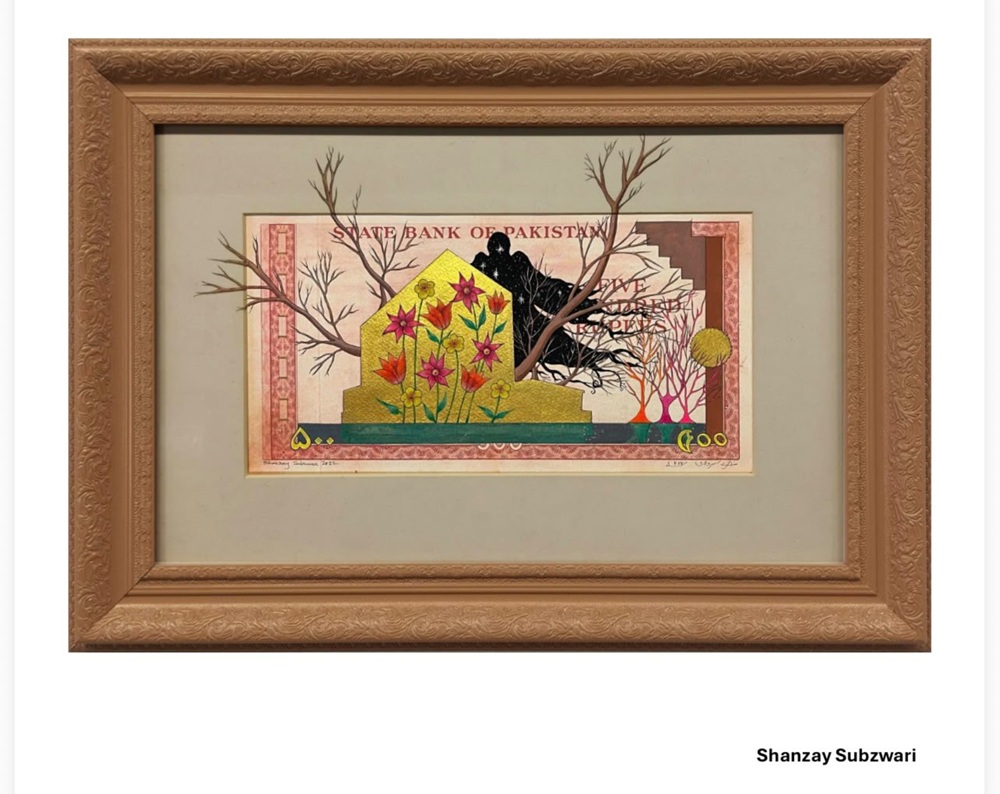
Shanzay Subzwari works with banknotes and small painted scenes. ‘Change My Destiny (I)’ places a small painted figure and a dark cloud on a Pakistani note. ‘Premonition’ shows a golden house and dark trees growing across another note. Both works mix the everyday paper of money with private images of hope or warning. They feel precise and slightly strange, keeping the original ideation of paper money.
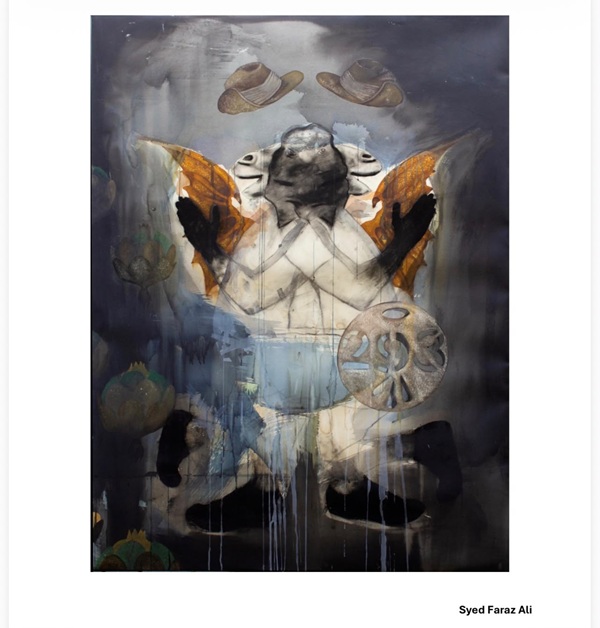
Syed Faraz Ali’s ‘untitled’ is a memoir and research from his time spent in Australia, an abstract piece of all the elements collected, a medallion showing the signature ceremonial motif for the camel Shepherds, and elements enclosing a distinctive pattern throughout the piece while they mirror each other.
Syed Faraz Ali
The exhibition as a whole does not try to make all these works agree with each other. A bright orange boat painting can hang near soft white plaster shoes. Fine ink lines can sit near heavy charcoal crowds. Gold leaf can rest near graphite maps. Small brass paintings of familial moments can sit near wide maps of departure. The differences create a living rhythm in chaos; viewers move from one work to the next and feel the change in materials and mood as the scented candles followed one through the rooms that participated in the exhibition.
What stays after leaving the space is the sense of beginning. Ground Floor does not close any doors. It opens a room where many ways of seeing can exist side by side. Shameen Arshad has chosen works that keep their own character while still speaking to one another; a gentle wisp of nostalgia wraps the viewer afterwards with all the miniature details seen on the walls. The result is an exhibition that feels honest and open. It invites return visits and further conversation. The show does not shout; it simply places the works in the room and trusts the viewer to match the dots.
You may also like: