Written by: Emma Alam
Posted on: June 01, 2026 | 

The book, What Remains After a Fire, and its author, Kanza Javed.
This collection of stories will compel you to question bleak realities prevalent in society regarding social structure and individuality; with a compelling capability of seizing reader’s attention, ‘What Remains After a Fire’ is hard to ignore.
Written by Kanza Javed, this compilation of short stories is the debut work by Kanza. This book unveils what remains after catastrophe such as emotional and societal calamity; nothing gets cured, but there remain the emotional aftermath, fragmented subjectivity, and the ethical burden.

Kanza Javed
The title focuses on the themes of male dominance and hidden hostility prevalent in society in terms of forced obligations on women; moreover, legitimated supervision and manipulation in family systems. The writer explores how the upper and middle strata of society maintain their esteem while housekeepers face exploitation. However, neglecting a stratified society and endorsing misconduct often becomes the norm of the ordinary people.
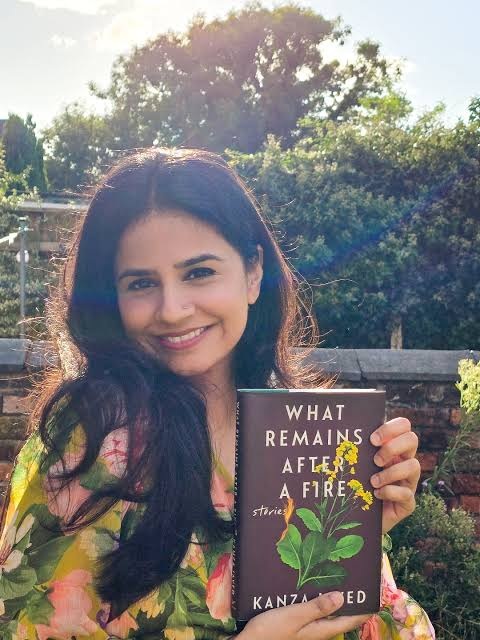
Kanza Javed with her book, What Remains After a Fire
There is a misconception in society regarding foreign immigration that people get freedom from all problems, but the grass is always greener on the other side; they face emotional detachment, extreme loneliness, migrant disorientation, fragmented subjectivity, and xenophobia. This concept is widespread today as immigration is considered to be an inevitable road to success; especially from the developing and economically struggling countries towards economically stable and politically powerful states.
This book suggests that distress is not something to be experienced only, but it can be transferred and transferred genetically as well. Ultimately, this phenomenon might immerse into behavioral patterns, emotional distance, suppression, unsettled issues, and prolonged vicious circles of deep-seated distress.
As Yael Danieli describes in Multigenerational Legacies of Trauma.” In Post-Traumatic Stress Disorder, (Oxford Academic, 2018), that:
“Children of traumatized people may experience the emotional consequences of trauma without directly experiencing the trauma themselves.”
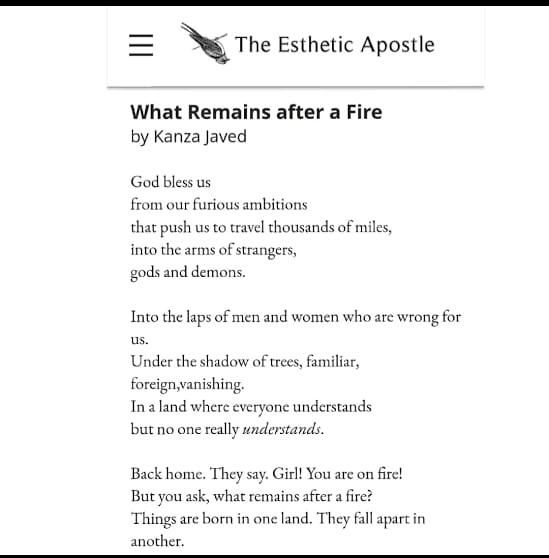
What Remains After a Fire by Kanza Javed
The book unfolds the ruthlessness that we assert is fictitious; it exposes the inhumanity that we encounter in our day-to-day life. Starkly different from folktales, this work is not about restoration, black-and-white thinking, or a sense of completion. Nevertheless, the author creates a well-crafted dramatis personae to address the concepts of sacrifice, ethical rectitude, family ties, and to value subjectivity and self-esteem.
The novel aligns vehemently with ongoing social and cultural circumstances such as current discourse regarding normative gender frameworks; escalating public concern about socioeconomic disparity. It not only shows inner conflicts but also the structural problems of corporate-driven lifestyles. The story addresses the cognitive load of immigration and perseverance of socially ranked cultural systems. The writer employs crisp narration, emotional nuance, and implied expression instead of straightforward interpretation. This usage of controlled prose reinforces the emotional profundity of the narratives.
The complicated plot of this novel caters to eight stories; the writer creates a realm in which characters are not depicted as figures of psychological resilience, rather indirectly responsible for their own collapse. Moreover, all the fictional agents demonstrate an adaptable yet affectively immersive perspective towards adverse circumstances, instead of being unreceptive and spontaneous.
The narrative’s title marker is dense with symbolic meaning. “Fire” has surface meaning and deep metaphorical connotation; signifying emotional collapse, agony, regret, pain, atonement, and transition.
The principal issue is that, when people are burned by the sufferings of life, what remains after?
The author’s answer is not optimistic at all when she highlights the aftermath as: reminiscence, stress, endurance, shadows of feelings, and the harsh reality of enduring the weight of living. After a disaster or a mishap in life, people continue to live not because they have recovered, but for the reason that life never offers any choices.
You may also like: