Written by: Saram Maqbool
Posted on: June 04, 2026 | 
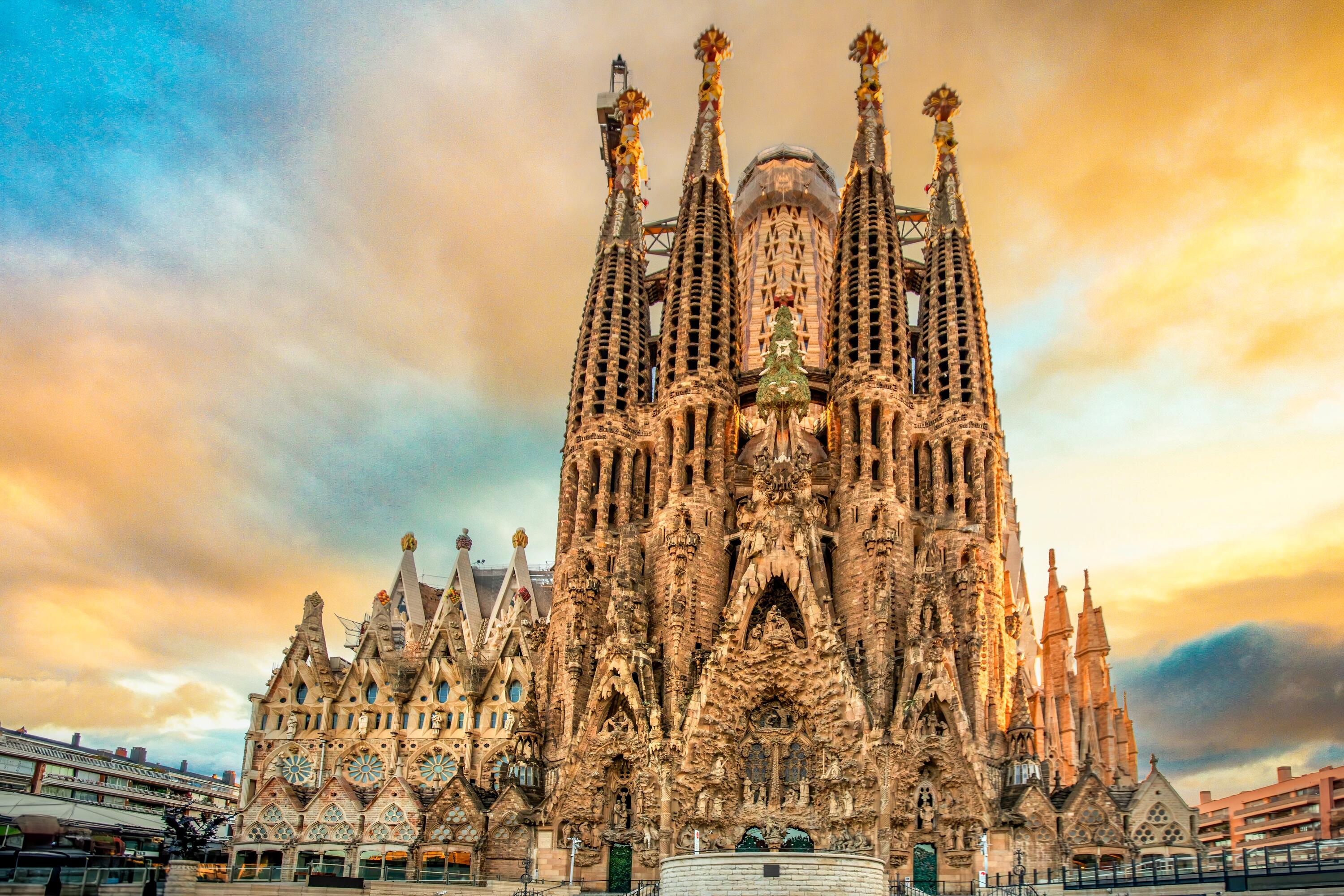
Sagrada Familia
In a world where architects loudly claim ownership of their designs, La Sagrada Familia stands unlike any other structure. I can't think of any other building that reveals architecture's temporal nature quite as well as this one. Unfinished even after nearly a century and a half since its conception, the building exists as a living collaboration across generations of architects, designers, engineers, sculptors, and more. In doing so, it challenges the modern assumption that architecture belongs to a single author or in a fixed moment of time.
When construction began in the late nineteenth century, the church was not yet the visionary experiment the world recognizes today. It was originally commissioned as a conventional Neo-Gothic basilica under architect Francisco de Paula del Villar, but shifted dramatically in 1883 when a young Antoni Gaudí assumed control. Gaudí transformed the commission into something radically different. His was an architecture inspired not by imitation of historical forms, but by the geometries of nature, theology, and structural experimentation.
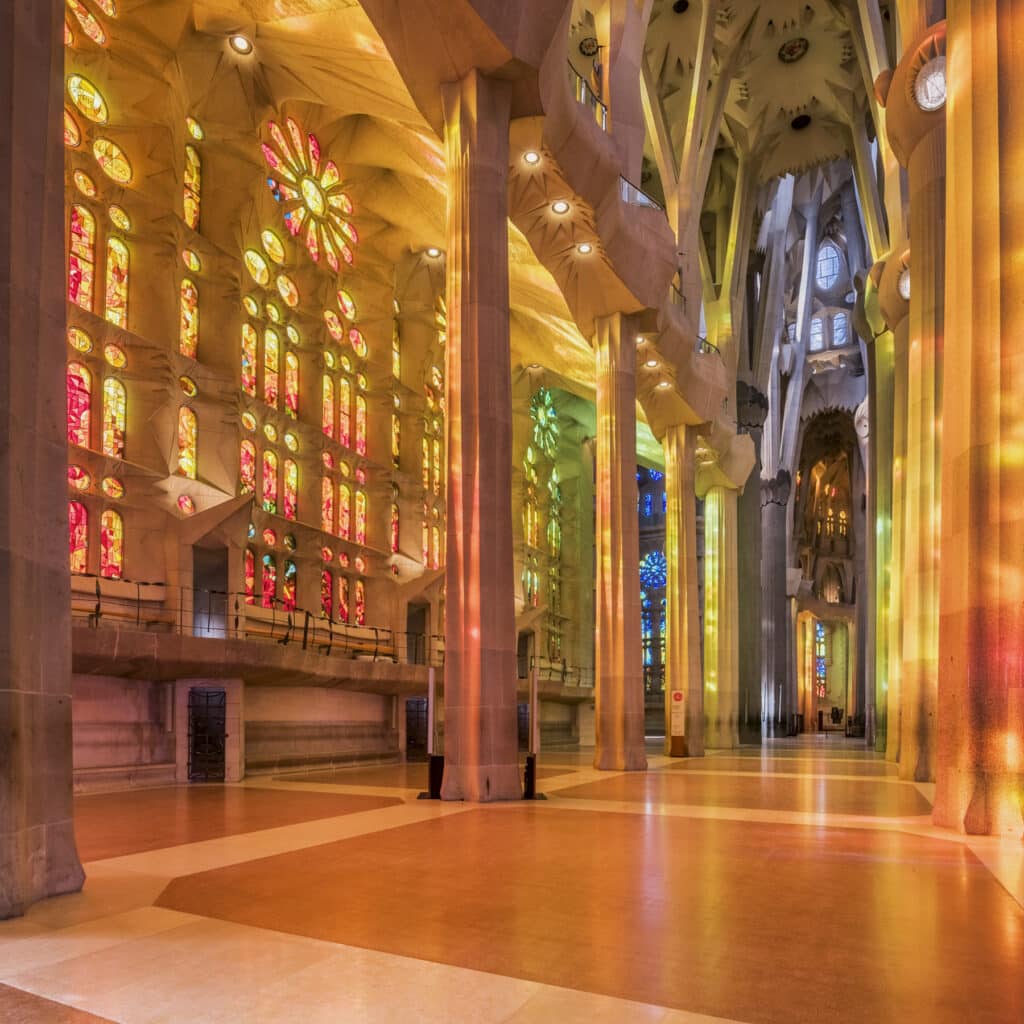
The inside of the church seems otherworldly when the light hits it at the right angles.
Gaudí understood architecture as an evolving organism rather than a static composition. Unlike many architects who finalized drawings before construction, he worked iteratively, constantly adjusting forms through models and material experimentation. He famously remarked that “my client is not in a hurry,” referring to God, an attitude that reflected both spiritual conviction and an acceptance of long architectural time. The Sagrada Família, for him, was not simply a building, but an act of devotion extending beyond his own lifetime.
Gaudí knew he wouldn't live to see the basilica finished, and by the time of his death in 1926, only a fraction of the building had been completed. The remainder of the design was to be completed using his extraordinary archive of plaster models, sketches, geometric studies, and workshop techniques. Unlike conventional architectural authorship, which often seeks control over a finished object, Gaudí embraced the inevitability of interpretation. The building would simply have to continue without him. That continuation, however, was anything but smooth. The outbreak of the Spanish Civil War threatened the project’s survival. Gaudí’s workshop was vandalized, and many original drawings and plaster models were destroyed. For a moment, it seemed possible that the Sagrada Família would remain permanently unfinished. Yet, architects and artisans painstakingly reconstructed fragments from surviving photographs, memories, and damaged remnants. This effort itself became an act of architectural archaeology. It was an attempt not only to preserve a building, but to recover a design language interrupted by history.
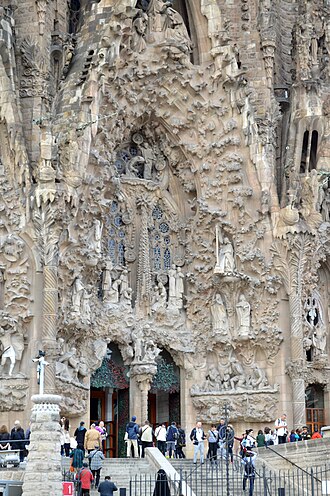
The portal of charity
Subsequent architects faced an immense challenge: how does one continue another architect’s unfinished masterpiece without imitation turning into stagnation? Figures such as Domènec Sugrañes, Isidre Puig Boada, and later Jordi Bonet inherited not only technical responsibilities but philosophical ones. They were tasked with interpreting Gaudí’s intentions in a changing world. Every generation contributed its own understanding of structure, material, and technology, transforming the Sagrada Família into a dialogue rather than a monologue. Engineering, in particular, became central to this process. Gaudí’s structural ideas were astonishingly advanced for their time. Rather than relying on conventional Gothic buttressing, he developed catenary arches and branching columns inspired by trees and gravity itself. He famously used hanging chain models weighted with sandbags to calculate structural loads. What seemed almost mystical in the nineteenth century would later prove mathematically sophisticated. Engineers in subsequent decades translated these analog methods into computational models, validating and extending Gaudí’s experimental logic.
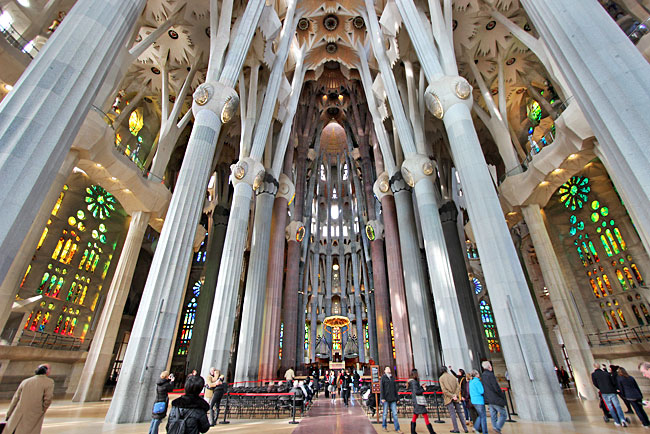
Tree-like columns inside the structure
The transition from handcrafted experimentation to digital precision marks one of the most fascinating chapters in the basilica’s history. Beginning in the late twentieth century, digital technologies revolutionized construction. Three-dimensional modeling, parametric design, and CNC fabrication allowed architects to interpret Gaudí’s complex geometries with incredible accuracy. Forms that were once impossible to calculate manually could now be modeled digitally and fabricated efficiently. It is perhaps this technological shift that’s drawn the most criticism. Critics argue that using digital tools means distancing the building from Gaudí’s handcrafted ethos. Supporters, however, suggest that this change fulfils the architect’s experimental spirit. In many ways, the use of technology aligns deeply with Gaudí’s philosophy. He consistently embraced innovation, pushing materials and techniques beyond convention. Had he possessed computational tools, it is difficult to imagine him rejecting them. The digital age, rather than betraying the project, may simply represent its next evolutionary stage.
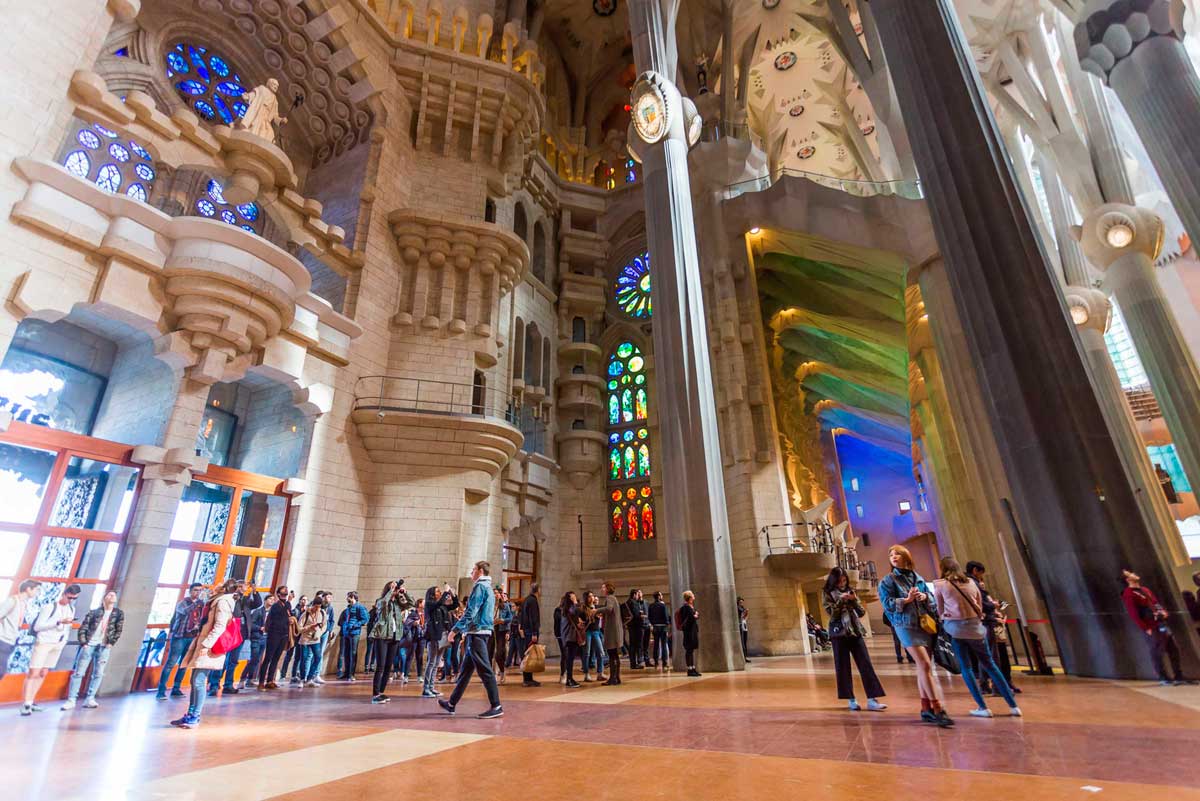
Every surface of the interior seems to be filled with texture and art.
One of the most striking aspects of the basilica’s design is the artwork integrated into its identity. Because of this, the Sagrada Familia depends heavily on human craft even in this day and age. Stone carvers, sculptors, stained-glass specialists, and metalworkers continue to shape surfaces with extraordinary precision. The Passion Façade, designed largely under the sculptor Josep Maria Subirachs, introduced a strikingly angular visual language distinct from Gaudí’s more organic forms. While controversial at first, it revealed another truth about multi-generational architecture: continuity does not require stylistic sameness. Every contributor inevitably leaves traces of their own time. The basilica’s stained glass offers another example of evolving collaboration. Contemporary artist Joan Vila-Grau introduced vivid gradients of color that transform the interior atmosphere through light rather than ornament. Morning blues and greens shift into fiery reds and oranges throughout the day, creating an experience deeply aligned with Gaudí’s belief that architecture should inspire emotional transcendence. Here, modern intervention enriches rather than competes with historical vision.
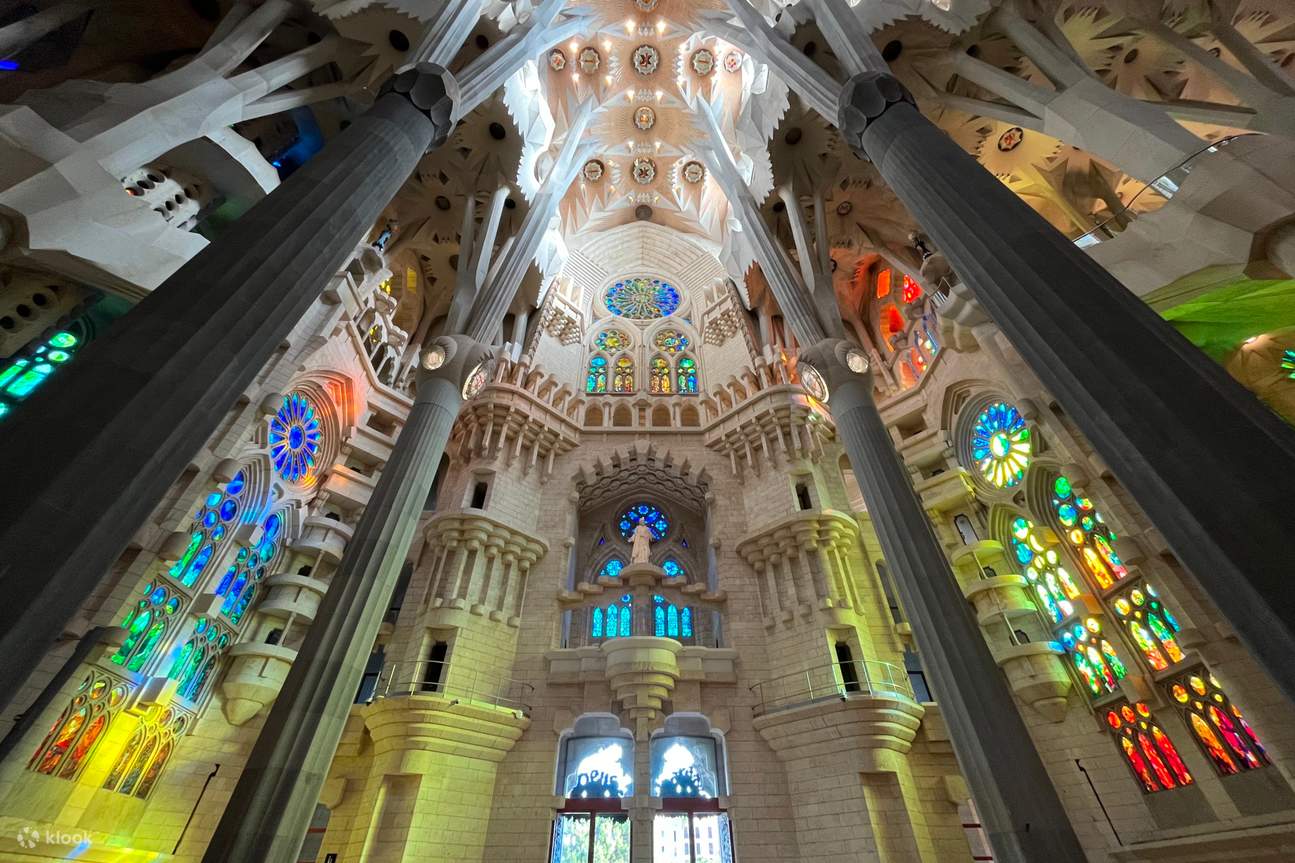
Stained glass windows inside the Basilica
What makes the Sagrada Família particularly relevant today is how profoundly it challenges contemporary architectural culture. In an era defined by speed, efficiency, and immediate visual impact, the basilica resists acceleration. Most architects rarely see buildings evolve significantly after completion, and yet, the Sagrada Família exists in perpetual becoming. It asks whether architecture might be richer when allowed to unfold slowly, adapting through successive acts of care and interpretation. The project also complicates conventional ideas of authorship. Architectural history often celebrates singular geniuses, yet the Sagrada Família reveals architecture as fundamentally collective. Gaudí provided the vision, but engineers translated structure, artisans shaped material, historians recovered fragments, and digital specialists expanded possibilities. No single individual owns the building anymore. Its authorship has become distributed across time itself.
You may also like: