Written by: Muhammad Hamza
Posted on: September 28, 2026 | 
The Divided Self
Of Mountains and Muses at Tanzara Gallery offers a luminous journey into the distinctive vision of Raja Changez Sultan. The exhibition gathers recent works that place the majestic imagined landscapes of The Himalayan Odyssey in quiet conversation with the enigmatic female figures of The Divided Self and the ethereal presences of The Wood Nymphs. Together, these series reveal an artist who moves fluidly between the figurative and the abstract, building atmospheres of colour and suggestion that feel suspended between memory and dream.
Raja Changez Sultan has long pursued a dual path of painting and poetry. His own words capture the spirit of that pursuit with characteristic clarity and warmth. At an early age, his life turned from mathematics and science toward the twin arts, guided by the modest yet ambitious aim of creating ten outstanding paintings and ten outstanding poems. Now in his mid-70s, he looks back on the journey as a fun ride he would gladly take again. That same sense of open-ended exploration animates the canvases on view.
Recently honoured with the Sitara e Imtiaz and an Honorary Doctor of Fine Arts degree from Trinity College in Hartford, Connecticut, Sultan continues to refine a language that is unmistakably his own.
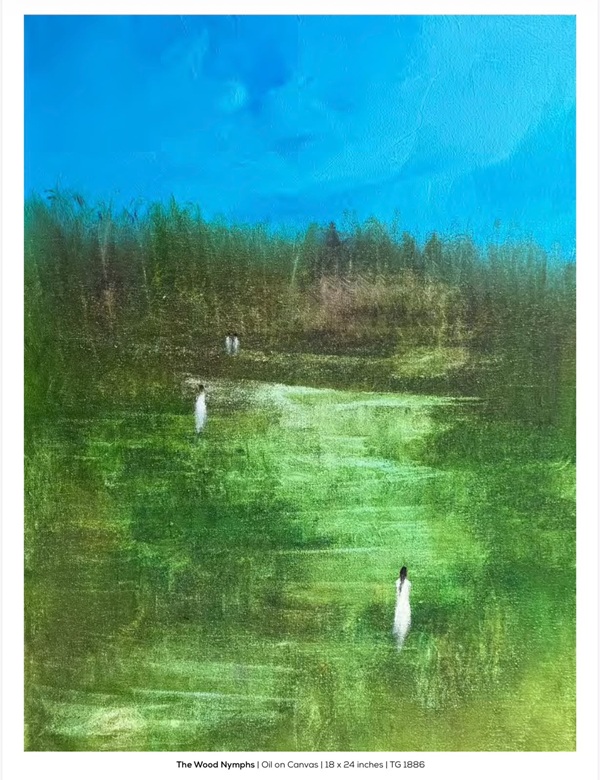
The Wood Nymphs
The Himalayan Odyssey series transports the viewer into realms of grandeur and contemplation. These are not topographical records of a known range but luminous meditations in which mountains rise through veils of blue turquoise and violet.
One work in particular presents a vast expanse of water that mirrors a darkened ridgeline under a sky heavy with cloud. The surface of the water seems almost liquid light, while the land mass above dissolves into soft purple and indigo forms. The effect is of a place that exists more in the mind than on any map, a landscape that has absorbed decades of looking and remembering. Another canvas in the same series deepens the mood with cooler greens and a dramatic waterfall-like cascade of pigment that cuts through the lower register. Here the mountain becomes a presence of pure atmosphere, its edges blurred so that the eye is invited to wander rather than fix upon a single detail. Sultan’s brushwork remains loose and layered, allowing underpainting to shimmer through and creating a sense of depth that feels both physical and psychological.
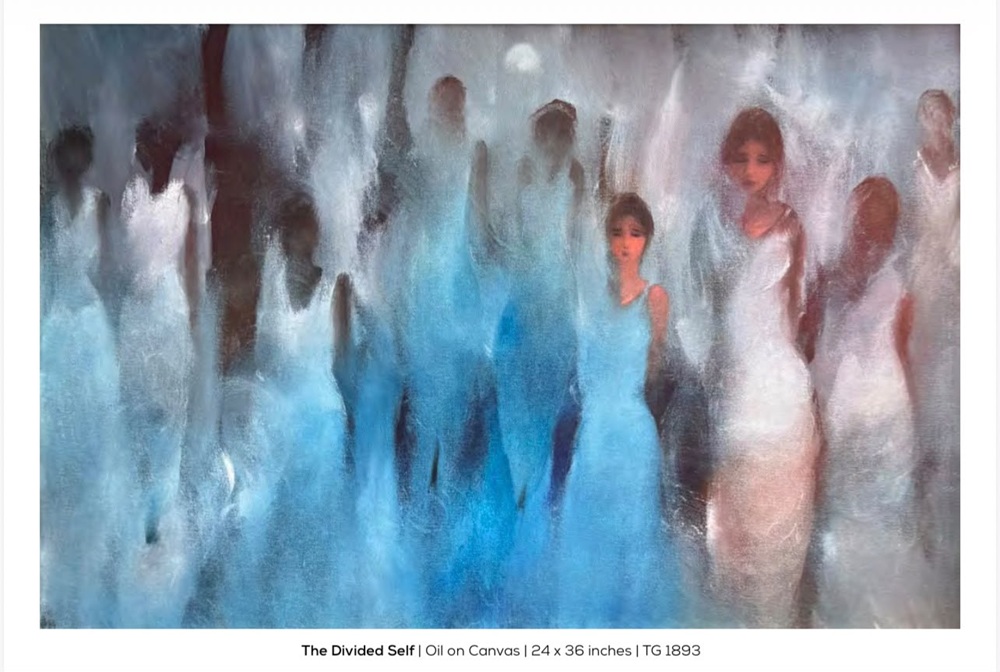
Enigmatic women appear solitary or in small groups, their forms hovering between presence and absence. In one canvas, five figures stand against a dark ground, their dresses rendered in bold primary colours that glow like stained glass. Faces are suggested rather than defined, eyes and mouths reduced to soft marks that convey inwardness more than portraiture. The figures seem to emerge from and recede into the surrounding colour, as though the self itself were a continuous act of revealing and concealing.
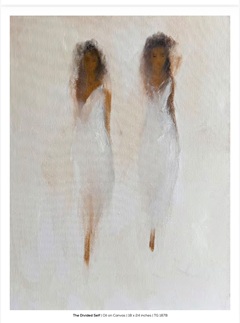
Another work shows three women in cooler tones of cyan, yellow and magenta, each body elongated and slightly translucent against a deep blue field. Their stillness carries an almost ceremonial quality, as if they occupy a threshold space between waking and dreaming. A further canvas presents a pair of pale figures against an almost white ground, their outlines dissolving so thoroughly that they appear on the verge of vanishing. The restraint of the palette here intensifies the sense of psychological complexity. These are not characters engaged in narrative action but embodiments of the divided self, each one both solid and spectral.
The Wood Nymphs series extends this exploration of presence within landscape. Small solitary figures in white appear within vast fields of green and blue, often near the edge of water or beneath distant tree lines.
In one painting a lone figure stands in the lower left of a turquoise expanse while another tiny form is visible far across the water. The surrounding colour is applied in broad horizontal sweeps that suggest both forest and reflection, dissolving the boundary between land and sky. The figures remain deliberately small, almost absorbed by the atmosphere that holds them.
Another canvas shifts the palette toward deeper greens under a vivid blue sky, with three white figures distributed across a grassy slope that rises toward a wooded ridge. The nymphs feel less like visitors than like natural emanations of the place itself, spirits that belong to the mountain air and the forest light.
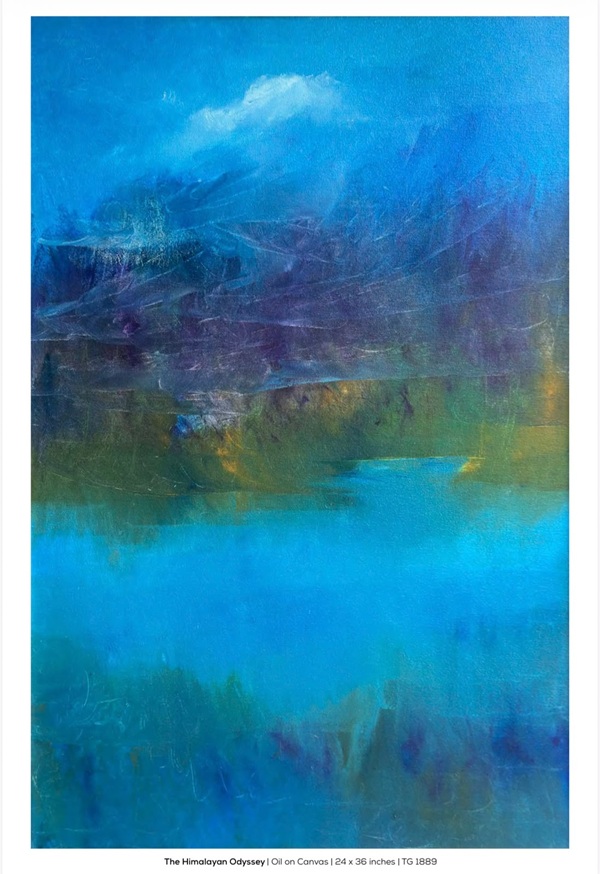
The Himalayan Odyssey
A larger work in the series opens onto a panoramic view of the lake and distant peaks, a single white figure in the foreground providing a quiet human scale against the immense blue-green space. The effect is one of contemplative solitude, the figure neither dominating nor diminished but simply present within the larger rhythm of the landscape.
Across all three series color functions as the primary carrier of emotion and meaning. Blues range from the deepest ultramarine to the most translucent turquoise, greens shift from mossy shadow to luminous spring, and warmer notes of orange, red, and pink appear as sudden accents of vitality.
Sultan builds these colours in successive layers so that each surface retains a sense of breath and movement. Edges are rarely hard. Forms dissolve into one another, creating the very atmosphere of suggestion that Noshi Qadir describes in her introduction. The result is a world that feels both intimate and expansive.
The exhibition also includes a poem by the artist titled I Am a Dream. Its lines move from mountain heights to ocean depths and finally into the freedom of wind through forest canopies. The poem’s imagery of soaring spirit and sudden plummet mirrors the dualities visible in the paintings: elevation and immersion, presence and disappearance, the self that is both free and bound. Reading the poem beside the canvases deepens the sense that painting and poetry remain inseparable in Sultan’s practice. Each medium explores the same territory of memory, mystery, and the restless human spirit.
What emerges most strongly from Of Mountains and Muses is the coherence of a lifelong vision. The mountains are never merely scenery and the muses never merely decorative figures. They are aspects of a single imaginative realm in which the outer landscape and the inner psyche continually reflect one another. The dialogue between The Himalayan Odyssey and The Divided Self is therefore not an opposition but a conversation. The same luminous atmosphere that softens a distant ridge also softens the outline of a standing woman. The same sense of suspension between memory and dream animates both the empty lake and the gathered group of figures.
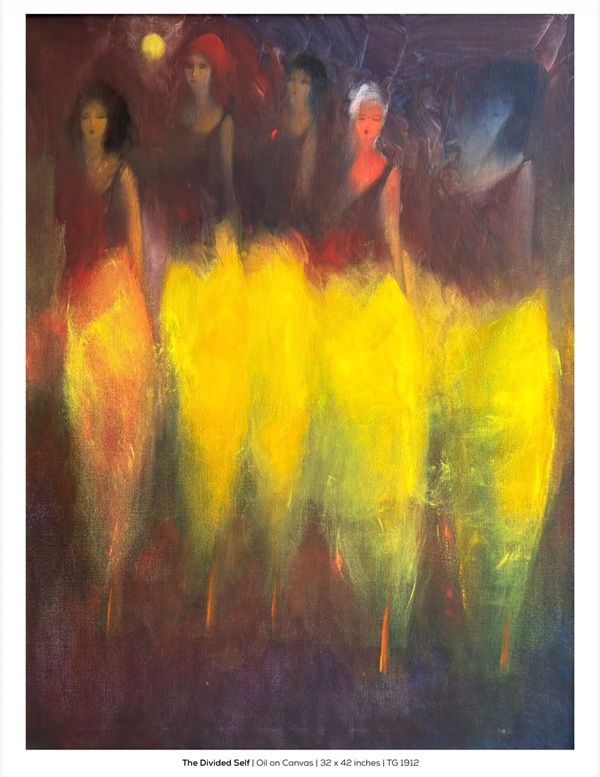
The Divided Self
Standing before these paintings, one feels the presence of an artist who has remained true to his early goal and who continues, decade after decade, to discover new ways of making that goal visible. Of Mountains and Muses is both a summation and a continuation, a body of work that confirms Raja Changez Sultan’s place among the most distinctive voices in contemporary painting.
You may also like: