Written by: Muhammad Hamza
Posted on: September 14, 2026 | 
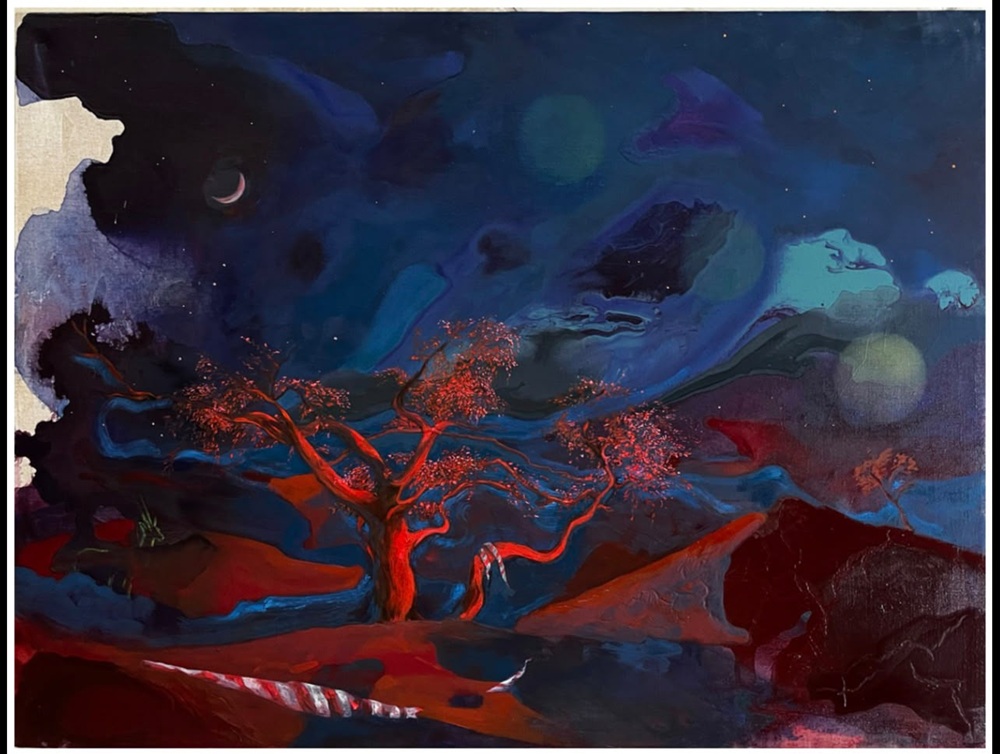
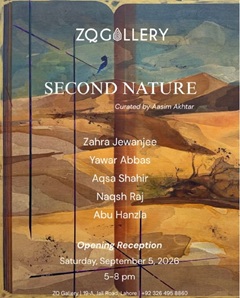
The exhibition “Second Nature,” curated by Aasim Akhtar at ZQ Gallery in Lahore, brings together five artists whose works quietly challenge the comfortable image of landscape that many of us grew up with. Opening on 5th September 2026, the show features Zahra Jewanjee, Yawar Abbas, Aqsa Shahir, Naqsh Raj and Abu Hanzla. Rather than offering pretty views of rolling hills or sunlit valleys meant to soothe the viewer, these painters treat landscape as something more complicated: a place shaped by memory, emotion, control and quiet observation.
Asim Akhtar’s curatorial essay sets the tone clearly. He reminds us that the pictures hanging in many homes once served as “pretend windows” onto happy recreational scenes, pastoral therapy, or visual attire. Classical Arcadia and sanitised Victorian watercolours taught us to see the countryside as eternally peaceful and unchanging. Yet the artists here refuse that there is easy comfort. Their paintings speak of both the need to belong to a place and the strangeness of it. None of them can be called landscape painters in the traditional sense. They compress space, blur the line between foreground and background, and focus on small shifts of light and form rather than grand vistas. The result is a refreshing take on a familiar subject.
Her paintings open the conversation with a sense of distance and irony. Works such as Landscape Symphonies, Offspring, Morning Ascent and Nocturnal Frequencies present remote, almost visionary scenes. Deserts, barren hills and night skies appear in muted or glowing tones, overlaid with geometric lines and floating circular forms that feel both decorative and slightly alien. Jewanjee’s practice explores the interplay between nature and culture, constructing layered landscapes that gesture toward internal and external realities. The wistfulness in these images is tempered by a cool detachment. She confirms how much we want and need illusions of beauty while gently showing their unattainability. The palette resists the surface; the world she paints feels so scattered and monochromatic that it could exist only in a picture. Her approach turns landscape into a meditation on belonging and marginalization of surrealism rendered with quiet precision.
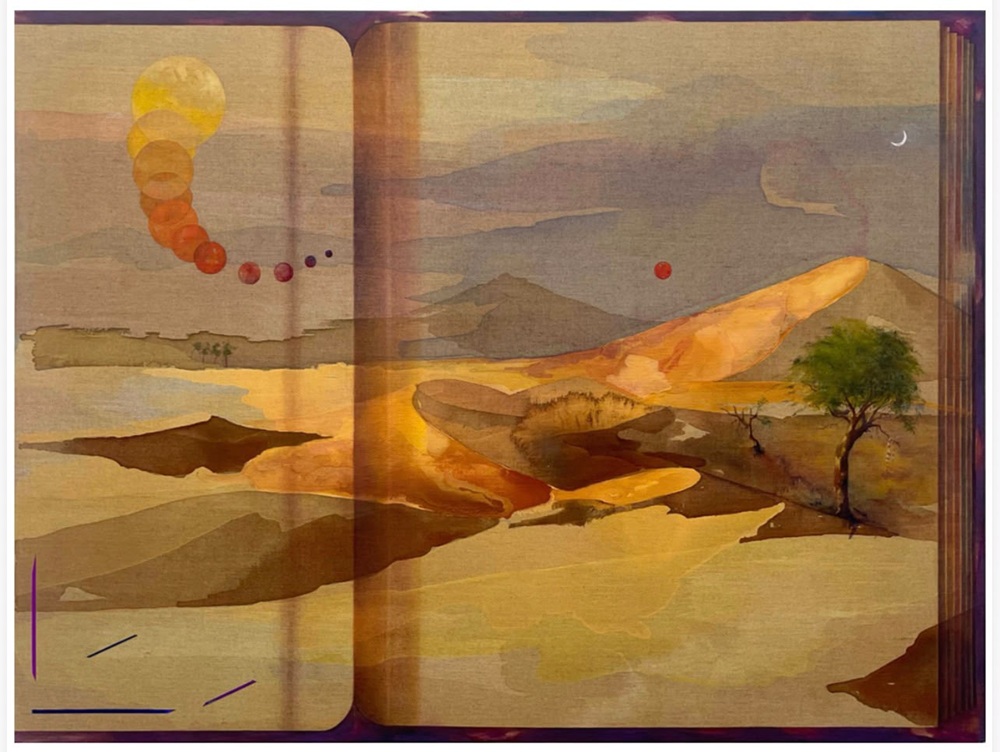
Offspring by Zahra Jewanjee
He brings a different energy. Drawing inspiration from the landscapes of his hometown in Parachinar and from artists such as El Greco and Jean-François Millet, he works with rich colour and textured brushwork. Vast Farmland, Untitled, Haystack Near Field and Aggressive Sky Before Rain show fields, trees and cloudy skies treated with impressionistic curves. Abbas moves from a once monochromatic way of seeing into a world of vibrant hues. His paintings capture the transient quality of light and weather, blending realism with a reductive abstraction that recalls post-impressionist approaches. The scenes are not idealised Arcadias. They feel full of the quiet anxiety of dim light that somehow resolves into charm and excitement. The presence of birds and the sounds of nature can be felt even when they are not directly depicted. Abbas reaffirms a deep responsiveness to the land through careful, almost reverent handling of paint.
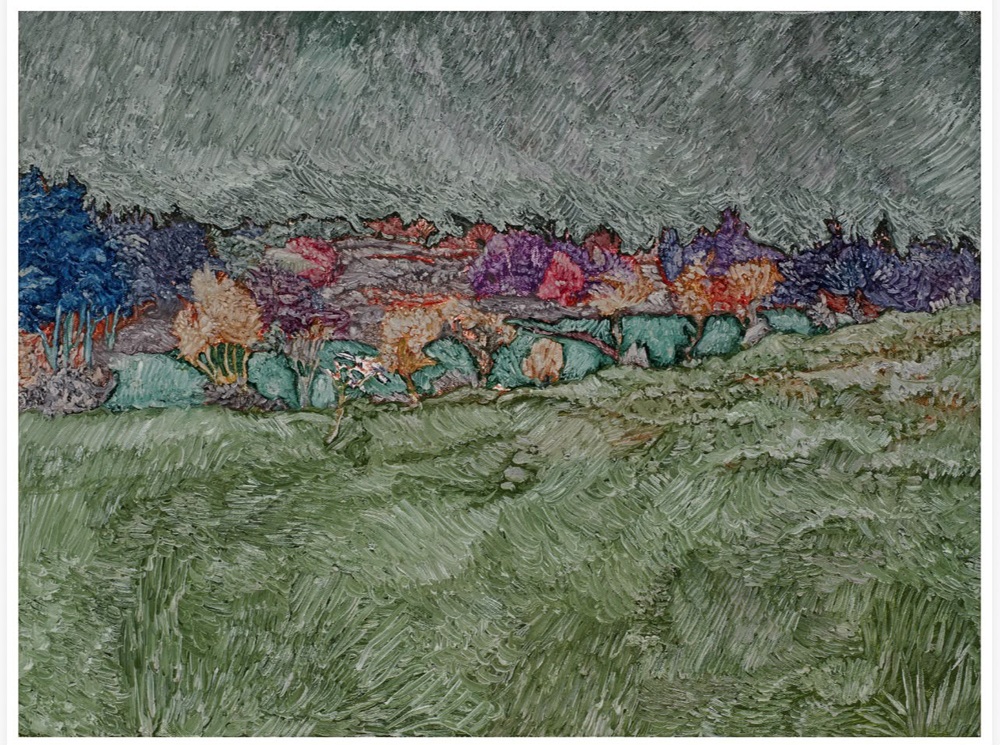
Aggressive Sky Before Rain by Yawar Abbas
Her approach to landscape is a disciplined process that combines free brushwork with mechanical control. Using stencils, she traps gestural marks into grids of vertical dashes. Language of the Land, A Land Holding Its Breath, The Land Finds Its Shape, and Fault Line reveal densely textured surfaces where clusters of colour accumulate and then are ordered by geometric windows. The foreground and background switch roles, creating instability that becomes a form of meaning.
The grid in her work is more of a caged, built-up sacred emotion that renders a new perspective; the absolute mirage that carries a facade in its own tide; the palette is pungent and as if it filters the energy from the outside world.
Raj’s method turns the canvas into a site of guided expression. The final compositions feel both personal and systematic; colour choices grow more individual with each layer. New details appear with prolonged looking. Her paintings suggest that landscape is not a passive backdrop but an active construction of marks and decisions.
Aggressive Sky Before Rain by Yawar Abbas
Aggressive Sky Before Rain by Yawar Abbas
Aggressive Sky Before Rain by Yawar Abbas
Taken together, the exhibition refuses the easy comfort of the rural tradition. The artists do not eliminate spiritual aspiration; they simply relocate it. Small events of colour and form, shifts in light and perspective, and the careful handling of paint create a sense of ephemerality. Akhtar notes that “sublime,” used as a verb, means the conversion of a solid substance directly into a gas. They convert solid scenes into something more transient and reflective.
Each artist maintains a distinct voice while contributing to a shared conversation about how we see, remember, and inhabit the land. Jewanjee’s ironic distance, Abbas’s textured responsiveness, Raj’s disciplined grids, Shahir’s symbolic stillness and Hanzla’s critical gaze form a coherent yet varied whole.
They are simply honest about the complexity of place. “Second Nature” does not replace the old ideal with a new one. Instead, it opens the window a little wider, allowing air, uncertainty, and genuine observation to enter; foregrounding such a perspective comes with a person’s journey of self, and it is seen in all the above. The result is an exhibition that feels both grounded and quietly expansive, that keeps one lingering for a few more minutes.
You may also like: