Written by: Anum Zaeem
Posted on: September 09, 2025 |  | 中文
| 中文
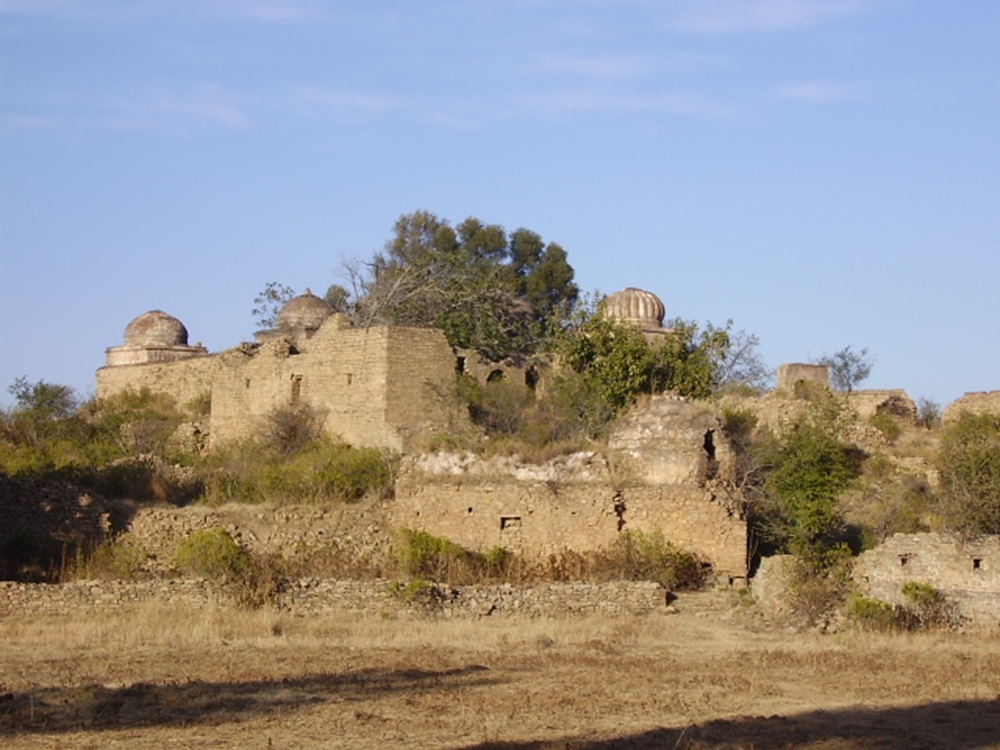
The ancient fortress of Tilla Jogian crowns a hilltop.
High atop the mystical Salt Range of Pakistan's Punjab province stands Tilla Jogian, an ancient Hindu temple complex whose weathered stones whisper tales of two millennia. This sacred summit, rising 975 meters above sea level, represents one of the subcontinent's most historically significant yet tragically abandoned pilgrimage sites. For the intrepid traveler seeking to uncover Pakistan's diverse spiritual heritage, Tilla Jogian offers an extraordinary journey through time, faith and architectural splendor.
Located approximately 25 kilometers west of Jhelum city and 50 kilometers north of Bhera, Tilla Jogian crowns the highest peak in the eastern Salt Range. The name itself reveals its sacred purpose: "Tilla" meaning hill in Punjabi, and "Jogian", referring to the ascetic yogis who once called this mountaintop home. The complex sits strategically near the historic Jhelum River and the ancient Grand Trunk Road, that legendary route which connected Central Asia to the Indian subcontinent for centuries.
The temple complex enjoys a unique microclimate due to its elevation, offering cooler, wetter conditions compared to the scorching Punjab plains below. Dense forests of olive trees, pines and Acacia modesta cloak the mountainsides, creating an atmosphere of profound serenity that continues to captivate visitors today. From this lofty perch, pilgrims and travelers can witness sunrise earlier and sunset later than anywhere else in the region, a phenomenon that made this site sacred to sun worshippers for thousands of years.
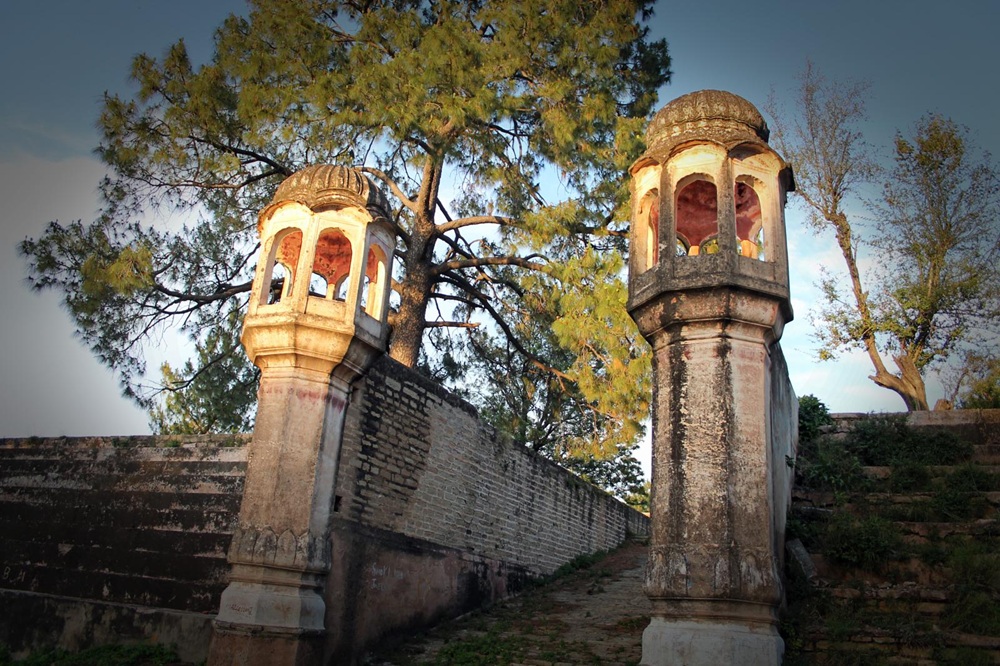
Golden hour light illuminates the intricate chattris (elevated pavilions) of Tilla Jogian.
The origins of Tilla Jogian stretch back over two millennia, with traditional accounts dating its founding to 100 BCE. The complex was established by followers of Guru Gorakhnath, the revered founder of the Kanphata Jogi sect, ascetics distinguished by their pierced earlobes, symbolizing their complete renunciation of worldly pleasures. These devoted jogis, also known as Nath Yogis, created a thriving monastic community that would endure for over 2,000 years.
The site's ancient pedigree attracted the attention of some of history's most prominent figures. Mughal Emperor Akbar visited what his chronicler Abul Fazal described as the "Shrine of Balnath," marvelling at its antiquity and noting that its origins had become obscured by the mists of time. The 17th-century Emperor Jahangir also made pilgrimages to these sacred heights, underscoring the complex's enduring religious significance.
Perhaps most notably, Guru Nanak, the founder of Sikhism, spent 40 days in meditation at Tilla Jogian in the early 1500s. This extended retreat, known as a 'chilla,' was undertaken to understand the ideology of the jogis and engage in spiritual discourse with them. The tradition of this visit is recorded in the Miharban Janamsakhi, and Maharaja Ranjit Singh later commemorated it by constructing a stone-lined pond and monument marking the exact spot where Guru Nanak meditated.
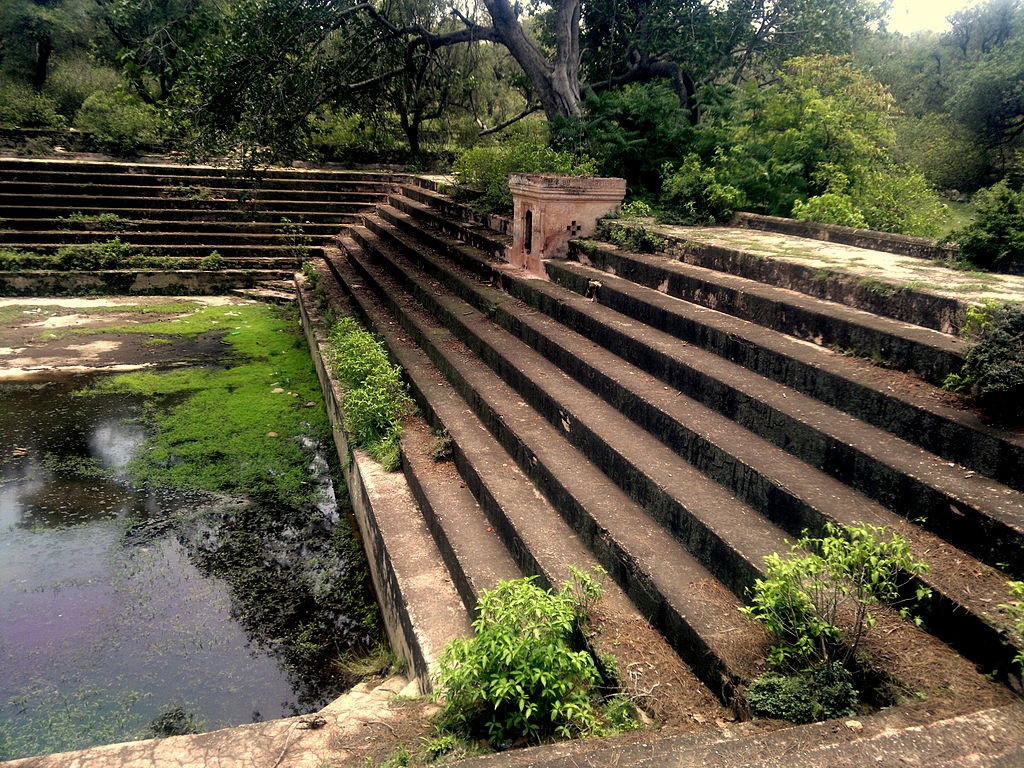
Geometric precision meets natural decay in these stepped water channels.
The Tilla Jogian complex represents a remarkable achievement in medieval religious architecture. Twelve intricately carved temples, all constructed from local stone in traditional square configurations, are clustered across the mountaintop. These structures, though now in ruins, once showcased the finest elements of Hindu temple architecture with detailed carvings and symbolic motifs that reflected centuries of artistic evolution.
The complex features a sophisticated water management system that speaks to the engineering prowess of its builders. At least three ceremonial baths and a network of waterworks, including two minor dams, ensured a constant water supply for the hundreds of resident ascetics. The crown jewel of this system is a magnificent square water tank, constructed during the Mughal period in Central Asian style. This sarovar features ten steps on each of its four sides and was designed to collect and store rainwater from the surrounding catchment area.
Particularly striking are the two cupolas with their descending staircases and the various temple structures scattered across the complex. The water tank's northern wall showcases a ramp flanked by semi-hexagonal minarets topped with elegant kiosks and ribbed domes crowned by decorative lanterns. The eastern section features carved female bathers and cross-legged deities, separated by walls that once provided privacy for different groups of pilgrims.
The famous stone pathway known as the "Poorhiwaala Rah" winds its way to the temples after crossing the Ratti Banni ravine, though this ancient route has begun disintegrating due to decades of neglect. The monastery itself once housed extensive residential areas surrounding a Brahminical seminary where religious learning flourished for generations.
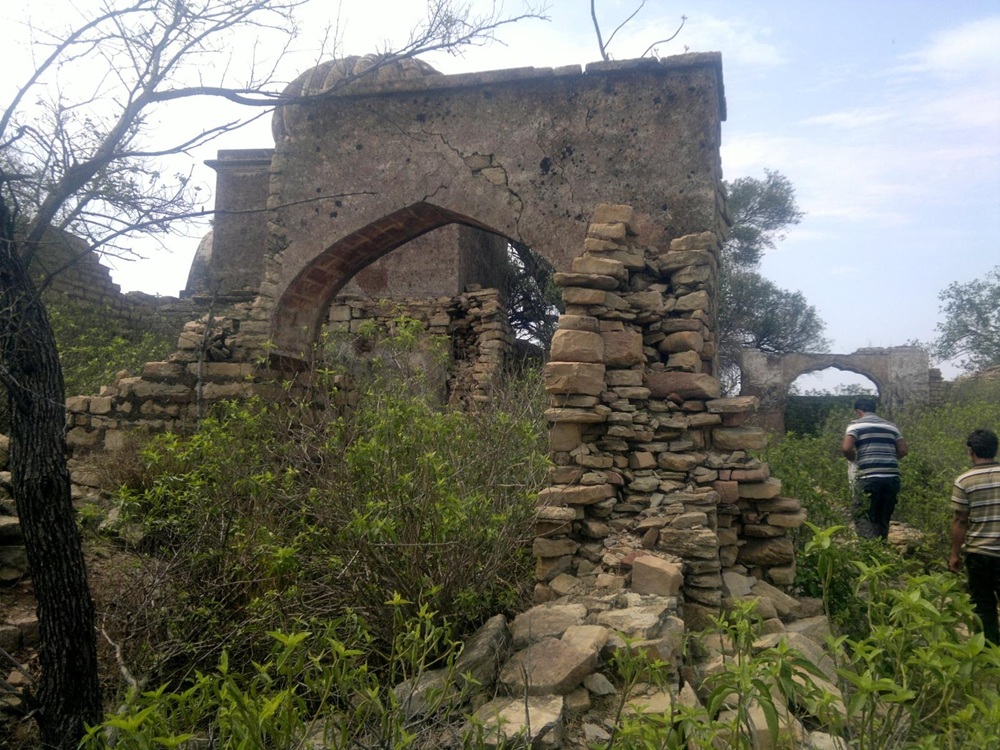
Crumbling archways frame glimpses of history at Tilla Jogian.
Tilla Jogian occupies a special place in Punjabi literature and culture, most famously appearing in Waris Shah's epic love poem "Heer Ranjha," written in 1766. According to legend, the heartbroken hero Ranjha travelled from his village in Jhang to seek solace at Tilla Jogian after losing his beloved Heer. Here, in the tradition of Guru Gorakhnath's followers, he had his ears pierced and joined the brotherhood of jogis, transforming into the "faqir of Heer."
The site also features in the accounts of Al-Biruni, the renowned scholar who accompanied Mahmud of Ghazni's expeditions. Some traditions suggest that this great mathematician spent thirteen years in the region, using Tilla Jogian as one of his observation points for calculating the Earth's circumference, a scientific achievement that remained unmatched for centuries.
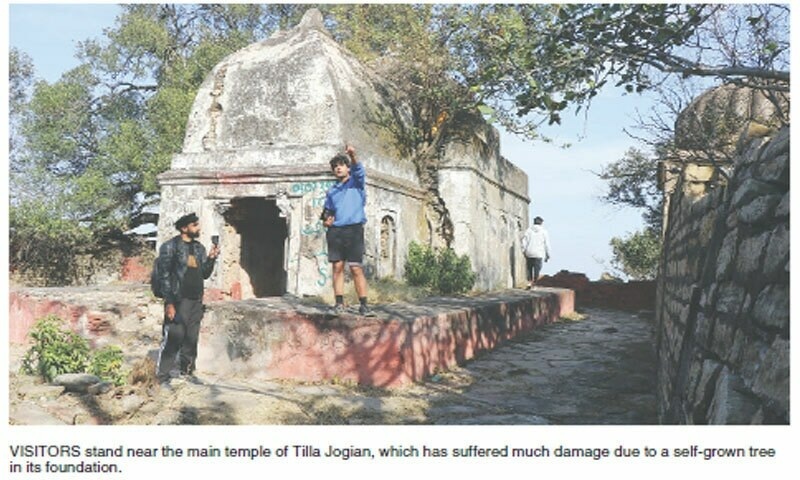
Visitors explore the main temple structure where ancient stones bear witness to countless prayers and pilgrimages throughout the centuries.
Reaching Tilla Jogian requires either physical endurance or an adventurous spirit. Two main routes lead to the summit: one begins from Rohtas Fort and winds 24 kilometers through scenic terrain, while another starts from the village of Bhet on the mountain's northern face. This latter route involves a challenging 3-kilometre trek with an ascent of nearly 500 meters through dense vegetation, rocky outcrops and thorny undergrowth.
For those preferring motorized transport, a jeep track suitable for SUVs and motorcycles provides access, though the journey remains an adventure. The reward for this effort is unparalleled: panoramic views stretching across the Punjab plains, glimpses of the historic Jhelum River and the serene atmosphere that has drawn seekers for millennia.
The partition of British India in 1947 marked the beginning of Tilla Jogian's decline. As communal violence erupted, the last priest, Samandnath Jogi, appointed a local caretaker and fled to India, never to return. Within six months, as instructed, the temple's modest belongings were auctioned off, marking the end of two thousand years of continuous religious observance.
Today, the complex stands as a monument to both human devotion and neglect. Vandals have damaged several structures, including Ranjit Singh's memorial to Guru Nanak's meditation site. Local villagers have scoured the ruins for coins and artifacts, while invasive vegetation gradually reclaims the ancient stones. Despite being declared a National Park in 2021, conservation efforts remain inadequate and this priceless heritage continues to deteriorate.
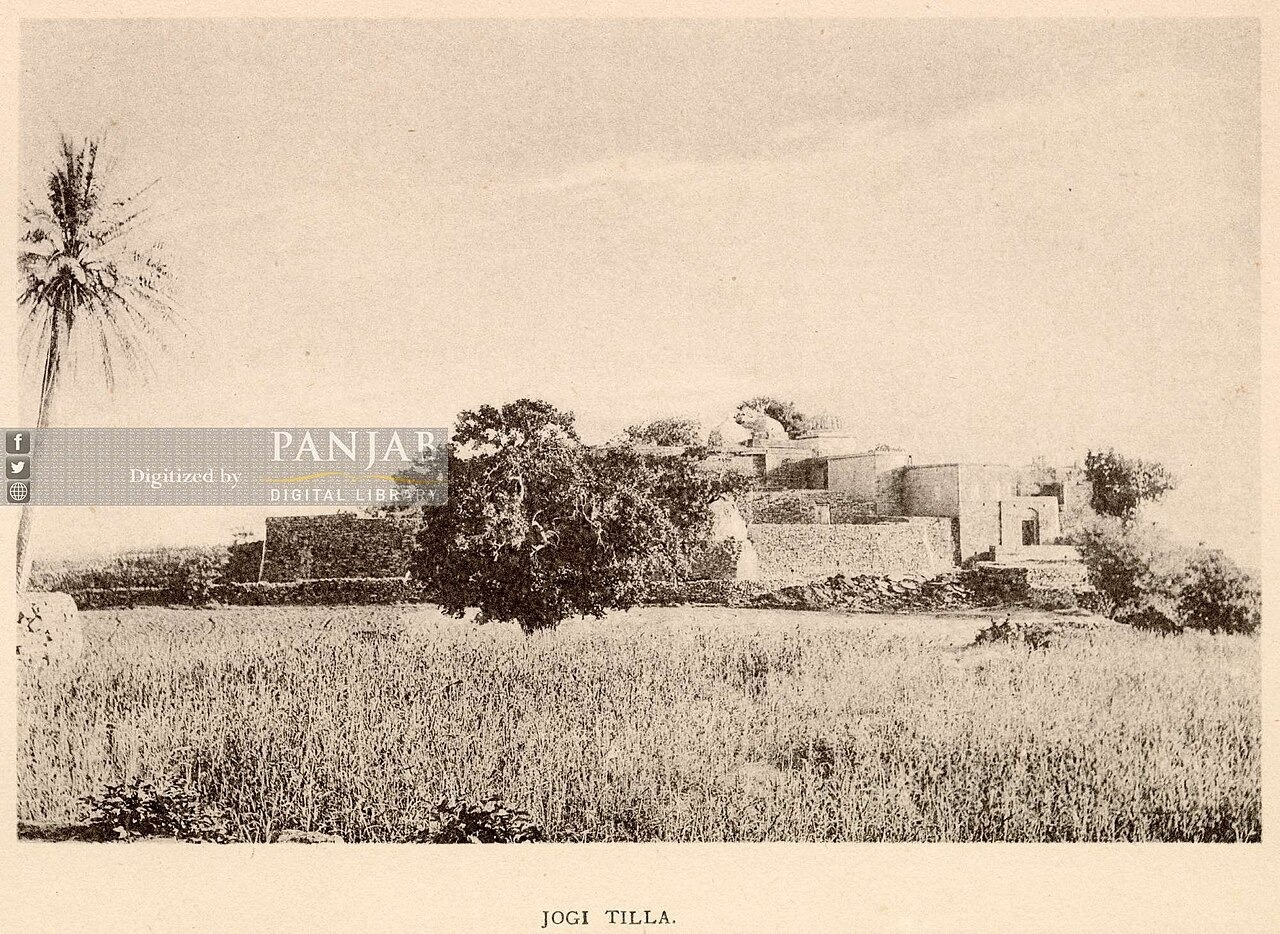
A 19th-century sketch captures Tilla Jogian as British colonial artists first documented it.
For the modern traveler, Tilla Jogian offers a unique opportunity to witness Pakistan's remarkable religious diversity and architectural heritage. The site represents not just Hindu history, but the shared cultural legacy of all South Asians. Residents, including elderly villagers who remember pre-partition festivals, continue to welcome the occasional Hindu and Sikh pilgrims who still make the journey from India and beyond.
As one dejected visitor observed, "Tilla Jogian is more than ruins, it is a testament to Pakistan's diverse spiritual roots and a bridge between civilizations." Its preservation represents not merely the safeguarding of ancient stones but the reclaiming of a narrative of coexistence and resilience that transcends modern borders.
Tilla Jogian stands today as both inspiration and warning, a sacred summit that connects earth to sky, past to present, and all humanity to our shared spiritual heritage. For those willing to make the journey, it offers rewards beyond measure: silence deeper than valleys, views broader than horizons and connection to the eternal human quest for meaning among these ancient, weathered stones.
You may also like: