Written by: Zulfiqar Ali Kalhoro
Posted on: March 25, 2026 |  | 中文
| 中文
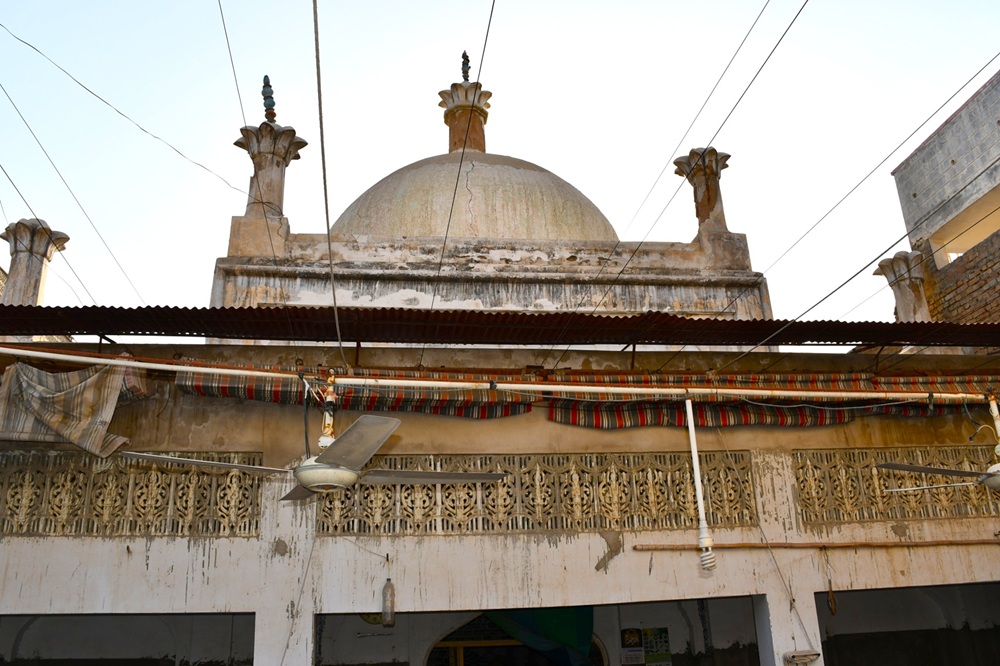
Front view of Qubai mosque in Memon Mohallah, Shikarpur (Picture credits to Zulfiqar Ali Kalhoro)
Shikarpur is home to a remarkable number of historic mosques constructed between the seventeenth and twentieth centuries, scattered across the city’s old neighbourhoods and lanes. These mosques are not only places of worship but also important markers of the city's social and cultural life. Over time, many of them have been renovated or completely rebuilt, reflecting the community's changing needs while preserving traces of their earlier character. The older structures were particularly noted for their rich decorative traditions: vivid wall paintings, ceramic murals, and beautifully carved wooden doors and ceilings. These artistic elements reveal the aesthetic sensibilities of local artisans and patrons, offering a glimpse into the devotional and cultural landscape of Shikarpur in earlier centuries.
I have been visiting and documenting these historical mosques since 1998. The earliest mosque in Shikarpur is said to be Haji Latif Shah Jilani, formerly known as Haji Shah Faqirullah Alavi mosque, located near Lakhidar (Lakhi gate). Haji Shah Faqirullah Alavi, an eighteenth-century Naqshbandi Sufi saint of Shikarpur, first taught here. Later, he founded another mosque, which is located adjacent to his tomb. It was built in the eighteenth century. Several other mosques were built in the eighteenth century.
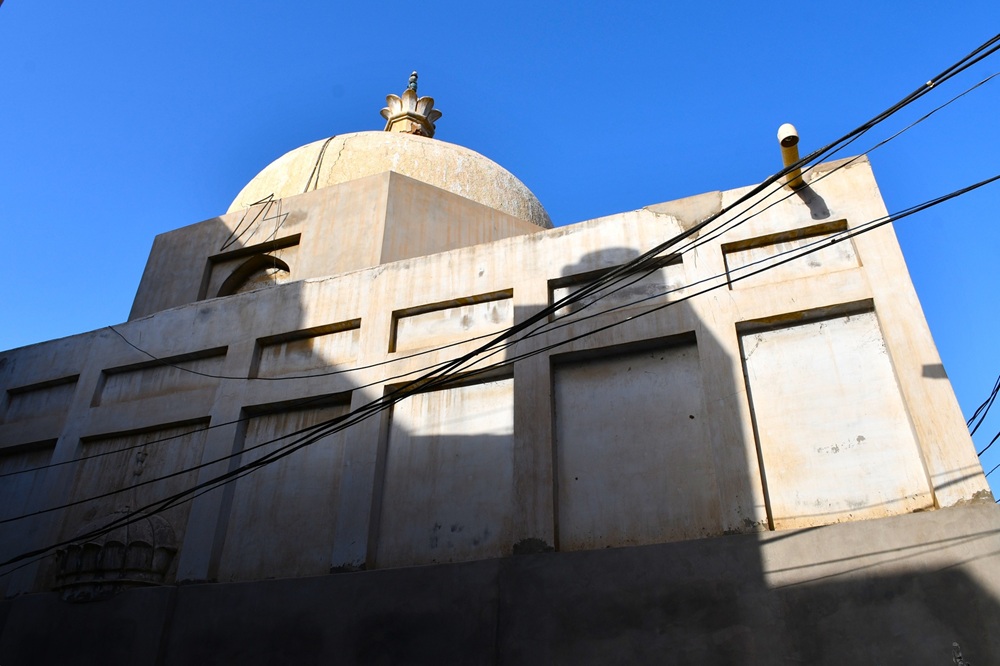
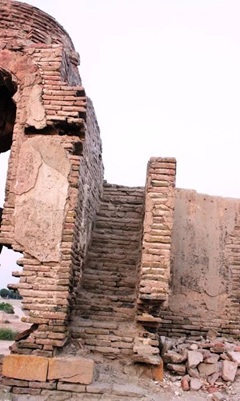
Western view of Qubai Mosque in Shikarpur (Picture credits to Zulfiqar Ali Kalhoro)
In this article, I discuss a historical mosque believed to have been built by Ghaffar Khan and Nawab Ibrahim Khan, as indicated by a Persian inscription in the mosque. This mosque is located in Memon Mohallah near Sattey Bazaar in Shikarpur.
According to Professor Abdul Hayee Moryani (2019:218), the author of Shikarpur Jun Masjidon Ain Eid, it was built in 1260 AH/1844 CE. However, on the same page (2019:218), he states that the mosque was built in 1269 AH, which contradicts his earlier claim that it dates to 1260 AH / 1844 CE. He suggests that the construction date was calculated through the Abjad numerical system, deriving the year 1260 AH from a Persian chronogram inscribed above the mihrab of the mosque. According to this reading, the mosque would indeed have been built in 1260 AH/1844 CE. During my visit to the mosque, I noticed the Persian inscription above the mihrab, photographed it, and later shared the image with my friend Abdul Hussain Musavi to verify the date through the chronogram. However, the inscription has suffered damage over time, and parts of it may have been whitewashed during renovation, making the exact date difficult to confirm. Despite this, the names Ghaffar Khan and Nawab Ibrahim Khan remain legible, indicating that they were the builders of the mosque. Locally, the mosque is known as the Qubai Mosque, a name derived from the prominent dome that crowns its main prayer hall, as it is a single-domed structure.
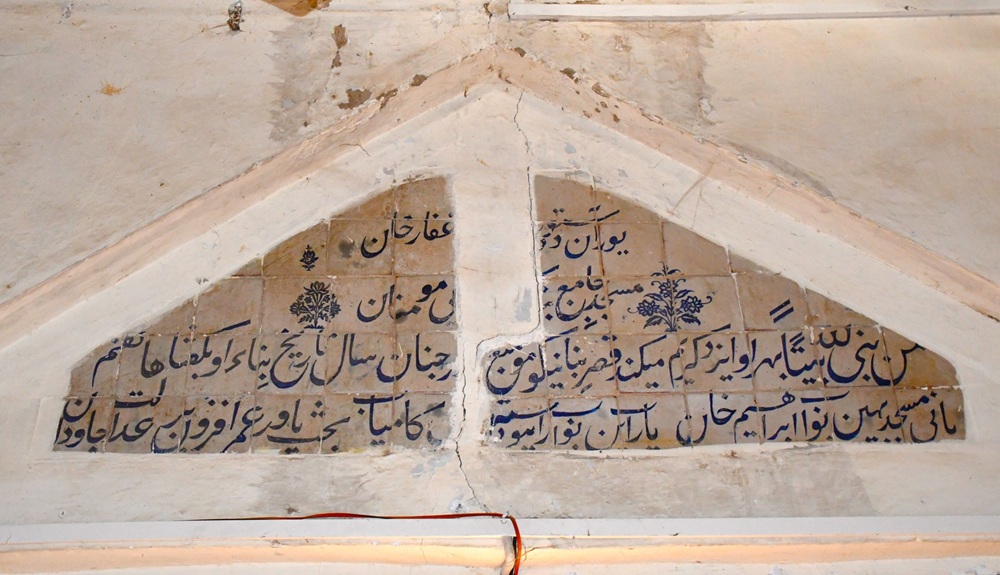
Persian inscription in Qubai mosque (Picture credits to Zulfiqar Ali Kalhoro)
Such single-domed mosques are located in the various localities of Shikarpur. These mosques are noted for their carved wooden doors and ceramic murals. One such single-domed mosque is located in Awan Mohallah. Qubai Mosque in Sheedki Khuhi, in Awan Mohallah, is one such mosque noted for its ornately carved wooden window. This mosque was probably built in the last quarter of the 19th century. Like several other historical mosques in Shikarpur, the Qubai mosque in Awan Mohallah has been renovated several times. Still, the mosque's window is a fine example of the fabulous craftsmanship of Shikarpur's artisans and was not removed during the renovations. The Kalma Tayyaba and ‘Bismillah' are engraved on the wooden window. Such intricate woodwork is not found in any other mosque in Shikarpur, reflecting the mastery of Shikarpuri artisans in wood carving. Intricate wooden windows and doorways are also found in other mosques of Shikarpur.
The main portal of the Qubai mosque in Memon Mohallah opens onto a spacious courtyard, leading to a later-added covered verandah. The covered verandah has concealed the facade of the mosque. A doorway leads from the covered verandah to the main prayer hall of the mosque. The distinctive features of the mosque's prayer hall are the Persian inscription and blue tiles adorning the spandrels of the mihrab arch. Previously, the entire mihrab was decorated with blue tiles. However, during a renovation, tiles were removed. The only surviving tiles are found on the spandrels of the arch. Blue-glazed tiles were used in most mosques in Shikarpur. Another mosque noted for its blue tiles is located in the Panj Pir locality and is called Panj Pir mosque. The Panj Pir mosque in Panj Pir Mohallah is also well-known for its wooden doors. The wooden door of the main entrance of Panj Pir mosque is ornately carved. This mosque is believed to have been built by Muhammad Umar Soomro, the father of Shaheed Allah Bakhs Khan Soomro (d. 1943). According to Professor Abdul Hayee Moryani (2019), the mosque was small and lacked ornamentation earlier. It was demolished, and a grand mosque was built by Muhammad Umar Soomro. He brought the masons from Multan to build the mosque. As per the inscription on the main portal and verandah of the mosque, it was built in 1327 AH / 1909 CE.
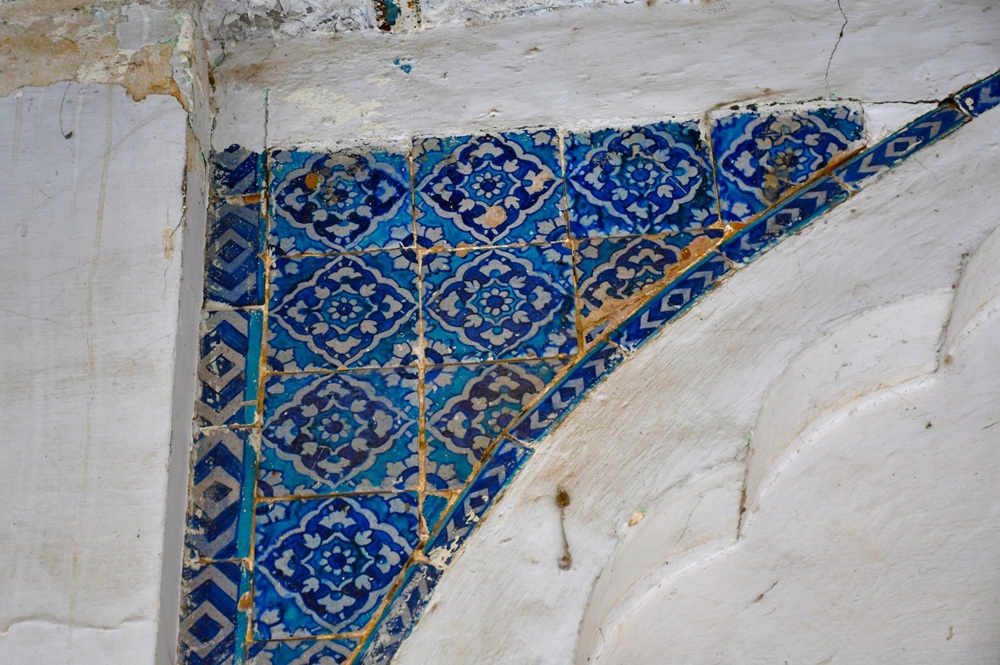
Blue tilework in Qubai mosque (Picture credits to Zulfiqar Ali Kalhoro)
Another distinctive feature of the mosque is the corner turrets. Two turrets rise from the parapet wall in front of the dome, adding beauty to the structure. A finial also surmounts the mosque's dome. The corner turrets and those in front of the dome resemble those of the Jamia mosque near Lakhidar, indicating that the Qubai mosque drew inspiration from it.
The lower sections of the western and southern walls of the Qubai mosque has been replastered with modern cement mortar. A darker cement layer now covers this portion of the wall, a practical repair often carried out by local masons to strengthen aging masonry and protect it from rising damp and weathering.
The masons of Shikarpur were remarkably innovative, skilled, and perceptive. They not only introduced their own ingenious techniques but also skillfully adapted and imitated architectural features that inspired them most, blending originality with borrowed elements to create distinctive and enduring structures.
The writer is an Associate Professor and Anthropologist at the Pakistan Institute of Development Economics (PIDE), Islamabad. He has authored 18 books on Pakistan's cultural heritage and anthropology. He tweets @kalhorozulfiqar. He may be contacted at zulfi04@hotmail.com
You may also like: