Posted on: September 07, 2026 | 
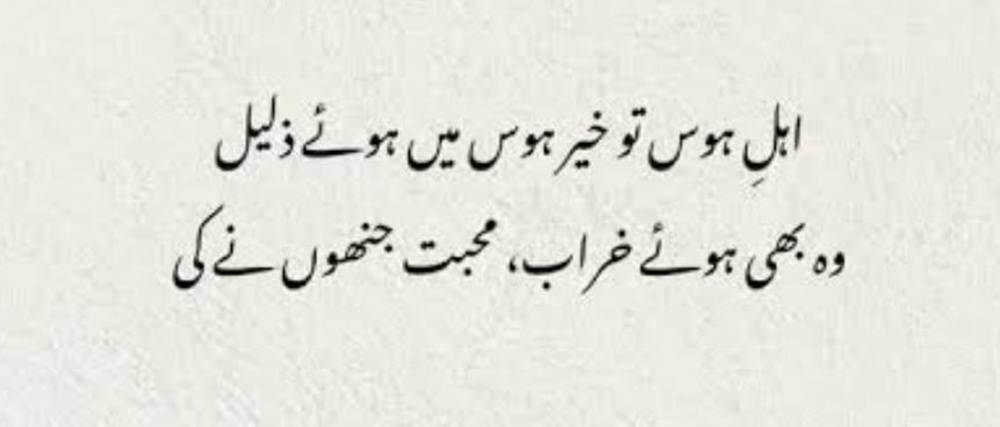
Lustfuls got robbed by the implication of their relentless desire/ But the problem is that even the people with brimming love in their hearts got destroyed as well.
There is sadness that makes you lose your appetite; it comes to your face, and there is sadness that does not announce itself. It lingers in shadows; you cannot really notice until you become aware of how it's glaring at you with its eyes wide open; it's there when you are in your space.
Bahar Khob Haso bolo
Ronay dhonay ko ghar hy
Enjoy yourself outside home
It's home where your morn your loss
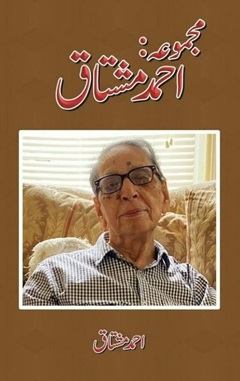
This is Ahmad Mushtaq writing your emotions for you.
The sadness in his poetry arrives the way dusk does, imperceptibly, and then all at once. Ahmad Mushtaq is a poet of that dusk. Across six decades of writing, from the Lahore of his youth to the Houston of his self-imposed exile, he carries a voice that speaks in a hush so precisely calibrated that silence itself begins to feel like a third syllable in every verse. Kulliyaat-e-Ahmad Mushtaq, the collected works published by Sang-e-Meel Publications and prefaced by Intezar Husain, himself a master of loss and cultural memory, represents the body of this labour.
He has been regarded as a poet of Neo-Classical tone by Rekhta. The designation is accurate, but dangerously reductive if left unexamined. Some scholars suggest that his craft lies primarily in preservation, in keeping the old lamps lit, an echo of the past. That would be an injustice because what Mushtaq actually does is more supple. He inhabits the classical architecture of the ghazal, the Matla, the Qafia, the Radif, the Maqta, not as a curator inhabits a museum, but the way a master carpenter inhabits a form: knowing the grain, knowing where to cut against it. His metrics are exact, his Radifs are chosen with a craftsman’s patience.
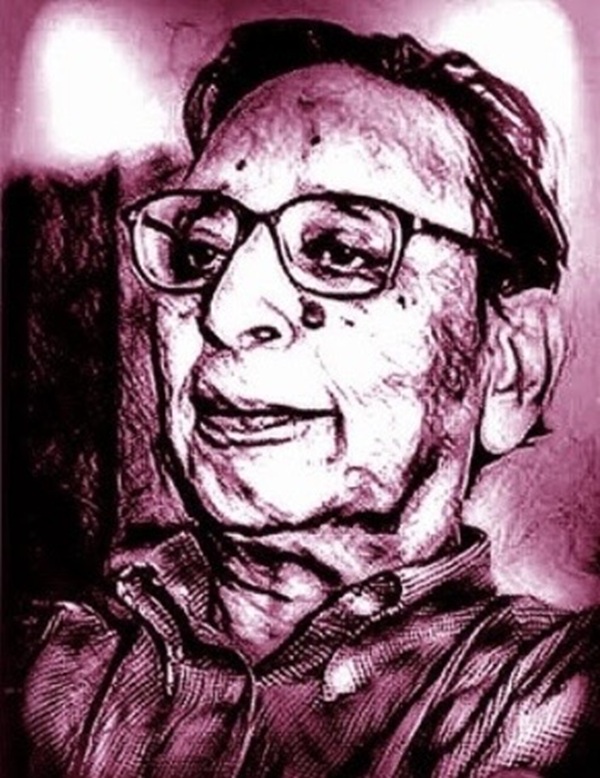
Ahmad Mushtaq
The form in his poetry is never the point. The form is merely the vessel through which something more urgent flows. The scholarly study Ahmad Mushtaq: A Poet in Quest of Civilization Traces (Tahqeeq-oTajzia, 2025) identifies this accurately: Mushtaq’s creative sensibility is “deeply engaged with cultural memory and civilizational heritage.” This is the more honest framing. He is not a poet who refused to enter the twentieth century; he did enter it, perhaps only to grieve what he found there.
In his poetry, form can be studied as feeling. The most distinctive technical signature of Mushtaq’s ghazals is what might be called the poetics of restraint: the refusal to decorate where the raw image suffices, the refusal to elaborate where the ellipsis says more. Consider one of his most celebrated couplets.
Paani mein aks aur kisi aasmaan ka hai
Ye naav kaun si hai ye dariya kahan ka hai
“The reflection in the water belongs to some other sky/ What boat is this? What river is this, and where does it flow?”
The line has the formal clarity of a classical sher, yet its vertigo is entirely modern; loss in the idea aligns with loss in form. The speaker does not know which river they travel, does not recognize the sky reflected beneath them. Belonging and reflection have come apart. It is one of the most economical expressions of diasporic disorientation in all of Urdu literature, and it achieves this without the word “diaspora,” without the word “exile,” without even the word “loss.” The river does the work. The sky does the work. The question mark does the rest. This is Mushtaq’s signature: image over any abstraction. He trusts the concrete object water, a window, a moon, an autumn leaf to carry philosophical weight that another poet would need three verses to explain. His ghazals rarely expatiate. They compress. Another sher, frequently cited for its aching understatement:
Ihlay haswas to khair hawas main hoaye zaleel
Wo bhi hoaye kharb muhhabat jinho nay ki
Lustfuls got robbed by the implication of their relentless desire
But the problem is that even the people with brimming love in their hearts got destroyed as well.
The contrast between love and lust has remained one of his striking themes across his Kuliyat.
In another verse he says,
Hamin sab ahlay Hawas napassand rakhtay Hain
Ke hum nawaye Muhabbat buland rakhtay Hain
I am always hated by lustful people, because I am the advocate of the celestial voice of LOVE.
At the same time, his classical flair can easily be seen in his metaphors,
Ek lamhay main bikhar jata hy tana bana
Or phir umar Guzar jate ha yaktai main
The metaphor of weaving, tana-baana, the warp and weft of cloth, is classical in resonance, rooted in the domestic and the craft, yet what Mushtaq does with it is distinctly modern: the instant of destruction, versus the lifetime of reconstruction. Time is labour. The ghazal’s brevity makes the asymmetry devastating: one line for the unravelling, one line for the entire rest of the life. The form mirrors the content with almost cruel efficiency.
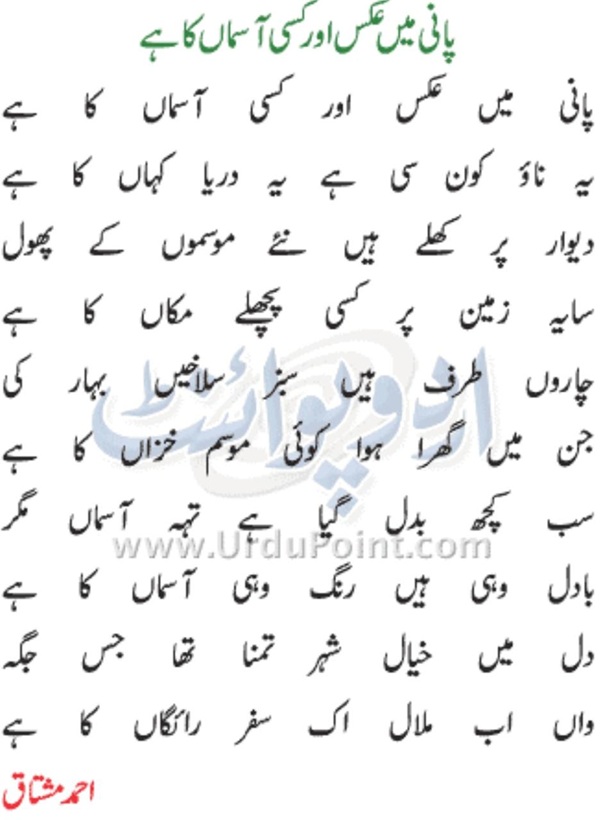
The reflection in the water belongs to some other sky
Mushtaq’s imagery draws from a consistent, carefully maintained symbolic vocabulary: water, moonlight, dust, autumn, the window (dareecha), the road (raasta), and the city seen from a distance. These are not arbitrary choices. Together, they construct a world in which beauty is always already departing, where the moon is seen in water rather than in the sky. The light arrives as reflection and not as a source. His collection Gard-e-Mahtaab “Dust of the Moon,” or more poetically, Moondust, announces this aesthetic from its very title. The moon is an ancient image in Urdu poetry, ranging from the beloved’s face in classical ghazal to the satellite of modernity’s alienation in progressive verse.
In Mushtaq, the moon becomes (gard) the dust. It is not the moon in its fullness, its illumination. It is what the moon leaves behind, the powdering of light on surfaces that cannot hold it. This is a characteristically oblique entry into the symbol not through the moon’s power, but through its residue. His relationship to Nasir Kazmi, documented in his critical work Hijr Ki Raat Ka Sitara (The Star of the Night of Separation), is also revealing. Mushtaq chose to write a critical biography of Kazmi, the great poet of partition-loss and Lahore’s fading aristocracy of feeling.
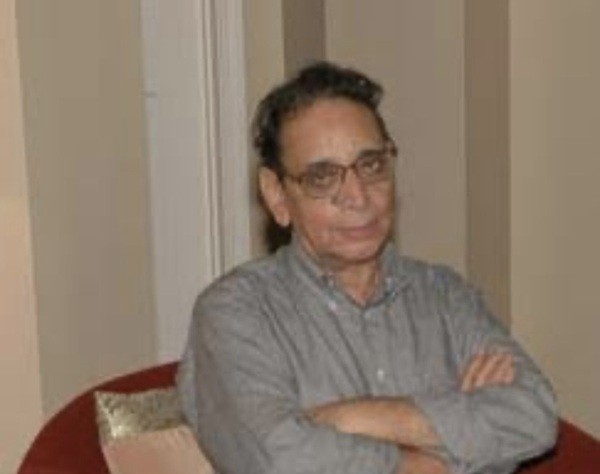
Ahmad Mushtaq
The title he gave it: a star that belongs to the night of separation. One senses that Mushtaq recognised in Kazmi a kindred aesthetic: the night not as a dramatic backdrop, but as the condition in which the lone star is even visible.
Mushtaq left Lahore though he carried Lahore. He has been writing the distance between those two facts ever since. His speakers do not wallow in nostalgia. They note, with the precision of a surveyor, the exact coordinates of what is no longer accessible.
Pata ab tak nahin badla hamara
wahi ghar hai, wahi qissa hamara.
“Our address has not changed; it is still that house, still that old story of ours.”
An address that has not changed. A house that remains. And yet the poem makes devastatingly clear that the speaker has changed; that the constancy is the cruelest detail. Home stays. The self that belongs to it is the thing that travels, that disperses, and becomes someone else in a foreign city under a foreign sky, and can never entirely reverse the becoming. This is what separates Mushtaq from a merely nostalgic poet: he does not romanticise return. He knows the door is the same. He knows the problem is the hand reaching for it.
What characterises his post-2003 verse is a quiet stillness: the compression has become even more exact, the images more solitary. If the earlier Mushtaq wrote with the controlled grief of a man who still believed the distance was survivable, the later Mushtaq writes with the more peaceful, more final knowledge of someone who has accepted the distance as the condition of his existence. He is not bitter. Bitterness requires a belief that things should have been different. Mushtaq has always known that things were as they were, that a river does not flow back to apologise to the banks it has left behind.
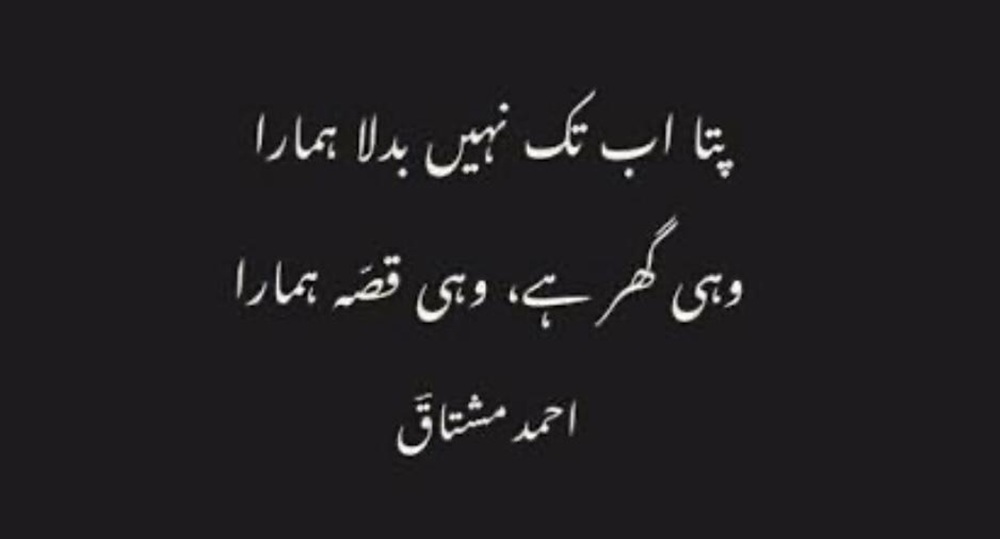
Our address has not changed/ it is still that house, still that old story of ours
To read him is to learn that grief has its kinds: the quiet, unexpressive, alive; it does not cry, it sits, still, like water carrying a sky that belongs to somewhere else, in a river one cannot name, moving in a direction one has long since stopped questioning. Ye paani khamoshi se bah raha hai. This water flows in silence. And in that silence, a whole literature. He is the poet of nameless longing whose verses blessed Urdu poetry.
Guzarnay wlay to kab kay guzar gaye dill sy
Ye kon chez chamalkti hy naqash-e-paa ki trah
Those who were to leave have left long ago
Yet there is a thing that flickers like a hope
You may also like: