Written by: Haroon Suhaib
Posted on: September 09, 2026 | 
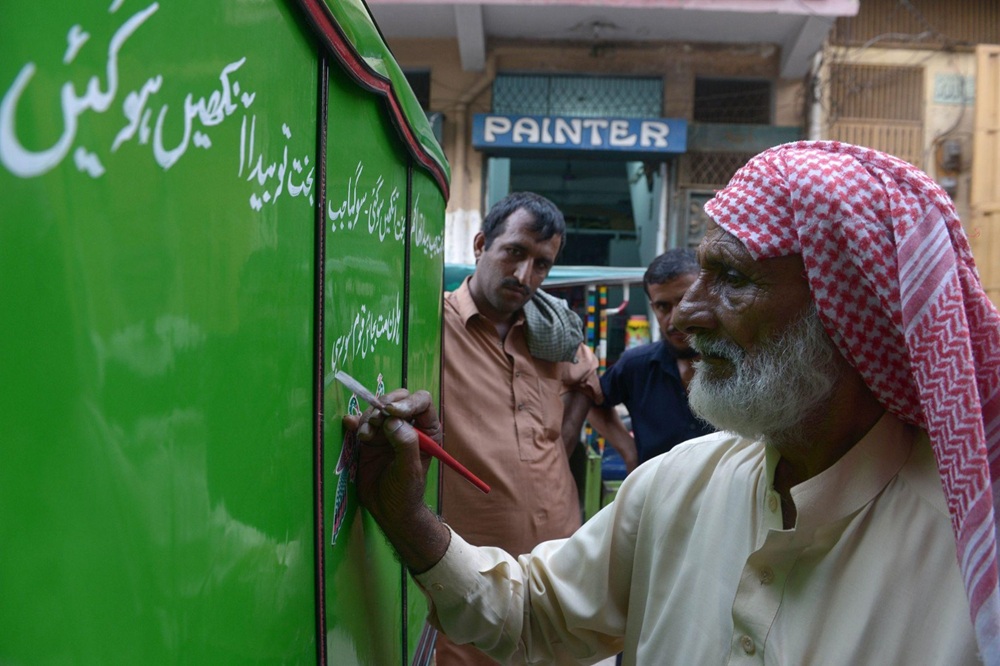
Before the pixel took over the street, there was the human hand. An ustad at work, carrying forward the vanishing craft of hand-painted lettering.
There was a time when walking down a busy Pakistani street meant being surrounded by somebody’s brushstrokes. Above shops, names curled across wooden and metal boards in Urdu and English, sometimes neat and restrained, sometimes flamboyant enough to compete with the business next door. A barber announced himself with painted scissors and a comb. A mechanic might have a tyre, motorcycle or improbably gleaming engine part suspended above his name. At railway stations, advertisements for tea, electric fans and beauty products were painted rather than printed.
Outside the great single-screen theatres, familiar faces returned in gigantic proportions. Sultan Rahi glared down at the traffic, gandasa in hand. Romantic heroes and heroines gazed dramatically past one another. Villains appeared suitably menacing. Film titles exploded across façades in stylised Urdu lettering. Colour was unapologetic, expressions exaggerated, and subtlety was hardly the point. The poster had only a few seconds to persuade a passer-by to buy a ticket.
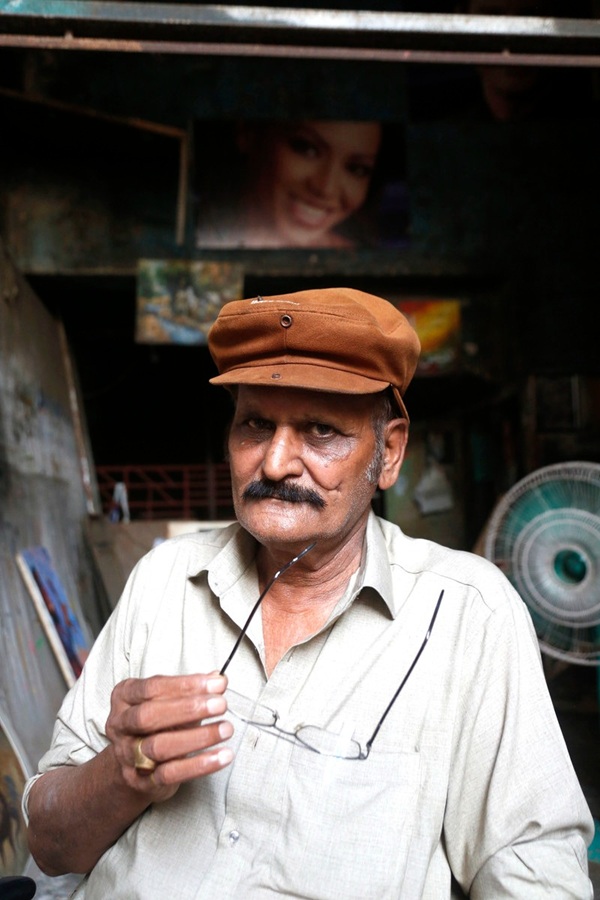
Pervez Bhatti began painting cinema advertisements in Karachi in 1971. With computer-generated banners having largely displaced the craft, he continues to paint from a corner of Nigar Cinema
Look closely at this streetscape and there was something else everywhere: evidence of a human hand. A line might not have been perfectly straight. Two versions of the same letter might differ slightly. A face had been interpreted rather than reproduced. Behind every board was a painter who had mixed the colours, judged the spacing with his eyes and climbed a ladder to put brush to surface. For decades, this was part of the ordinary visual language of Pakistan. Nobody necessarily stopped to call it art. It was simply what the street looked like.
Today, much of that street has disappeared without the streets themselves going anywhere. Walk through a commercial market now and the names are still overhead. Advertisements still compete for attention and the colours may be brighter than ever. But increasingly, the brushstroke has been replaced by the pixel. Flex and vinyl stretch across shopfronts. Photographs are reproduced perfectly. Logos remain identical from one branch to another. Fonts are selected on a screen, and something that once demanded the labour of a painter can be designed, printed and installed remarkably quickly.
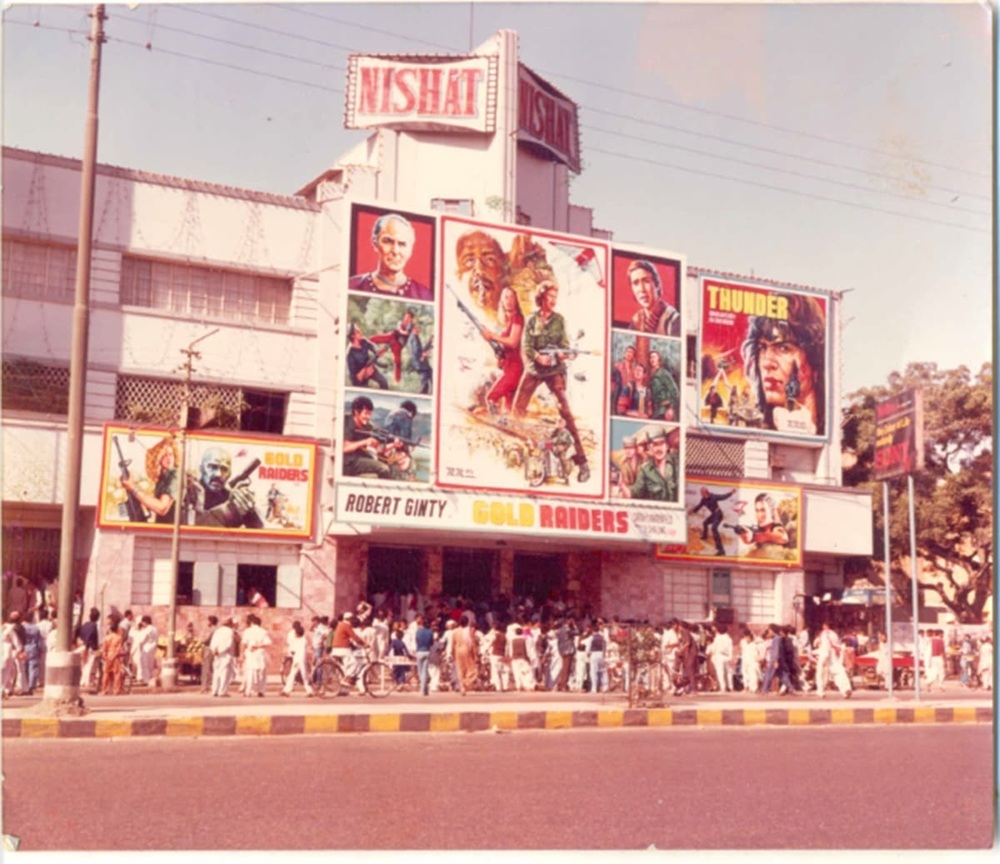
Before digital screens and flex banners transformed the urban landscape, cinema façades were themselves spectacles, covered with larger-than-life imagery designed to stop people in the street
Something was gained in that transition: speed, consistency, affordability and precision. But something was lost too. Pakistan did not merely replace one method of making signs with another. Almost unnoticed, its streets began losing a handmade visual language, and with it a generation of craftsmen who had helped paint the country’s public face.
Hand-painted advertising was once a substantial part of Pakistan’s commercial landscape. One history of outdoor advertising in the country identifies hand-painted signage as the dominant phase between 1947 and 1990. Early commercial boards appeared at railway stations advertising products such as tea, electric fans and beauty creams, while their use expanded considerably from the 1970s onwards.
Pakistan’s film industry pushed the form to its most spectacular extremes. In Lahore, Royal Park, behind Lakshmi Chowk, became a centre of the film business. Distribution offices, cinemas and commercial-art workshops existed alongside one another, and painters worked on the enormous hoardings that would cover cinema façades. Accounts from former artists recall dozens of ustads working in the area during its heyday.
These were not simply enlarged photographs. Painters sometimes worked from small, even black-and-white, reference photographs and had to imagine the colour, drama and scale themselves. Veteran Karachi billboard painter Pervez Bhatti recalled choosing shades, adding highlights and exaggerating expressions to communicate whether the figure towering above the street was a hero or a villain.
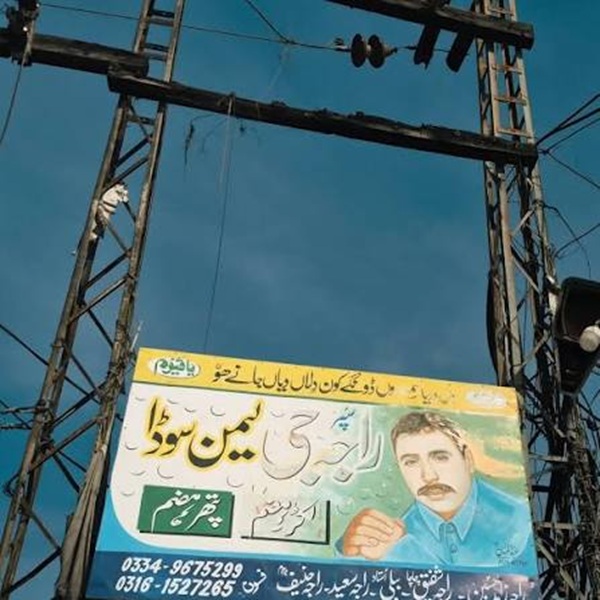
Color was unapologetic, expressions exaggerated, and subtlety was hardly the point in hand-painted billboards
Some hoardings were extraordinary in size. Former painters have described canvases extending up to 200 feet across. Such works were divided into sections, sketched and painted separately before being assembled. The cinema façade may have been the grandest canvas, but the instinct behind it was visible on a more ordinary scale across the country: on shopfronts, workshops, restaurants, buses, rickshaws and commercial boards.
Long before "brand identity" became part of everyday marketing vocabulary, sign painters were creating one for thousands of small businesses. It is easy to overlook the technical skill involved in something as familiar as a shop sign. There was no font menu. No instant resizing. And certainly, no undo button.
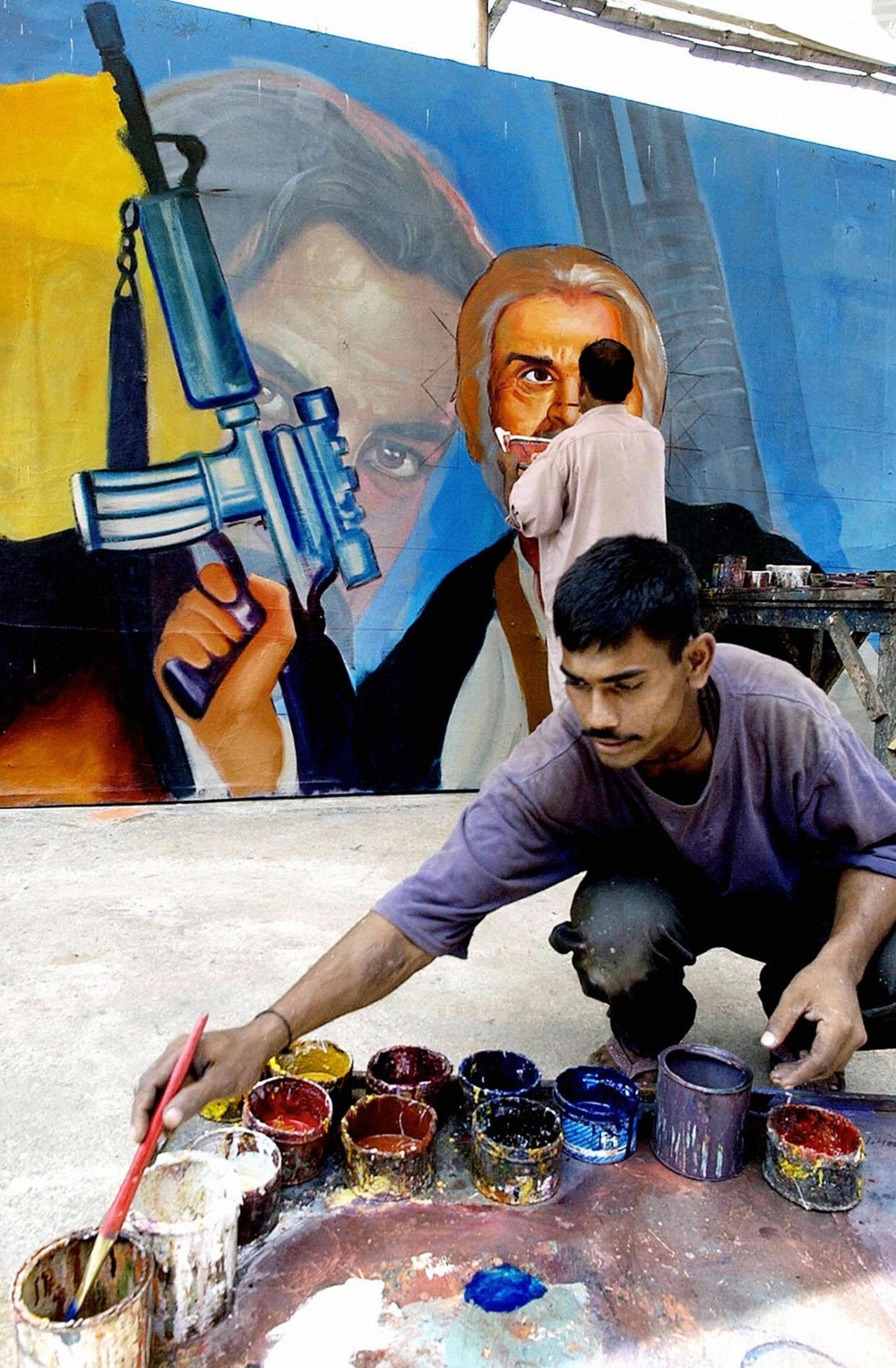
Cinema painters worked at a scale that demanded both precision and imagination, enlarging small reference images into faces and figures capable of commanding an entire façade
A painter had to understand proportion, spacing and visibility. Letters needed to remain balanced across a large surface. Colors had to stand out against the noise of a bazaar. Shadows could make words appear three-dimensional. Urdu calligraphy demanded a different control of line from English lettering, while illustrations required yet another set of skills. Much of this knowledge was not acquired in formal institutions.
The craft traditionally operated through apprenticeship. Young painters entered workshops, observed experienced ustads and gradually moved from basic tasks to lettering, illustration and more demanding work. Accounts of Pakistan’s cinema painters similarly describe most learning their craft at a young age through apprenticeship rather than art school. That mattered because the painter was not merely executing a design created elsewhere. He was often the designer, typographer, illustrator and fabricator at once.
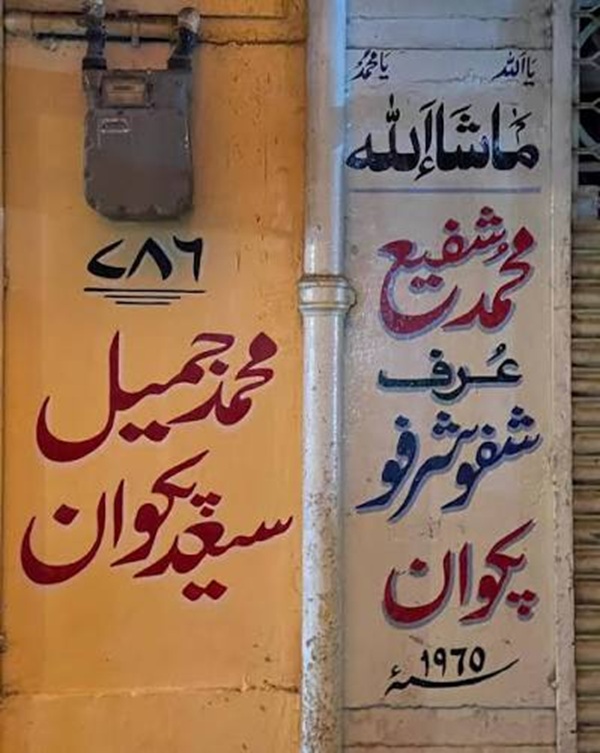
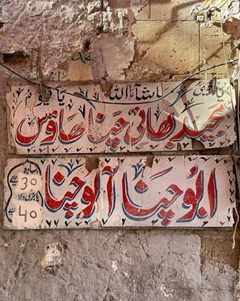
Hand-painted Urdu typography on a shopfront captures the distinct texture and character that digital prints leave behind
Then the economics changed. Large-format and digital printing began transforming Pakistan’s outdoor advertising industry in the 1990s. Businesses could reproduce photographs at scale, duplicate designs precisely and make alterations without repainting an entire board. From a shopkeeper’s perspective, there was little mystery about the appeal. Digital signage was faster. It was consistent. A logo could look exactly as its owner intended. Photographs no longer needed to be interpreted by an illustrator. The same artwork could be reproduced repeatedly and distributed across locations. Technology had solved genuine commercial problems. But for the painters, it also dismantled an economy built around their hands.
The story of Pervez Bhatti gives that transformation a human face. Bhatti began painting cinema billboards in Karachi in 1971, when he was only 17. Over the following decades, he painted promotions for films including Wehshi Jatt, Maula Jatt and Aina. He remembered the satisfaction of seeing people stop to admire a newly installed hoarding and hearing them praise his work. By 2023, the giant cinema paintings were gone from his working life. Most of his fellow billboard illustrators had either died or left the profession. Bhatti was still painting, but now from a corridor inside Karachi’s ageing Nigar Cinema, producing portraits and landscapes rather than the enormous advertisements that once towered above the city. There is something almost too fitting about that image: one of the men who once painted the city’s largest faces, still holding a brush inside one of the cinemas from the world that created him.
Pakistan’s hand-painted commercial landscape was not some perfectly curated outdoor gallery. It could be noisy, cluttered and gloriously excessive. Colours collided. Lettering competed for attention. Cinema heroes acquired impossibly broad shoulders and villains even fiercer expressions. A shopkeeper did not commission a sign because he wanted to contribute to the country’s visual heritage. He wanted people to notice his shop. Perhaps the old streets were not more beautiful at all. Perhaps we remember them fondly simply because they were ours. Nostalgia has a habit of tidying the past. We remember the character and forget the clutter. We remember the cinema poster and not the peeling wall underneath it.
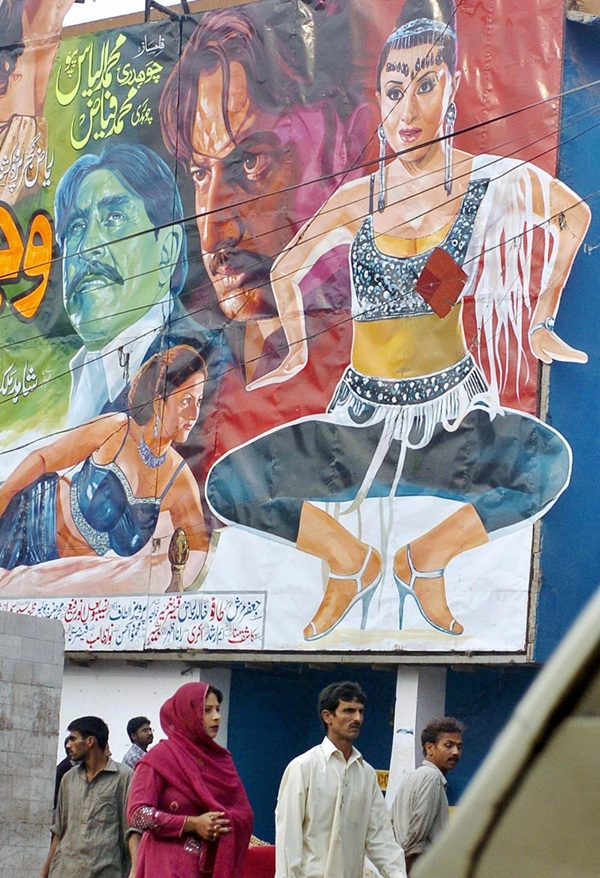
Hand-painted cinema hoardings were not viewed in galleries_ they loomed over ordinary urban life, bringing exaggerated colour, glamour and drama directly onto Pakistan's streets
Digital printing has not made Pakistan’s streets colourless. Far from it. Today’s markets are saturated with photographs, logos, typography and enormous advertisements. What digital production has made possible, however, is sameness. A design created on one screen can be reproduced perfectly a hundred times and placed in Karachi, Lahore, Peshawar or Islamabad without changing a pixel.
Preservation need not mean pretending that every old sign should remain hanging indefinitely or that businesses should abandon digital printing. Cities change. Technologies emerge and evolve. The more interesting question is whether a skill can survive after its original economic purpose has diminished. Hand lettering has qualities that digital reproduction deliberately removes: irregularity, texture and evidence of authorship. Those qualities could give it another life in murals, restaurants, cafés, cultural spaces, and businesses seeking something deliberately local rather than universally reproducible.
You may also like: