Written by: Shameen Arshad
Posted on: August 12, 2026 |  | 中文
| 中文
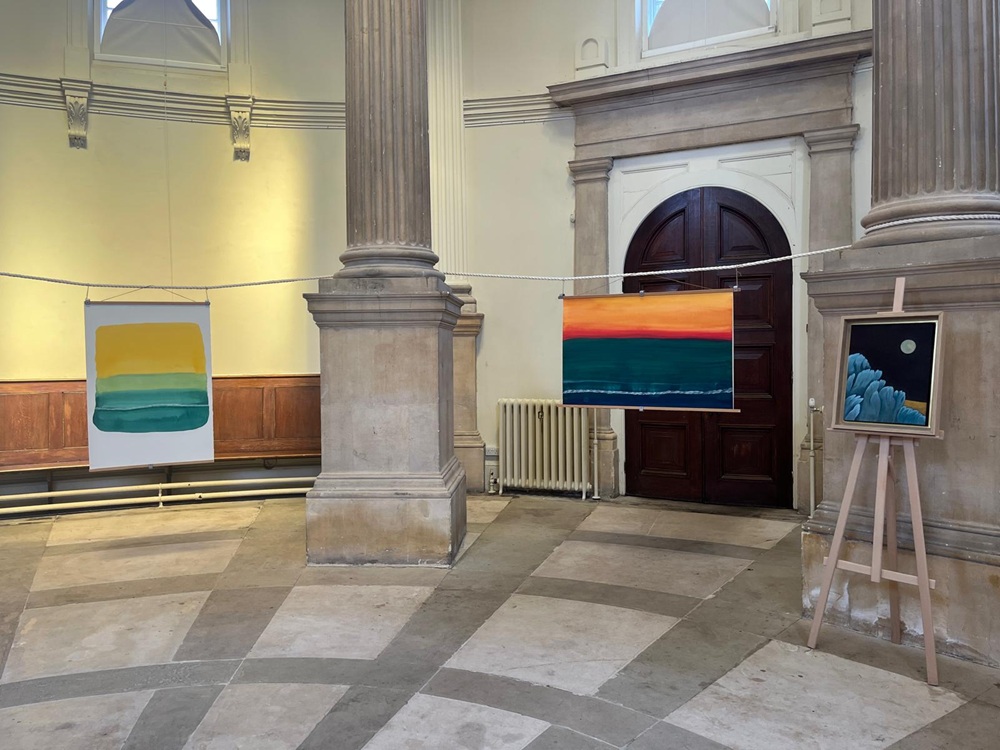
Alia Bilgrami’s Halcyon Waves, Brompton Cemetery Chapel, London.
Alia Bilgrami’s solo show Halcyon Waves, exhibited at Brompton Cemetery Chapel in London, is a profoundly moving encounter. The exhibition is an ode to family, to those who have departed, and to the struggle of inhabiting a world in their absence. Emerging from the loss of her father, Bilgrami produces art that is deeply personal, yet not confined to biography. Halcyon Waves touches on an almost universal human tendency to hold on to a person, a place, and a memory. Bilgrami herself holds on through her paintings, archiving a life and loss through her creations.
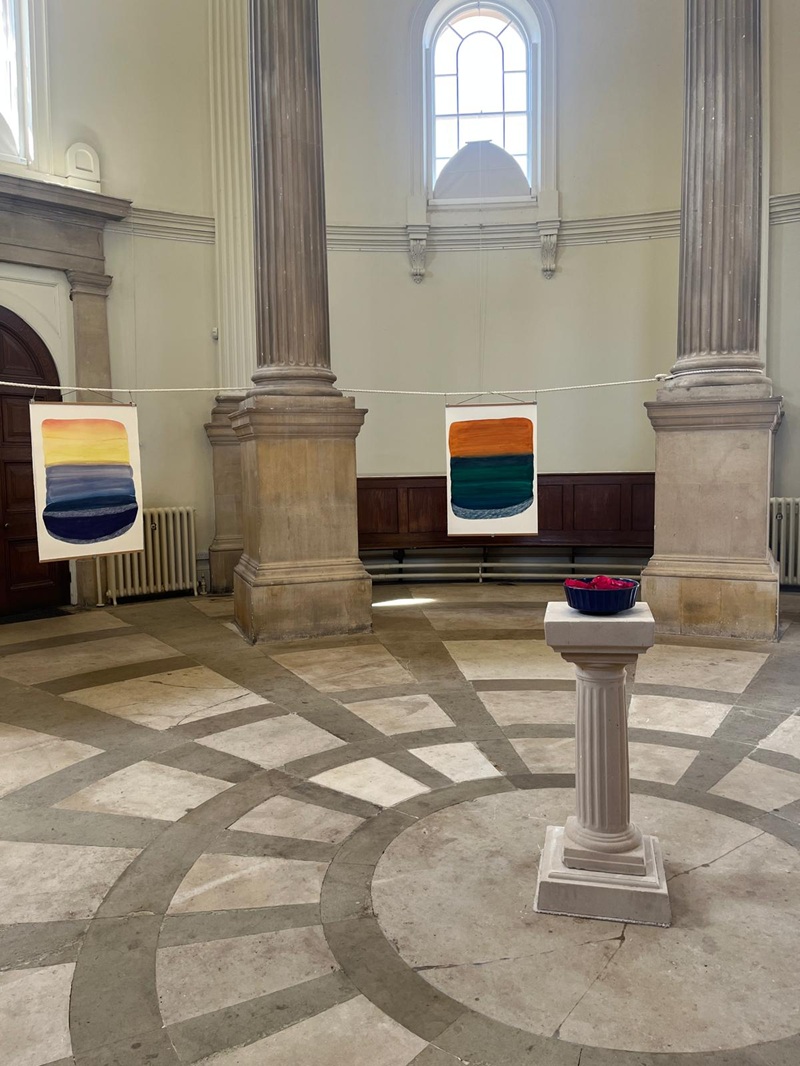
Alia Bilgrami’s Halcyon Waves, installation view. Image courtesy Alia Bilgrami.
While the works are intensely personal meditations on loss, they are not simply records of grief. They grapple with questions of identity, belonging, and displacement. Loss, in Bilgrami’s work, is not only someone’s absence or mourning, but it’s a complete reevaluation of one’s own sense of place within the world. The work explores what happens to one’s identity when someone central to it is suddenly lost. Therefore, while the exhibition is ostensibly an ode to her father, it is equally a portrait of the daughter left behind.
The exhibition moves between the personal and the inherited, the autobiographical and the biographical. Bilgrami’s artwork presents identity as something that is not singular or self-contained, but an accumulation of lived experiences, inherited histories and relationships. The boundary between biography and autobiography therefore becomes increasingly porous.
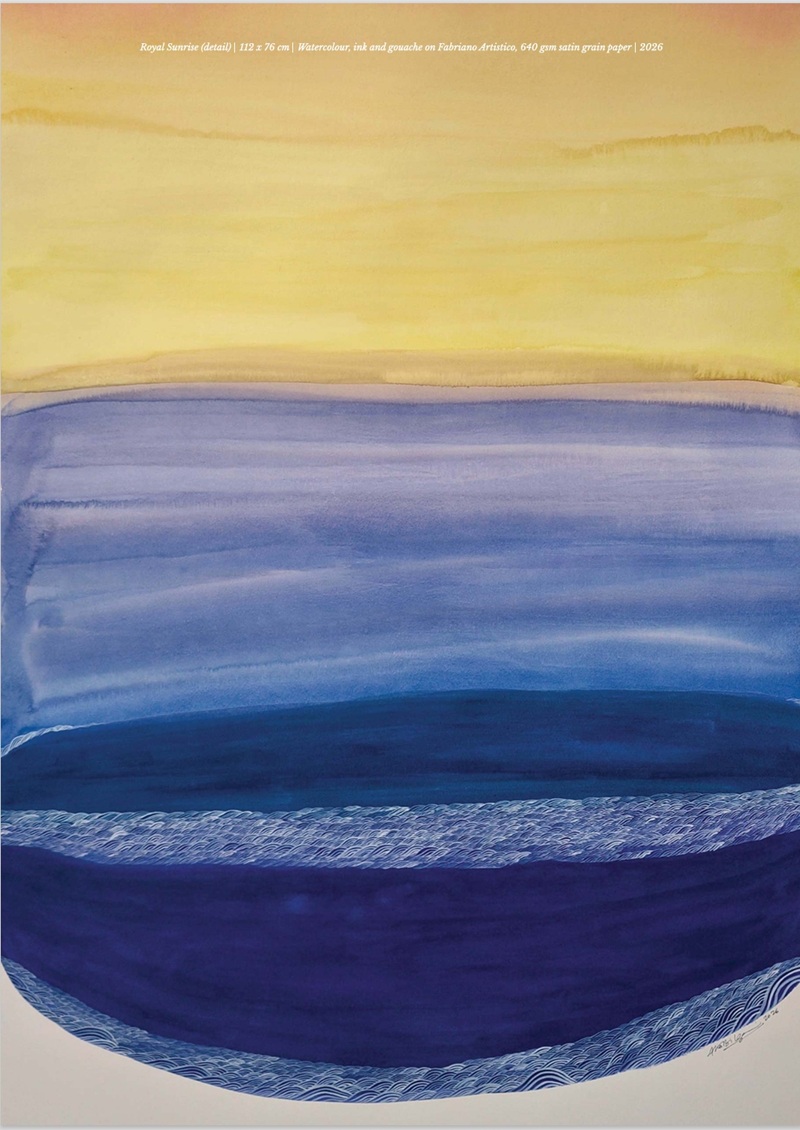
Alia Bilgrami, Royal Sunrise (detail)
The exhibition’s site, located in the neighbourhood where Bilgrami’s father spent his youth, becomes a conceptual part of the work. The chapel introduces another layer of temporal and geographical connection, placing the paintings within a landscape already tied to Bilgrami’s father’s past. The exhibition operates through a series of overlapping spaces: the landscape of skies and water that is represented in the paintings, the remembered landscapes of childhood and family that come through in the hoopoe bird and colouring book illustration (both things that she associates with her father), and also the physical landscape in which the exhibition itself is encountered.
Bilgrami draws from the visual vocabulary of Miniature painting. Her engagement with the tradition is evident in the intensity of colour. Like Miniature paintings, in which brilliant palettes depict scenes of hunting, battle and death, Bilgrami uses dazzling colours to address an emotionally heavy subject. The vibrancy of the works initially generates excitement, but this is not confused with joy. Instead, the brightness creates a productive tension between visual seduction and emotional weight.
Her image The Hud Hud’s Secret Garden, which comes across as the culmination of the entire series, is rendered in the traditional miniature technique upon Wasli, with an elaborate composition that is reminiscent of the narrative density of Miniature painting, where individual elements within a surface can carry their own stories. Much more direct references to Persianate and South Asian Miniature traditions are the stylized clouds and waves, the use of natural pigments and lapis lazuli. Bilgrami draws on this tradition not simply as an aesthetic reference, but as a means of constructing a personal mythology from inherited visual and cultural forms. The paintings are rich in symbolism - the Indian hoopoe, tulips, and flying doves are both inherited from history and personal and traditional beliefs.
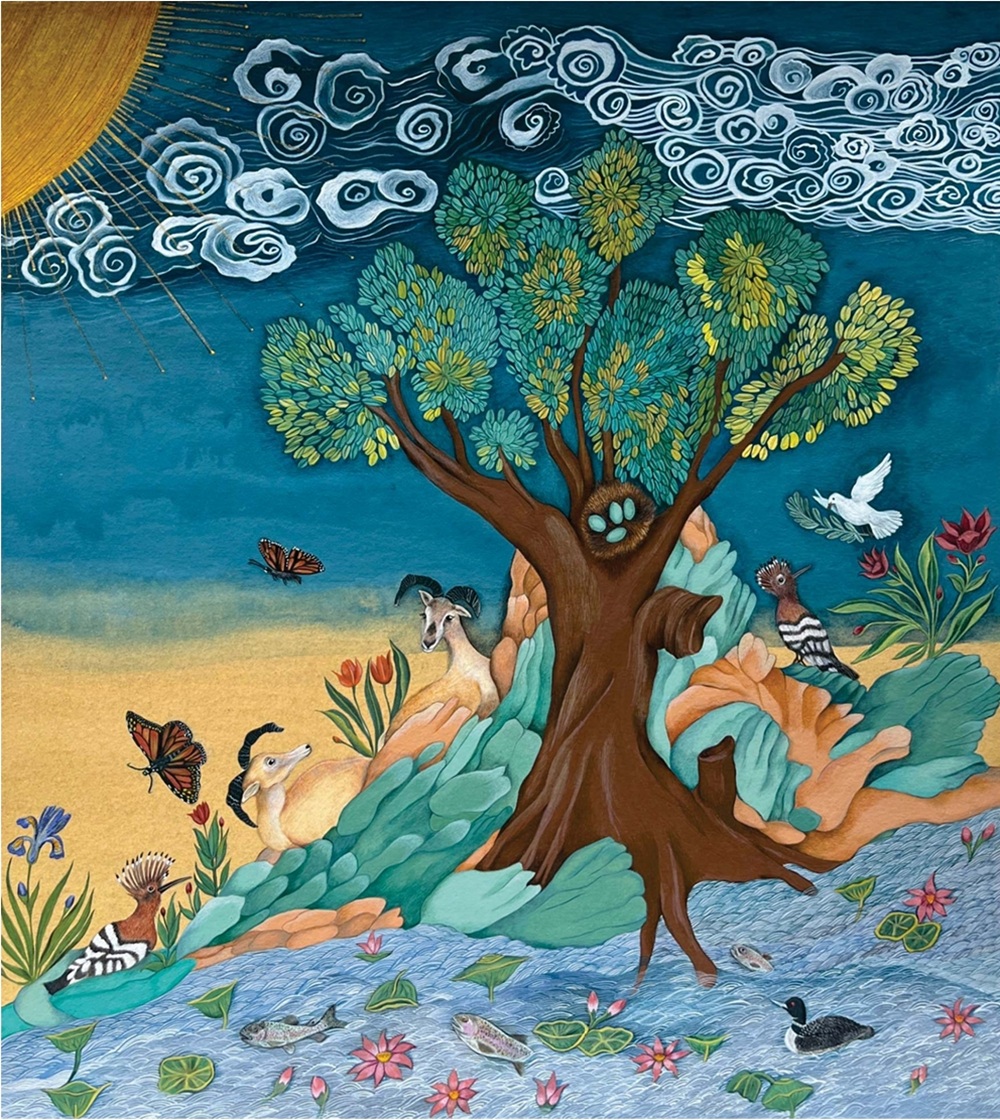
Alia Bilgrami, The Hud hud's Secret Garden
Tradition, however, does not remain fixed within the exhibition. Bilgrami moves between established techniques and a looser, more spontaneous mode of making, bringing egg tempera, watercolour and natural pigments into dialogue with poetry and excerpts from her father’s diary. The contrast between egg tempera and watercolour is particularly revealing: the opaque surfaces and controlled compositions of the tempera work create a sense of structure and containment, while the translucence of watercolour allows pigment to disperse, merge and move across the surface, suggesting an openness to uncertainty. These shifts make visible Bilgrami’s search for an adequate language for her emotional experience, with the evolution of technique becoming inseparable from the evolution of thought.
This progression becomes clearer when the exhibition is viewed chronologically. The works move from a colouring-book illustration, through more solid egg-tempera compositions, towards increasingly fluid watercolours and elaborately rendered landscapes. Bilgrami’s father’s dated diary pages placed within the gallery further emphasise this passage through time. Rather than presenting grief as a resolved experience, the artwork exposes the prolonged process of working through memory.
Bilgrami’s landscapes are not conventional representations of nature but operate more convincingly as psychological spaces. Shifts in colour, rhythm and paint application register changes in mood, transforming the natural world into a projection of the internal one. The recurring representation of water is particularly suited to this function. Its capacity to flow, disperse and change direction provides a formal language for emotions that resist fixed definition. In the watercolours, pigment moves across the surface with a degree of unpredictability, creating landscapes that fluctuate between stability and dissolution.
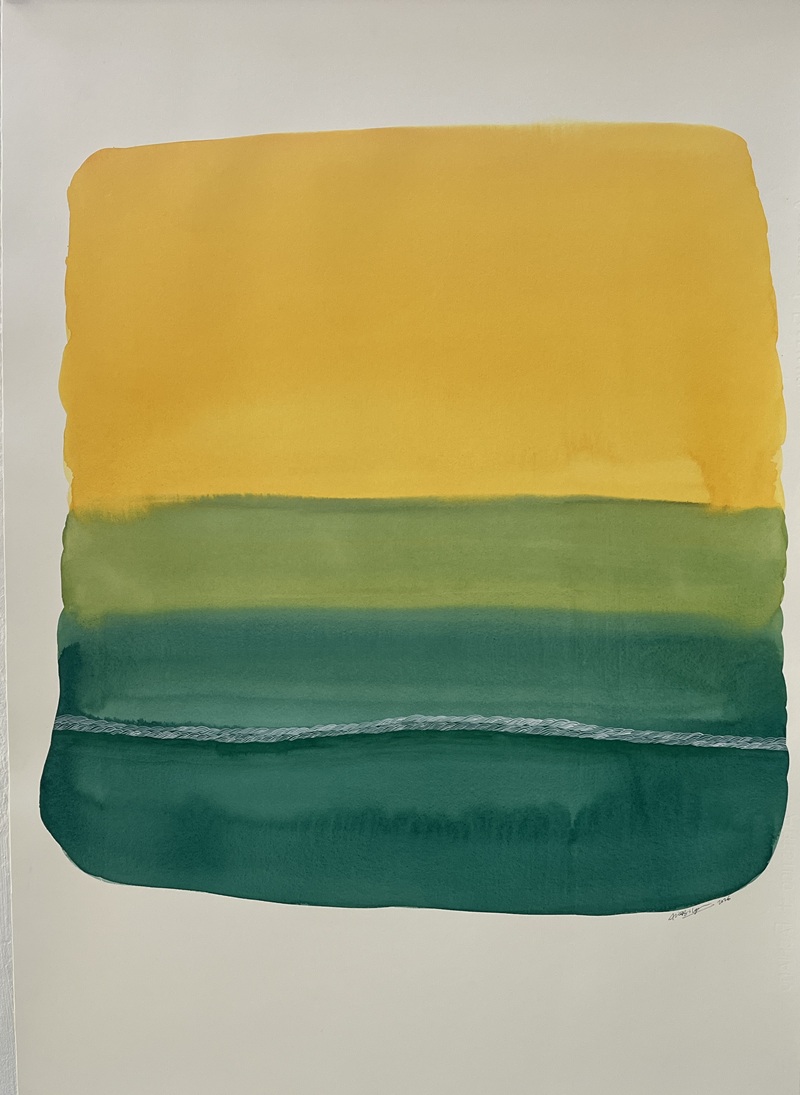
Alia Bilgrami, Viridian Shores (detail)
This can be seen in Viridian Shores, where soft layers of translucent colour create a sense of emergence and calm. The yellow appears to rise through the surrounding hues, while the evenly constructed waves introduce a measured rhythm. There is a sense of deliberation here, as though the repeated movements of the hand provide temporary control. Sea of Green, by contrast, is rawer and more tumultuous. The uneven rhythm of the waves and the sudden disappearance of one before reaching the edge of the paper create disruption and a lack of closure.
Other works continue this emotional oscillation. Violet Range suggests a state of reverie, while Royal Sunset evokes the relative calm that follows disturbance. Panorama appears almost like a point of release, its composition quieter and more settled. Malachite Waves, however, returns to a more charged visual register. Its burning sky and dark blue hues create a sharp chromatic contrast, repeatedly jolting the eye between opposing areas of the image.
Across these works, landscapes frequently assume physical weight. Forms swell and expand, while downward movements within the compositions suggest heaviness. The emotional experience of grief becomes bodily. It’s felt as a sense of pressure and fullness. Bilgrami’s landscapes therefore do not simply represent an internal state; they embody it.
The exhibition reflects on human beings’ sense of longing and moving through loss. The poetry and writings collected by Bilgrami’s father suggest his own preoccupation with absence and yearning. The Hoopoe, recurring within the exhibition, can be understood as a metaphor for something or someone lost to him, becoming a vessel through which he articulates a longing that cannot be directly expressed. Where the father turned to poetry and writing to give form to his longing, Bilgrami turns to painting. Her landscapes, birds and shifting waters become her own vocabulary for articulating absence. In this sense, the exhibition does not only memorialize a father; it reveals an inherited mode of processing loss, where the act of looking, writing and making becomes a means of reaching towards something that can no longer be recovered.
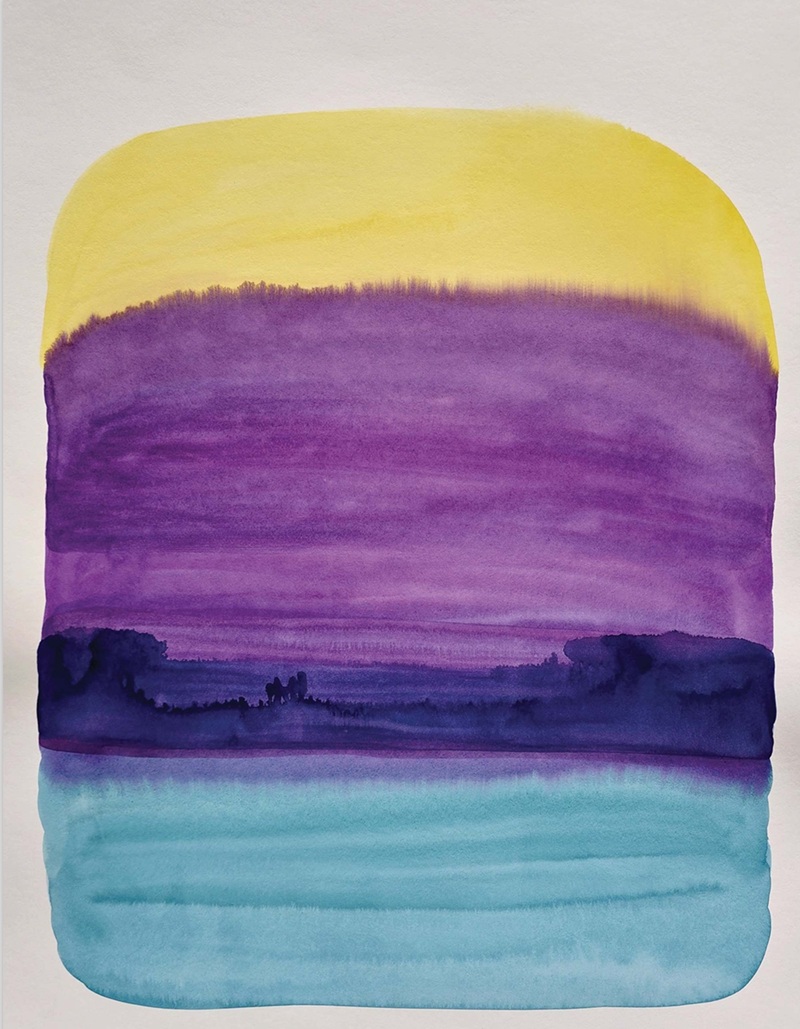
Alia Bilgrami, Violet Range
The exhibition presents grief not as a linear journey towards closure, but as a continual movement between presence and absence, memory and forgetting, control and surrender. Through Miniature traditions, personal archives and the fluidity of watercolour, Bilgrami gives material form to this instability.
The show is open to the public till the 9th of August.
You may also like: